Friday, September 4, 2015

Grenades and dynamite

A few weeks ago the guys at coffee were discussing the difficulty in finding .22 rimfire ammo.  One of the guys had recently acquired a revolver chambered for .22 Short.  The .22 Short was first manufactured in 1857 making it the oldest, continuously manufactured cartridge in the world.  Many firearms can fire .22 Short, .22 Long and .22 Long Rifle interchangeably.  Regrettably, this revolver could only accept .22 Short.  Anything else could cause it to lock up.

.22 Short used to be much more common than it is now.  At one time it was less expensive than the .22 Long Rifle, a cartridge that is nominally 30% more powerful.  Now the .22 Short is considered a "specialty cartridge" and you have to pay a premium for it.
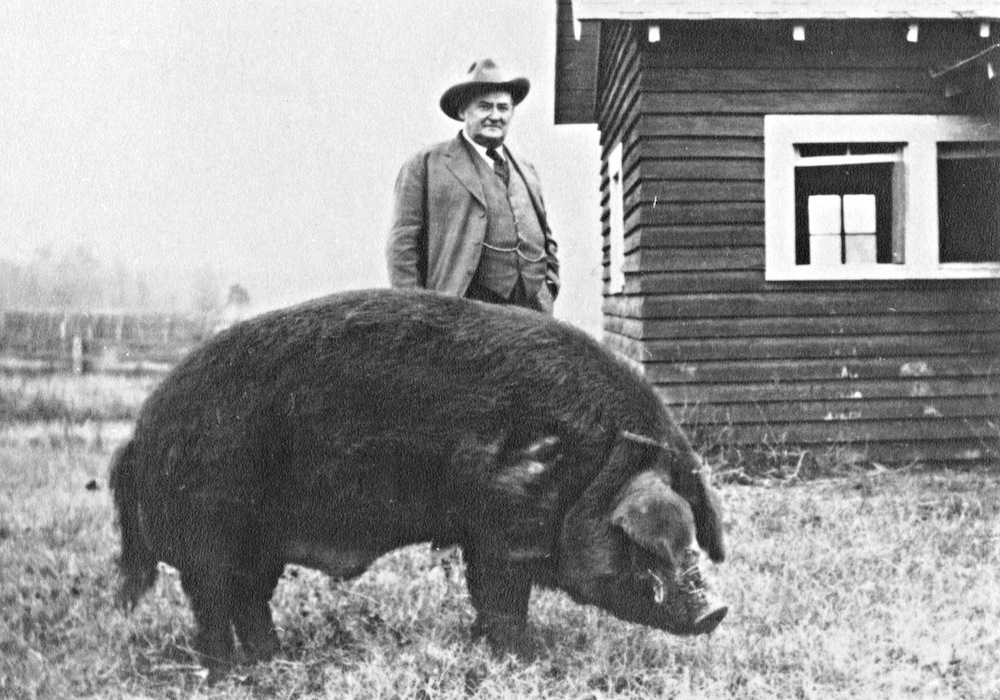
It used to be common to grow hogs to enormous sizes when lard was a highly priced commodity.  A .22 Short was all it took to finish them off.

Back when it was cheaper, it was all  farmers used for pest control and slaughtering hogs.  It does not take much to put down old Wilbur when you hit him right between the eyes at a range of 2 feet.  Great read HERE.

It was even considered a tolerable self defense round before antibiotics were available.  No sane person wanted to get shot with ANY bullet when they knew that a long, lingering death was a near-sure result.

So, there we were drinking coffee, telling lies and talking about ammo when this fellow walked up and sat down at the table.

I had seen him a couple of times in the last few days but had never seen him before.  He had the look of a roofer or a rough carpenter who was in his early sixties.  He and his clothing definitely had a lot of miles on the odometer.  I knew he was new in town because he had an extravagantly, bushy mustache the size, color and density of a push broom.  I am sure I would have noticed him.

After a little bit of vague small-talk, as in, "I live just over yonder" with a sweep of the arm that encompassed an arc ranging from the Hudson Bay to the Florida Keys, he launched into his real reason for sitting down at our table.

"Do you guys have any grenades?"

Nope.

"Do you know where I can get some?"

Fast Eddie leaned over.  His eyes darted left and right.  And then he rasped out in a conspiratorial stage-whisper, "My daughter just bought some at Toys-R-Us"

The table chuckled.  The roofer did not.

Then he asked,  "Do you guys have any dynamite or blasting caps?"

I fielded that one.  "No I don't.  And even if I did, which I don't, I would not tell you."

"Well," he responded, "do you know where I can get some?"

I whacked him with the same answer.  "No I don't.  And even if I did, which I don't, I would not tell you."

Today


What was remarkable is that none of us ever saw that guy again.  He showed up for two or three days and then just disappeared.

One of the fellas who was sitting on the other side of the coffee table claims that the "roofer" had been sitting at a table with a guy who appeared to be wearing government issued polyester before he joined us.

I would dismiss that as BS except we live in strange times.

Incidentally, the guy who needed the .22 Short ammo found some in stock at Wideners.

Grenades and dynamite?  I don't have any and have no idea where to get them.  And even if I did know, which I don't, I would not tell you.

Thursday, September 3, 2015

What if Trump and Sanders BOTH run as third party candidates?

Trump as much as said that he will run as a third party candidate if he does not get the Republican nod.  Nearly all of the focus has been on Trump.  I want to burn a few pixels talking about Bernie.

Sanders is running neck-and-neck with the presumptive nominee, Hillary Clinton.  Mz Clinton has an enormous amount of baggage that may derail her candidacy.  So the Democratic king makers in their smoke-filled rooms are now touting Joe Biden.  Where is the respect?

According to Bernie's website, this is what Bernie stands for.  My comments with blue background:
  1. Demanding that the wealthy and large corporations pay "their fair share" in taxes.  He does not elaborate how "fair share" will be calculated.
  2. Increasing the federal minimum wage from $7.25 to $15 an hour.  A proven job and business killer.  Will he also ensure that business owners net at least $15/hour?
  3. ...rebuilding our crumbling roads, bridges, railways, airports, public transit systems, ports, dams, wastewater plants, and other infrastructure needs.  In many cases "make work" that distorts the signal value of pricing.  We have "shovel ready" jobs adding curbs to rural roads simply to buy concrete and generate paychecks for the otherwise unemployable.  Nobody seems very concerned about "carbon footprint" when buying concrete.
  4. Reversing trade policies like NAFTA, CAFTA, and PNTR with China.  Nothing like starting a trade war.  Does he really think industry will start building flat-screen TVs in the US?
  5. Making tuition free at public colleges and universities throughout America.  Living in a dorm on a large campus is a pure manifestation of socialist paradise.  "Free" food.  "Free" room.  "Free" access to mates. "Free" medical.  "Free" bus rides.  A 15 hour/week work load is considered grinding.  A godlike caste system of administrators, TAs, RAs, associate professors, assistant professors, tenured professors, professors emeritus...  Our kids will be surprised when we re-enroll in college because it is the most economical form of assisted living.
  6. We need to re-enfranchise the more than two million African Americans who have had their right to vote taken away by a felony conviction.  This is a direct quote.  Does that mean that non-African American felons will still not be able to vote due to a felony conviction?
  7. As president, Sen. Sanders would expand funding for Planned Parenthood.
  8. Sanders would require employers to provide at least 12 weeks of paid family and medical leave.  Another job killer.  This would be further disincentive to hire people under the age of 45.  Presumably available to full time workers.  Do you suppose this would make part time workers more attractive?
  9. Sign comprehensive immigration reform into law to bring over 11 million undocumented workers out of the shadows. That is, amnesty.
  10. As mayor of Burlington, (Sanders) was a strong collaborator with unions.  Most economists believe that collective bargaining power distorts the economy.  It makes winners and losers, it does not increase the size of the pie.  Unions are most successful when some portion of the counterparty's "plant" is immobile.  Immobile can be due to fixed costs, captive customer base or long development lead times. 
  11. ...tax carbon and methane emissions.  I guess you have to pay for college somehow.  It will be pretty interesting when all of those urban poor are paying half their income for heat and air conditioning.
  12. The Federal Reserve, a government entity which serves as the engine of the banking industry, must eliminate its internal conflicts of interest, provide stricter oversight.  This falls under "...even a blind pig category." But can he do this with an executive order?  I don't think he will get much help from the legislature.
  13. (Sanders) proposed a financial transaction tax.  A little bit of numerical damping can be a wonderful thing for system stability.
  14. (Sanders supports) a tax on Wall Street speculation to make public colleges and universities tuition-free.  Historically, government subsidies drive up the cost of inputs with modest increases in production.  And why go to college if there are no jobs?  Better to reconfigure it into a Club-Med, socialist utopia.  But they better put it on a pleasant tropical island with temperate trade winds.  An island like Cuba.  Oh.  Wait. Never mind.

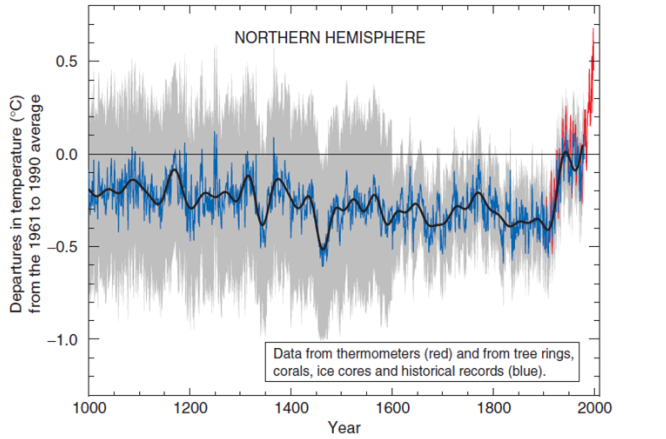
A new crisis: Man-made Global....Gentling?

News flash:  Not enough wind to drive wind turbines.
Interesting loss in spectral content on the extreme right side of the chart.
First we had a crisis in "Man-made" global warming, supported with data that was so uniform in its relentless upward trend that it looked like lab data pencil-whipped by a high school freshman.

Next, we had a crisis in severe weather to explain the fact that we were still setting record lows.  The narrative was that the atmosphere is an enormous heat driven engine.  "Global warming"  evolved into "Violent, unpredictable weather".

And now this:

In January of 2015, wind speeds remained 20 to 45 percent below normal on areas of the west coast, but it was especially bad in California, Oregon, and Washington, where those levels dropped to 50 percent below normal during the month of January.

The power density contained in wind varies by the cube of the velocity.   The kinetic energy per cubic meter that impinges upon the blades varies by the square of the velocity.  The number of cubic meters that impinges upon the blades per unit of time varies with the velocity.  Multiplying them together tells you that halving the wind speed reduces the power to 12.5% of what it was.

"Wind plant generation variability occurs over different time scales, from subhourly to seasonally and even annually, reflecting variations in wind speeds," EIA added. "Unexpected drops in output may require grid operators to schedule other sources of power on short notice. Furthermore, because the federal tax credit for utility-scale wind energy is based on generation volumes, lower wind speeds mean reduced tax credits."

The implication is that it is all about the tax credits.  Wind energy cannot stand on their own without the tax credits  and renewable energy mandates.  Utilities have to "peg" wind energy production, otherwise they are stuck with enormous legacy costs and no revenue to service it.

That is why the operators yank traditional generating resources through a knot-hole.

I wonder how the apologists will rationalize our latest crisis in man-made global gentling.

A few pictures from the garden

Raccoons


Raccoon damage.
They knock over and destroy ten times as much as they eat.  There are a bunch of corn stalks stomped down flat all through the patch.
A few ears are starting to dry down.  I picked a couple to dry for seed just-in-case.
The guys at coffee suggested that I feed them soda pop.  For some reason that seems to diminish their appetite for corn.  One of the guys has a scientific bent.  He told me that the raccoons around his place preferred Red Pop to Coke Classic by a ratio of 3-to-1.

Read as much, or as little, into the relationship between soda pop and future appetite as you want.

Purple pole beans


As always, you can click to embiggen.

Approach grafts


Two of the eight approach grafts I made on July 28 are showing signs of life.  Apple leaves are in upper left corner and are frosty green in color.


Apple squisher to extract seeds


This is pretty high tech so you might want to take notes.
Left over scrap lumber from building Kubota's loft.  Bottom piece (reddish) is a 36 inch long piece of Douglas fir 2-by-6.  Top piece is a 2-by-4.
An old hinge.
An old screen door handle.
And a screw run into the base to prevent over-travel of the top piece. The goal is to crush the fruit, not smash the seeds.
You might want to sit at a picnic table and wear a swim suit when you use this tool.  You are likely to get juicy.

Wednesday, September 2, 2015

Budget

August was a stressful month for budget.

The red line is our base, non-overage Verizon bill.
Herc biting the neighbor's dog was not anticipated.  Not only did we cover their vet bills, another couple of hundred dollars went into fortifying the dog kennel.  It is my sincere hope that this is a non-recurring expense.

More vexing is the Verizon overage.  There are multiple dynamics in play.  Cell phone companies, in general, seem to have punitive overage fees as a basic part of their business plan.  They get you to sign up and everything is jolly until your child has a girl-friend and sends 8000 texts in one month.  You fix it with unlimited texting, and then they discover Snapchat or Facetime.

This is George Jetson stuff that was pure fantasy five years ago.  It is a video streaming technology that is very bandwidth intensive.

One of the keystones of the business plans is to keep users in the dark.  They don't want the users to be able to calibrate and make adjustments.

Kubota figured he was doing great as long as he did not get any "overage alerts".  So he ran with the throttle pushed all the way forward until he hit the wall.

Guess which three days Kubota was spending at a friend's?  On the 25th, 29th and the 31st it was just Mrs ERJ and me using the bandwidth.   Cumulatively, we are about 4 Gig above our trend line for the month even though we are only nine days into the billing period.
After a few hours of churlish behavior (on my part) we came up with a plan.

Every day for the rest of the billing month I will produce a new chart showing daily usage similar to the green-and-red one shown above.   We have to get our arms around this because it is very tough to claw our way back on a fixed income.

It absolutely SUCKS that Verizon is complicit in this.  It SUCKS that I have to go through all of the extra push-ups to provide Kubota the information he needs to make responsible choices.  It SUCKS that I cannot pull Kubota's devices/usage out of the mix and present them separately.  It SUCKS that Verizon does not provide a suite of tools that allows me to administer my WIFI, to allow me as the administrator (and bill payer) to throttle back specific devices while leaving those that are used responsibly unchoked.

Kubota's plan


Kubota impressed me.  He came up with a plan.  He thinks that the problem is that he is using his electronic toy as a pacifier on nights when he has difficulty going to sleep.  In other words, he plays online games to entertain himself.

He came up with the idea of putting new batteries in his electronic keyboard.  He can turn the sound level down low and compose music.  I had some spare rechargeable batteries and so the deed was done.

The sound of him dinking around on that Yamaha keyboard will sound like coins clinking into the family cash register.  It will lull me to sleep.

Tuesday, September 1, 2015

Apple rootstock, Part II

I received a comment on the last post regarding apple seeds.  It came via email and it was from somebody who has practical orchard experience, nursery/propagating experience and has done much heavy lifting in the breeding for rootstocks.  In other words, he knows five hundred times more than I do about apple trees and rootstocks.

In his email he asked, "Why plant seeds and get a big unmanageable tree?  Why??"  That is a very good question.

The next generation


It is a little known fact that a tidal wave of new apple rootstocks are being released.  The previous generation was based on  apple rootstock that were "collected" and categorized in Britain in the 1920s.  Those rootstock were given names like M-9, M-7 and such.  Some of those rootstock, clones actually, were several hundred years old.  Only a few of them were suited for the rigors of North America.

Around 1970, it was realized that improvement required more than the haphazard application of the scientific method.  A team developed a list of 12 essential priorities (primarily resistance to diseases and early/heavy/quality fruit production), another 8 that were important and 4 that would be helpful.  They established benchmarks for each priority and started identifying genetic material that might contribute toward meeting those goals.

It was a very long slog.  Priorities changed as new problems became economic concerns.

Are seedlings tougher?


At one time a fruit grower could confidently say that seedlings were tougher than the commonly available size controlling rootstock that had been semi-randomly selected under western European climatic and pest pressure conditions.

That is not a good call when looking at these new rootstock coming onto the scene.

In a typical year, the "Geneva" program produces more than 20,000 seeds.  They are from controlled crosses where elite size controlling rootstock were crossed with dream-dates that have the potential to compliment the elite rootstocks weaknesses and buttress their strengths.  An example would be Ottawa 3 (a dwarfing rootstock) crossed with Robusta 5 (an incredibly tough crab apple).

Collar rot killed ornamental plants
The seeds are planted in trays and even before their first leaves emerge they are water boarded.  That is, they are immersed in water that is contaminated with multiple strains of Phytophthora cactorum (collar rot) zoospores.  Early crosses resulted in 95% mortality.  That attrition rate has been dropping as the breeders became more familiar with sources of resistance and as they started "stacking" traits.  By 1983 the attrition rate had dropped to 25%.  So 8000 seedlings a year survived the water boarding in the early 1980s.
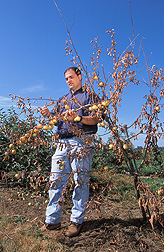
Fire blight can kill the roots, which then results in tree death.
Then the seedlings were subjected to multiple, direct injections of Erwinia amylovora (fire blight) spores.  Like the P. cactorum, a cocktail of multiple, virulent strains was used to assess survivability.

That knocked the number of survivors down to 2000.
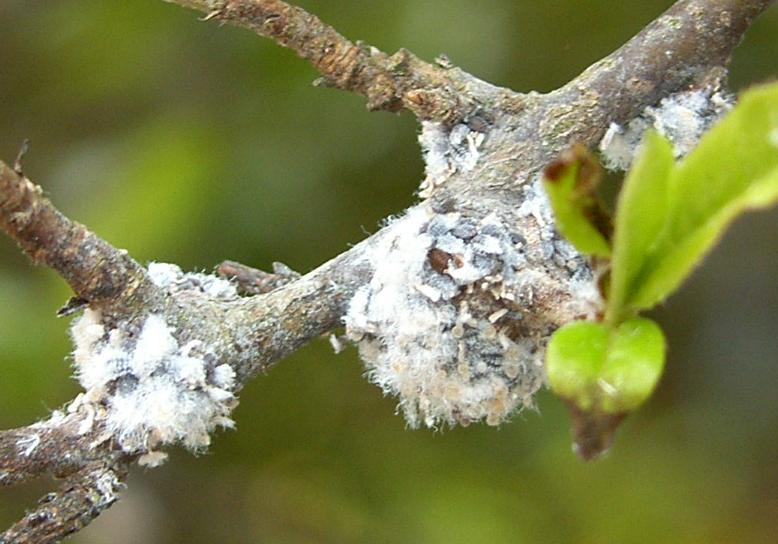
Woolly apple aphids.  They also go below ground and attack the roots.
Then the tiny seedlings were swarmed with assorted insect pests.  One rarely considered the ramification of growing a plant that is inherently attractive to bugs is that every bug bite is a potential conduit for disease or a potential source of viral infection.  There is even a name for this resistance, i.e. unattractiveness to biting insects, "Klenducity".  I think we have all been outside in a group of people and noticed that some people are more bedeviled by mosquitoes and biting flies....they lacked klenducity.  That same variation exists in individual plants.

That knocked the number of seedlings from 20,000 to less about 500.  From there they are culled for leaf diseases, smooth wood, winter kill and thorns.  By the end of the first year the breeders have culled 99% of the seedlings while a ruthless producer of seedling rootstocks might have rouged out a whopping 80%.

That is, the team at the "Geneva" project exert 20 times more selection pressure than even a ruthless producer of seedling rootstocks. 

"Why plant seeds and get a big unmanageable tree?  Why??"


So the question remains.  I am not growing seedlings because I think they are tougher.
This is what 850 "Ben Trio" seeds looks like.

I am growing them because I can.  I have the seeds.  I have the garden space.  I don't have oodles of money to buy size controlling rootstock.  And frankly, I am in a holding pattern until these new "Geneva" rootstocks become more available.
A typical set of yards in Fabulous Acres.
A final reason for growing big trees is because one of my "customers" is a guy with community gardens in Lansing.  He is based in an older neighborhood named "Fabulous Acres".  The houses are tall and close together.  The yards are small.  There are many mature shade trees.  Sunlight is at a premium.

I am not growing seedling rootstocks because they produce more/sooner.  Almost any size controlling rootstock is capable of producing 30 pounds of fruit per tree in its third growing season on a good agricultural site under best management practices.  A seedling rootstock is doing well to produce its first fruit by the fifth growing season.

I am growing those big, unmanageable apple trees because Fabulous Acres is not a good agricultural site and its residents are not professional farmers.  Those big, unmanageable trees might be able to survive and and grow tall enough to find some sunlight.  They might actually produce some fruit in that environment.

I intend to share some of these seedling rootstock with Marcus, if he wants them.
Apple seeds

I want to grow a mess of apple seedlings next year.  My primary goal is to produce some rootstock for grafting.

Most commercially produced apple rootstock are from random apple seeds.  In the United States, random translates into Red Delicious.

Red Delicious seeds do not produce bad rootstock.  They tend to be fairly resistant to fire blight and fairly well anchored.  In general, they lack winter hardiness in the coldest regions and they are vulnerable to wet feet.

Dwarf rootstock


All commercial apple orchards are now planted on dwarf and semi-dwarf rootstock.  The time value of money requires that revenue be generated as soon as possible to start servicing the debt.  That debt can run from $60k to $100k per acre.  Just to provide a frame of reference, a standard high school football field is about 1.3 acres.

Much research was done on sources for seedling rootstocks prior to the 1940s and the "modern" emphasis on dwarfing rootstocks.

Of the common varieties, McIntosh was found to have the best anchorage (although more vulnerable to wet feet than Delicious).

A minor variety called Mercer was touted by some as a good parent.  One shortcoming of the older research is that the researchers did not always tell the reader what their selection criteria were.  All I can tel you is that some writers were fond of Sweet Bough X Mercer but I cannot tell you why they thought this was a good set of parents.

Hardy crabapples from the Malus baccata, Malus X robusta and Malus prunifolia cluster of species were often used in the most extreme climates....like Saskatchewan and the Dakotas, Russia and China.  Growers in these regions also like varieties with these species in their pedigrees:  Kerr, Dolgo, Columbia, Robin, Bedford, Ranekta and so on.

Incidentally, some researchers (like Forsline) are dubious about Malus prunifolia being a valid species. They look at the variation within the "species" and think it looks like a pile of the misfit toys got swept into...much like you would expect to see in a flock of bastard children from M. baccata and M. domestica.

There are a few niche sources of apple seeds.  For example, Lawyer Nursery lists "Columbia crab"seeds in their seed catalog.  Columbia crab is one of those Alaska/Sasketchewan capable varieties.  They also list M. baccata and M. prunifolia seeds.

Research


Liberty fruit as photographed September 1, 2015 in Eaton Rapids, Michigan.  As always, you can click on the pictures to embiggen.

Seeds from Liberty.  Extracted September 1, 2015.  Not quite ripe.
The closest I can get to McIntosh is Liberty, a disease resistant apple released by Cornell University in 1974.  It also has Wealthy in its background.  It is reported cold hardy to -30F.  I really like Liberty.   It is not perfect but it does many, many things very well.

Ben Trio.  These fruit are about the size of golf balls.  Photo taken September 1, 2015.
Based on their color, these seeds are much more mature than the Liberty.  There is a modest correlation between early maturity and increased winter hardiness.  These seeds likely had Liberty as the pollen parent as this branch was grafted into a tree of Liberty and both varieties flower at the same time.
The closest I can get to Mercer is an apple called Ben Trio that was selected in South Dakota by Niels Hansen in 1938. Mercer is listed as one of its parents. Professor Hansen released many apples with the last name "Trio" as he claimed those selections had genetics from three sources: domestic apples, native crabapples and Siberian crabapple species.  Modern researchers now take many of Professor Hansen's claims with a grain of salt.

Malus x robusta.  Fruit the size of marbles.  Literally, many thousands of fruit on this tree. The branches are cracking.  Based on the color of the fruit you would not expect the seeds to be mature.  Their is a limb of Liberty grafted into this tree but this selection blooms earlier than Liberty so I don't know how many of the seeds were actually pollinated by Liberty.
And you would be wrong.  Seeds extracted and picture taken September 1, 2015.

The best M x robusta I have is this one selected for having fruit that hangs on all winter long.  One potential issue with crabapples is that they are often sensitivity to apple viruses.  Modern rootstock breeders now believe that many cases of reported "incompatibility" were actually due to viruses in the scion wood killing the rootstock.  The baccata-robusta-prunifolia corner of appledom is not the most sensitive group of crabapples to viruses but cases of "incompatibility" have been recorded with Malus baccata.

Composite picture showing relative size and color of the seeds


Upper-left, Malus x robusta.  Upper-right, Ben Trio.  Lower-left, Liberty.  Obviously, bigger seeds can be expected to have greater seedling vigor when they first start growing.