Monday, August 10, 2015

Batteries

I am shopping for a new cell phone.  The screen of my slider died.  Mrs ERJ wanted me to try a "texting" cell phone.  I did.  I do not send many texts.  I am more of a receiver than a sender.

I am replacing my slider with a low tech flip phone.  I can open it while driving and still keep my eyes on the road.  Battery life can be very, very good.  They are smooth and fit in my pocket easily.  My two highest frequency cell phone failures are
  1. I am not carrying it because it is recharging
  2. I am not carrying it because I have too much other crap in my pockets.


Batteries, Part II


We had a run of varmints on the chickens a few weeks ago.  It is distressing to run out of the house at 3:00 AM with a loaded shotgun and not have the Red Dot show up.  Yup, sure enough, I had put it in the gun safe with the scope illuminated. 

It is not a matter of cost.  2032 batteries can be purchased very inexpensively in bulk....which I did.  The problem is thinking you can count on a tool and having it compromised when you really, really need it.

I see that there are models with automatic turn-off and some that are motion activated.  The prices are a bit steeper than simpler scopes.  I think I will start saving my pennies.  I want to hear from any readers who have any experience with these kinds of scopes or if they have any recommendations.


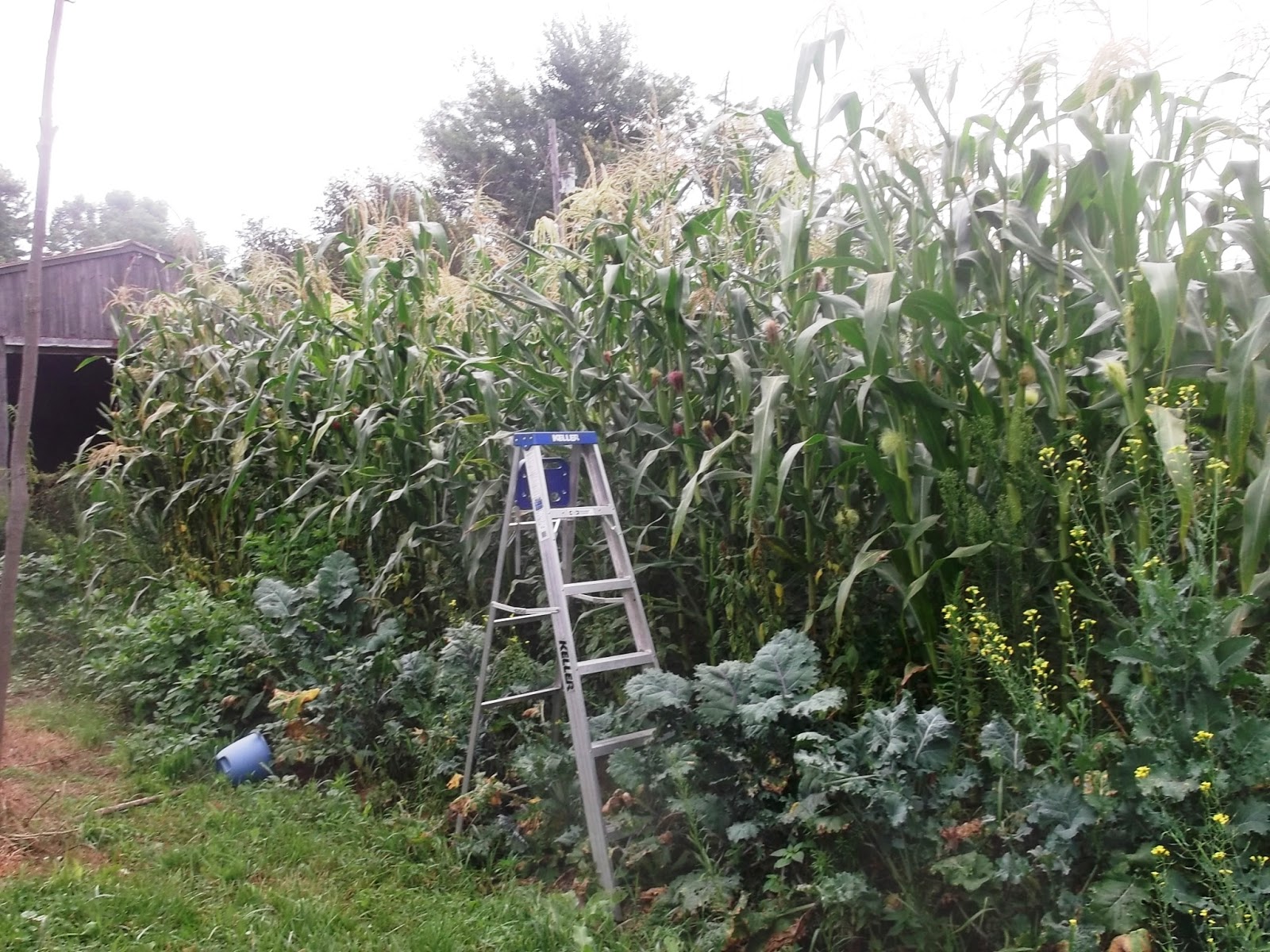
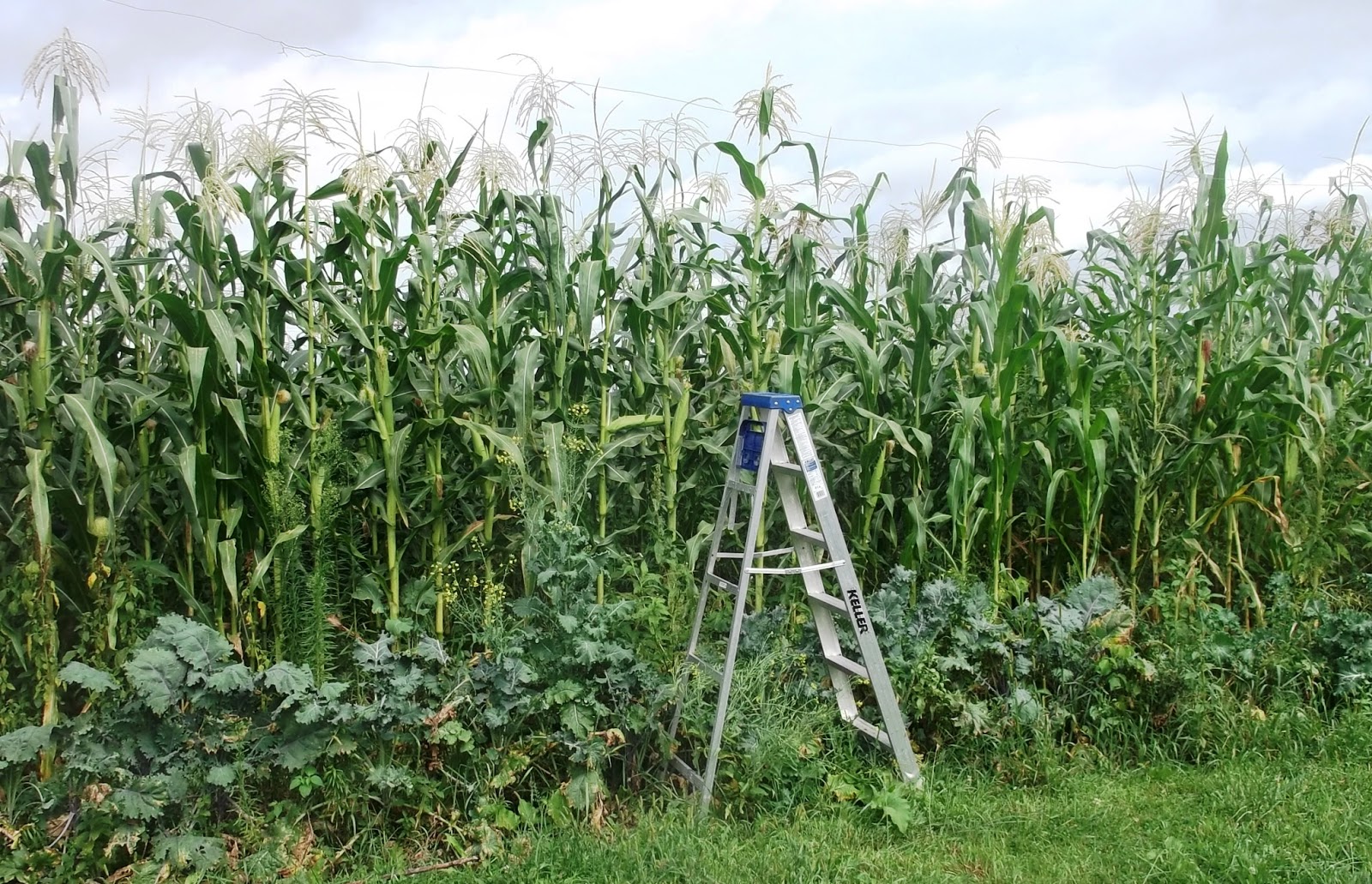
Corn as High as a Elephant's eye

Six foot step ladder for comparison.  I will update this picture in the afternoon when the light is better for photographs.
Picture taken at eye level.


Modern hybrid corn is much shorter than the older, open pollinated varieties.  Shorter corn is more resistant to lodging (that is, being blown over) and, consequently, can be fertilized more heavily.  Shorter corn does not squander resources by investing in stalk that is inefficient at photosynthesizing.  In fact, the optimum height would be a single corn leaf carpeting the ground.

One advantage that taller corn has over the shorter,  modern varieties is that taller corn is more tolerant of marginal weed control.  The taller corn simply overtops the lambsquarters, Giant Foxtail, amaranth, nettles, etc.  Most of those weeds top-out between four and six feet of height. Once shaded, the weeds lose vigor and become much less competitive.

In days of yore, farmers did not have glyphosate, simizine, atrazine or 2,4-D.  Cultivation was not done from an air conditioned tractor but by walking behind a horse or with a hand hoe.  Sometimes weeds got away from the farmer.  That is one of the simple facts of farming: Stuff happens.  Tall corn provided the farmer with a final safety net when that happened.

It is easy to become arrogant from our perspective in history.  It is easy to think that farmers in 1900 were unsophisticated yokels who would not be competitive in today's environment.  A key point that is missed is that, in general, those farmers were all about competition and optimization.  The difference is that their systems were optimizing to a different set of boundaries and criteria.

Not only were their systems optimizing, but the systems were intelligently de-tuned to ensure robust performance.  That is, their systems were error tolerant and performed adequately through a broad range of environmental challenges.  That is the magic of "corn as high as an elephant's eye", it is error tolerant.

Good fences

Mending Wall   -Robert Frost

Something there is that doesn't love a wall,
That sends the frozen-ground-swell under it,
And spills the upper boulders in the sun;
And makes gaps even two can pass abreast.
...
He is all pine and I am apple orchard.
My apple trees will never get across
And eat the cones under his pines, I tell him.
He only says, "Good fences make good neighbours." 
Much of the fence was still there.  It had not been rolled up. 
The trunk leaning over the fence needed to go.  A trunk like that is living on borrowed time.  It is about fifteen inches in diameter.  This portion of the fence separates the Captain's property from mine.  I called him up and informed him that I would be cutting the portion of the tree that was leaning over my property. 
That is a two inch diameter walnut seedling growing through the fencing.

This is where Herc went through.

Much of the stretch was overgrown with Autumn Olive.
Somebody laid this fence post against this Box Elder.  It was a while ago.  The tree started growing around the "T" post.
Kubota was going to help me but he gassed out early.  The picture in his head was that we were going to slam in some fence posts into the ground, hang some fence and be done.  Like some big men, he is not fond of flying insects and crawling arthropods.  Nor does he much like dragging brush. He was not favorably impressed by the amount of pre-work that we had to do.

It was only eighty, humid and no breeze.  It was all I could do to keep moving.  I don't know how you guys down south get anything done.  Is it acclimation?

While I was not all that keen about the amount of prework, it had to get done.  It would have gone better if I had not started out with stale gas in the chainsaw.  The saw started fine but acted fuel-starved when I needed power.  It took a while to get that sorted out.

This job involved some ladder work.  The fifteen inch diameter trunk mentioned above had some branches that would likely hit some items I did not want it to hit when I dropped it.  Therefore, they needed to be trimmed off beforehand.

Here is a helpful ladder hint.  You do not have to pay rent on the amount of ladder that sticks out, above the upper contact point.  More than one amateur arborist has been surprised by the loss of his upper contact point when the limb jumped upward after being freed of the cantilevered weight.
Yes, the fence is not tight.  I can fix that.  I needed to have the fence up the next day to show good faith to my neighbor that I am serious about keeping my dog on my property.
The obligatory before-and-after shot.  It looks like crap but it will keep Herc on my side of the fence.  It would not withstand a serious challenge by him, but there are plenty of interesting things for him to sniff on my side of the fence.

Sunday, August 9, 2015

Personal Responsibility

I ran into  local one of my reader yesterday.  She is a liberal (lower case "l").  She shared one of those delightful snippets of unedited thought.

She said, "You are a puzzle.  I don't understand how you can be a conservative.  Every once in a while you say something intelligent."  Then, hearing how that came out, she back-pedaled.

I had to laugh.  You have to have a sense of humor about these things.  It was funny because her thoughts mirrored mine.  I have much respect for many liberals as individuals but think somewhat less of "liberals" in the abstract.

I think her perception of "conservatives" is that we are "cheap" to the point of being borderline "mean".  I told her, "To me, being a conservative is a matter of 'personal responsibility'".

Yesterday was not a fun day for "Personal Responsibility"


Hercules, one of my German Shepherds bit and bit Sookie, the neighbor's Jack Russel terrier.

The Right Thing To Do was to ride with them to the vet and wait two hours....then pay the bill.

Sookie is a rescue dog and very skittish.  Getting bit in the butt by a German Shepherd is not going to help that.

Vet care


My perception is that Vet care has increased in price.  The front desk now has placarding with various methods of veterinary care financing (i.e., credit).  It is difficult to separate whether access to credit for vet care is a response to increasing cost or a driver.

Another subplot is insurance.  I had one neighbor tell me, in a different incident with a different dog, that home owners insurance would cover those costs.  She was of the mind that insurance is a financial resource to be milked.  My perception is that my insurance carrier would simply raise my rates.  They would recoup that outlay many, many times over.  And is that really any different than a credit card that you can never pay off?

I pay these costs out-of-pocket (actually, I use my credit card because I do not keep that much money in my checking account).  Involving an insurance company only adds cost.  Every dollar dispersed from an insurance company must carry the "over head" on both the dispersing and billing ends of the transaction.  That is not a trivial burden.  Before Obamacare, the average billing costs, per medical doctor (for humans) was $68,000.  Essentially, every doctor in practice necessitates the employment of one billing specialist.  And that does not include any of the costs on the dispersal end.

Another cost driver is that diagnostic imaging equipment has trickled down to small vet clinics.  I guess the manufacturers of this equipment saturated the human medicine side and are now loading up the vet clinics.  The problem with pricy equipment is that you need billable events to pay for it.  The X-rayed Sookie's but to look for broken bones.

In the good old days, the vet would have watched Sookie walk across the floor and done some gentle mobility testing of her hind legs, given her a whacking big shot of 48 hour Pen and sent her home with pain pills and follow up antibiotics.

Sookie


Sookie is going to be fine.  She has  a couple of punctures on one butt cheek and a bruise on the other.  The owner really does not want stitches (optional given the small size of the punctures) because Sookie sleeps on the bed with them and they would find the "satellite dish" awkward.

The final bill will be somewhere between $500 and $800.  I admit to being cheap enough to have that really, really sting.  But I am not mean about paying for it.  My dog is my responsibility.

And I have some fence repair to do today.

---Bonus link:  Protocol for treatment of puncture wounds in humans---

Saturday, August 8, 2015

On being grateful


"Being grateful" is not the usual reaction to food poisoning.

But I am grateful that the piece of chicken was very thoroughly microwaved.  I think that all of the pathogens were dead and I only had to deal with the toxins.

I am grateful that I spit out the first (and only) mouthful because it tasted "off".

In retrospect, I wish I had thoroughly rinsed out my mouth instead of just spitting.


I am grateful for the timing.  All of the purging was done before our Friday day trip.  I was still cramping.  My body still wanted to get rid of every vestige of the toxins.  But there was nothing left to push out.

I am grateful for the long shelf life of Loperamide (aka, Imodium).  The blister pack in our medicine locker had expired 18 months ago but it still worked.  There is much to be said for storing meds under favorable conditions, that is, cool, dark and dry.

I am grateful that we got to spend some time with Mrs ERJ's second cousin.  Mike is a retired Civil Engineer.  He used to work for the Michigan Department of Transportation and he was responsible for inspecting highway bridges.  Consequently, he knew about "Historic Bridge Park".  This little county park in Calhoun County (Michigan) is sort of a retirement home for old wrought iron and steel bridges.


Mike was our tour guide and he was personally invested in this park because several of the bridges were "retired" on his watch.  In many cases, the bridge was not retired for safety reasons but because they were either not wide enough to meet current standards or because they were too flexible....drivers were not comfortable with the amount of creaking and sag-and-sway they experienced while driving across them.

These bridges all span a trout stream.  It was a beautiful day.  The Purple Loosestrife and Queen Anne's Lace are at peak bloom.
The comment about their still being safe requires a little more discussion.  One reason narrow bridges get retired is because drivers start hitting the sides of the bridge as they approach them.  Historically, this was due to drunk and/or drowsy drivers.  Now it is more often due to distracted drivers (i.e., focused on their communication devices).  These collisions don't do the bridges any good.  They were designed in the days of horse drawn conveyances and were not designed to withstand that kind of beating.  It also does not do the driver's, passengers or vehicles any good.

One of Mike's motives for going to the Historic Bridge Park was to introduce his nephew to the nuts-and-bolts of Civil Engineering.  His nephew will be a senior in high school and is still feeling his way along regarding careers he will pursue.
Sidenote:  According to Mike, modern bridges are designed to be highly redundant and structurally indeterminate.  That means that a truck can plow into an abutment and the bridge will, most likely, remain standing such that vehicles on the upper span can safely clear the span.  Of course, the bridge is likely to be declared unfit for use until repaired....but it will, probably, not come crashing down.

If you do an image search for "truck stuck under bridge" you will notice that most of the bridges that are pictured are railroad bridges.  Image from HERE
Even further, it is is now general practice to design in a "sacrificial" beam on the outsides of the bridge.  This is most typical of railroad bridges where the vehicular traffic passes beneath the railroad tracks.  It is prohibitively expensive to raise the elevation of the tracks so this type of bridge is likely to be lower clearance than road-road overpasses and thus more susceptible to vehicle-span strikes.


Another trend in bridges was to get away from above-roadbed trusses.  Putting the support structure beneath the roadbed reduced the likelihood of drivers hitting it. Of course, some drivers will still try as shown in the video shown above. 

Cousin Mike was a fabulous host.  He pointed out little details like head-stamps on bolts (see, I meant nuts-and-bolts literally!) and the shape of weld beads and was able to estimate when various maintenance work had been done on these bridges.  He also treated us to a delicious picnic lunch.

Engineers


As a Mechanical Engineer it was necessary for me to give him a little bit of grief.  Our pet name for Civil Engineers is "Target" Engineers. He was very good-natured about the ribbing.  

He reminded me that Civil Engineers have saved more lives than all of the Doctors in history by virtue of the design of sewerage and waste water treatment plants. Then he shared a pretty cool idea he had:  Why don't waste water treatment plants capture the methane generated by the anaerobic processes and use that methane to power gas-turbine/generators to make the plant self powering?  

Mike's primary motive was not economic but to armor the waste water plants against power interruptions.  Weather events that cause power interruptions often dump a lot of water that would challenge the plant even if the power stayed on.  He sees it as a public health and an environmental health issue.  And even if the plant does not produce enough methane to power a turbine it could be supplemented by natural gas.  The NG pipeline system is not dependent on the local power grid to maintain pressure.

He noted that people near waste water plants sometimes complain about the smell.  That smell is methane gas.  The observations that "A weed is a perfectly good plant growing in the wrong place." and "A problem is simply a misplaced or under utilized resource." are still true.  It was neat to see how Mike's mind works. 

He is a sharp guy.  I am grateful that he invited us to visit "his" park.

Friday, August 7, 2015

Friday Menu

Low sodium, low fat, low spice, no "mold" menu.

Cherry, grape and golden tomatoes from the garden.  I will take a mix of "ripenesses" so they can eat them over several days
Salmon.  They never bought salmon when I was a kid because it was WAY too expensive.  Between the two of them they will be hard pressed to eat half of one of these pieces.

Eaton Rapids grown Super Sweet sweet corn.  This was grown by the Pray family.  Modern sweet corn is about twenty times better than it was forty years ago.  Plant breeders found some "defective" corn genetics....the defective corn lacked the enzymes needed to turn sugar to starch.  The upside is that the corn becomes super sweet.  The downside is that the seeds are shrunken and they are fussy germinators.

Cut-and-come-again broccoli.  This looked prettier raw than it looks cooked.


Thursday, August 6, 2015

Road Construction and home invasion

Enormous amounts of road construction dollars are released twenty months before every major election.

It takes about 18 months for these cash injections to have maximum effect.  It has to do with the velocity of money and how long it takes to wash the taste of 60 months of unemployment out of people's mouths.  The thinking is that people will feel upbeat and will return the incumbents to office.

Not everybody is happy


Potterville, Michigan, population 2600.

The area circled in orange is where the bridge on M-100 is being widened and repaired.

The area circled in red is where THIS STORY occurred.  This area is so rarely traveled that Google street view does not have imagery.

The broken white arrow is the approximate path (one mile long) that the perps fled along.

...10:30pm Saturday. The victims told deputies two (not local) men tied up the father outside and then assaulted the man's wife and son who were in the home, before holding them at gunpoint and robbing them.

The father was able to free himself and call police. The suspects took off before police arrived. Neighbors in the area subsequently called police, reporting contact with one of the suspects who appeared to have been running through a swamp. Deputies eventually arrested one of the men at a business in Potterville and recovered the stolen property. A 26-year-old man is behind bars on potential charges of home invasion, armed robbery and unlawful imprisonment.

Kudos to the father for freeing himself and effectively using his cell phone.

Kudos for the Eaton County Sherrif's department and Michigan State Police for the rapid response.

Kudos to the neighbors for their assistance.

Kudos to the local business that noticed something was amiss.

It will be interesting to learn if the two home invaders had any affiliation with the road crew working on the bridge.  It is difficult to imagine any other reason they would have to select that home on that stretch of road.

I guess the cautionary tale is that being remote is no guarantee of safety.