Friday, August 21, 2015

Recording our Failures

In the mid-1990s one of the US automotive "Big Three" was in the process of introducing its first "all new" compact car in twelve years.  The stakes were high and the very top management decided to pull out all of the stops and hire one of the world's most celebrated "Ride and Handling" experts.  We will call him Roger, the Pro from Dover.

The local guys were very excited.  Roger's billing rate was $1500 a day + expenses.  The man was legend.  He tuned quarter million dollar European super cars.

He entered the vehicle and sat down behind the steering wheel.  "Let me see the log book.  I want to see what we are riding."

He was handed a spiral notebook.

He stared at it as if they were kidding him.

"This will never do!  You need a bound book with numbered pages."

"Why?" they asked him.

"Because us guys are all the same.  We want to forget our failures.  The temptation to tear out the pages where our best guesses did not work out is too tempting.  We end up on an endless loop where we keep trying the things that did not work out. For most of us, we end up retrying a failed combination about every four weeks."

"We need a bound book with numbered pages so we dare not tear out the pages.  Only then will we stop remaking the same mistakes and start progressing in a meaningful, permanent way."

Those words stuck with me.

Failures


Greenwood approach grafts.  Leaves browned and fell off.  Twigs look OK but will probably  not make it through the winter.  In retrospect, the end of July was too late in the season.  The scions did not break dormancy.
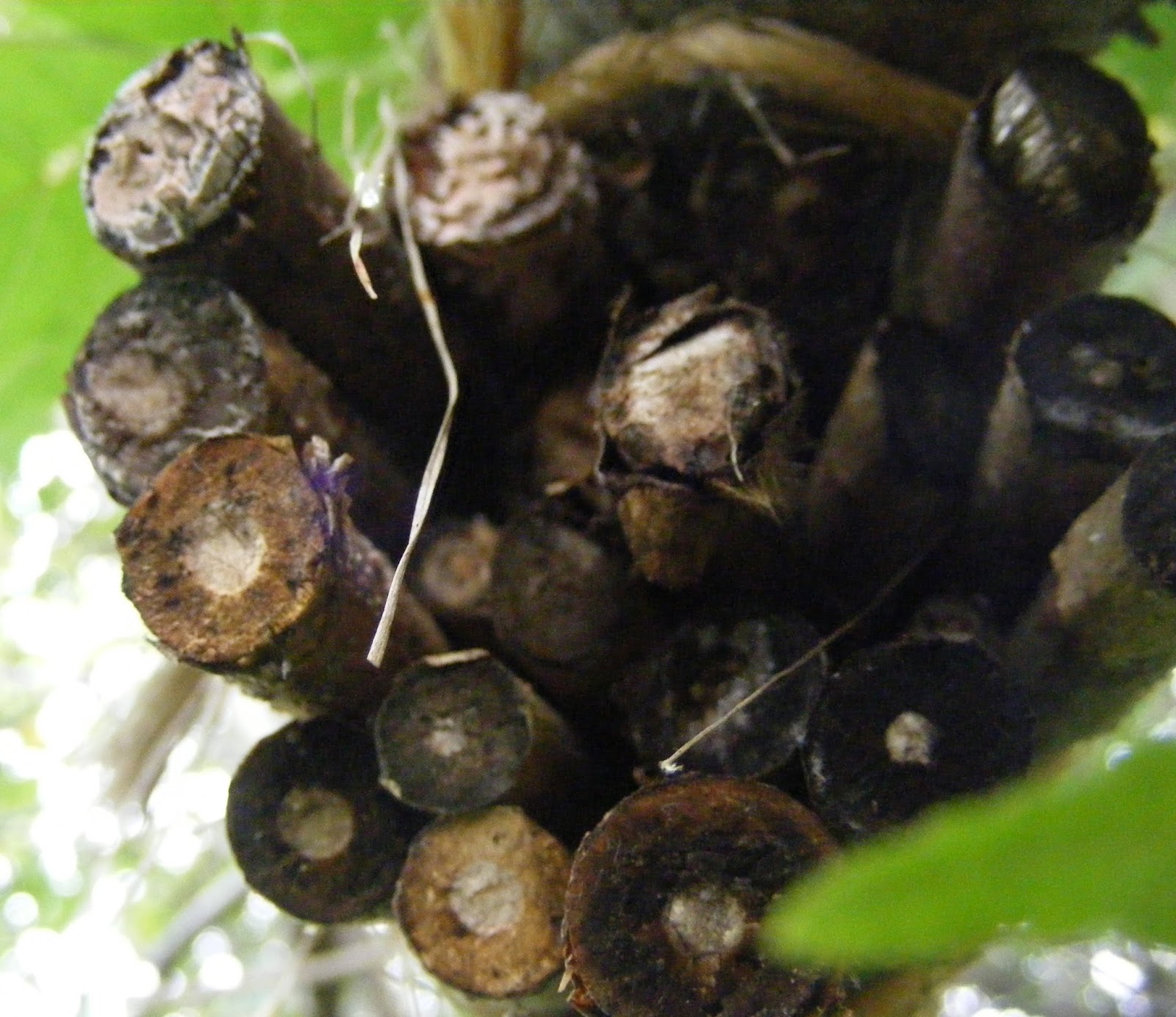
Homes for solitary bees.  The piths on some of the bottom twigs might have solitary bee eggs in them.  They are much smoother than the raggedy piths of the twigs on top.   This is a watch-and-see.
The usual assortment of grafts.  I think this was a case of bad (dead) scionwood.
Japanese beetles tearing up trees in "tree tubes".  This is a filbert.
And even when totting up the failures good things happened.  This is a Red Clover plant that is throwing all "four-leaf clover".  I will take that as God telling me to not take failures too seriously.  We cannot have successes if we are paralyzed by the fear of failure.

Epilogue


The company flew Roger over from Britain every two or three weeks.  Each visit, Roger would ask to see the bound log book with numbered pages.  Every visit, the local pros would shuck-and-jive.  They did not think it was necessary.

Roger took notes.  Six months into the program Roger was called onto the carpet for lack of progress.  He pulled out his notes and discussed rubber durometer, stab bar diameters, strut valving and tire sizes.

The squirrels were running on a wheel going no where.  It cycled every four weeks.  Not only were they running in circles but there were some basic structural issues that had compromised the "property" to the point of unusable.

One of the "boy-racers" had run a test where he replaced all of the rubber bushings with machined, aluminum bushings.  The machine shop, familiar with the boy-racer's casual regard for measuring and recording had machined all of the bushings 1/8th inch (3mm) shorter than he specified.  When boy-racer had them installed, one ear on the the clevis that held the left side of the steering gear bent forward when the bolt was tightened, the clevis on the right side had an ear that bent rearward.  The steering gear was cocked katy-whumpus in the car.

To Roger's credit, he noticed the "lumpy steering" (asymmetric response) in the first six feet he drove the car...while he was backing out of the parking place.

Very shortly after Roger was called on the carpet the local pros bought a proper log book.

There is a reason you pay $1500/day to hire the "Pro from Dover."

Thursday, August 20, 2015

Friday Menu

Low sodium, very low fat, no spice, no "molds".

Some color drift due to the flash being in-op.  Actual color is more red-hued.
Three chicken breasts, on sale.  Extended price: $2
1 pound Great Northern Beans.  Extended price: $1.59
Sweet corn stripped from two ears of corn.  Extended price: $0.50
Half an onion.  Extended price: $0.50
No-added-salt chicken stock, one quart.  Extended price: $2.79
One small can tomato paste.  Extended price $0.99
Splash of Cream Sherry.  About one ounce of vinegar.  Two Tablespoons of flour to thicken.

"Dry" ingredients after browning and before adding chicken broth, tomato paste and flavorings.
A few of the tricks to cooking with no-spice and very low sodium is to trick the palate with mouth feel (the sweet corn, beans not cooked to mush, the chicken still a bit chewy from browning), flavors from "browning" both meat and vegetables before adding liquids, and a dash of vinegar.  My guess is that "sour" is very close to "salty" in the taste processing centers of our brains.

This made about two quarts of no-chili "chili".  Mom and Dad will probably eat it with toast. 

We will probably eat it over spaghetti, rice or cornbread and we will add more spice.  Spice makes it more like flavoring and makes it go farther.

What are "found materials"?

An earlier post referenced "found materials" as being something different than local or native materials.

This post is my attempt to explain how they are different and to give a simple device that one might construct out of "found materials".

Native or local materials are the geological resources (soil, rock, water, wind) or biological resources (plants, mammals, fish, birds) that are available within, say, a half day's walking distance.

Found materials are materials that are not local or native but are ubiquitous and easily obtained.

Examples of found materials might be things like railroad spikes, screwdrivers, electrical wire, microwave transformers, batteries, metal grill work (like refrigerator shelving), baling twine and the like.  I dare say that you could go into any house in America and find multiple examples of each item...or reasonably close substitutes.

So what might an enterprising person MacGyver together using found materials?

Kubota's room has about a half dozen 14.4V "RC" vehicle batteries.  Running the screwdriver across the metal wires (like a kid slapping the uprights of a picket fence) of the grill produces an AC current (with DC offset).  I advise you NOT to attempt this unless you are really, really hungry.  Microwave transformers are not insulated and it will likely knock you off the bridge or out of the boat if you are near it.


---This is not a legal "method of take".  This is poaching.---

In dire circumstances normal "sporting" methods of take will not be efficient methods of collecting food.  Fishing consumes much time for the food collected.  During periods of social unrest the fisherman is exposed to risk.  Exceptions might be trot lines, except in some states (Michigan is one of them) that outlaw unattended fish lines.

Chumming a shallow area with a gallon of soaked/sprouted/soured corn for a few nights in a row will cause many "rough" fish to concentrate in the area.  One might be able to harvest hundreds of pounds of fish using this method.


Wednesday, August 19, 2015

Primitive laundry

While I have a firm appreciation of old, proven designs I am also aware that things can be improved upon.  Examples include disease resistant apple cultivars, "rocket" stoves and pivot pole laundry.

If any of my readers can help me out, I want to be able to properly attribute the pivot pole laundry but I was not able to find the inventor via Google.

Best told with pictures

Dirty clothing in a mesh or netting bag.  The bag relaxes and allows soapy (or rinse) water to infiltrate dirty clothing.

Free end of pivot pole is pushed down, lifting bag out of wash water.  Soapy (or rinse) water exfiltrates.  Wash water exits bag via gravity and constricting effect of the netting bag and drips back into tub, taking dirt with it.

Repeat.


Hey, mom, can I help?

Flipping the pendulum toward the pivot will cause the bag to drop into the tub.  Flipping the pendulum away from the pivot will lift the bag out of the water.
An inverted pendulum can be used if there is a shortage of children.

There is no reason a laundry business could not have an assembly line with twenty of these teeter-totters.  The left end of the pivot pole has a hook on it.  Bags of dirty laundry progressing from soapy water through successive rinses. 

Tubs of water could move in the opposite direction.  The last rinse would be the cleanest "newest" water.  The rinse water would become progressively soapier and warmer as it moved from last rinse==>to==>first rinse.  The first rinse water could be heated and additional soap could be added to become the last "wash" tub.  That same water could keep moving in the opposite direction of the bags of laundry.  After a stint as "first" wash it could be tossed onto the garden.

"Low Tech" can be labor and resource efficient.  "Low Tech" can be elegant.

Tuesday, August 18, 2015

Historically, who wins when the economy goes into the septic tank?

Historically, who wins when the economy goes into the septic tank?

I am not talking about the one-percenters or the 0.1-percenters.  I am talking about the folks you work with, the folks in your neighborhood, the parents of your kid's friends, the folks you rub elbows with at church.

And "goes into the septic tank" is way beyond going into the toilet.  I am not talking about a 25% "correction" in the stock market.  I am discussing those times when the formal economy simply stops working.

The book When Money Dies is a detailed study of the Weimar Republic and the hyperinflation they experienced in the early 1920s.  The book suggests that the "winners" are people who can manufacture or grow products or services that meet primary needs using local or found materials.  The book has many stories of the formerly wealthy being strip-mined of their wealth...their fur coats, carpets, furniture, grand pianos....for bags of potatoes or fifty pounds of grain.

Nothing to Envy is a book that looks at North Korea.  North Korea experienced a one-two punch when the Soviet empire collapsed in the same time period as a significant drought.  The economy crashed when power plants and pumps in the coal mines ran out of fuel and lubricating oils.  North Korea had coal, but no way to extract it after the mines flooded.  Loss of the Soviet empire meant the loss of the markets for their products and the loss of the hidden subsidies.

One North Korean family was able to keep their head above water because they had a small mill for grinding grain.  Other families would bring grain and fillers.  First the grain would be ground and then enough filler was ground to bring the level up to the amount necessary to make the day's bread or noodles.  Fillers were often corn cobs and husks but virtually anything could be pressed into service.  Another family made "cookies" and sold them for lunches.  The "cookies" made with grain, filler and any sweetening that could be found.  A third family survived because one family member traveled on business and filled her suitcase with rice before returning home.  Another family survived because family members in Japan mailed them high-performing, modern seeds every spring.

Interesting article HERE that explores this issue.

Key points:  Inputs are local or found materials.  Outputs are basic needs.

Examples (hat tip to Peter Grant who contributed ideas for this list):
Fire wood
Manufacture food dehydrators
Dehydrate seasonal foods
Gardens
Fruit trees
Propagate garden plants or fruit trees
Seeds
Knife sharpening
Chickens and ducks
Fish
Puppies (dog breeding)
Trapping mice
Repair/mend clothing
Shoe and glove repair (you will be stunned to learn how fast these wear out when you burn 3000 Calories a day working)
Tanning leathe
Laundry (incredibly labor intensive without automatic washers)
Make dwellings more resistant to break-ins
Awnings for windows
Reworking fixed windows so they can be opened
Screen repair
Vehicle repair
Bicycle tire repair
Recycle containers
Make carts and wheel barrows
Fence building
Trapping pests
Making fly swatters
Make cheese/yogurt
Blacksmithing
Preaching, neighborhood church
Resale shop
Sell books or for-profit library
Recharge cell phone batteries
Start a newspaper or swap bulletin board
Basic wound care
Home brew
Distilling
Grow and cure tobacco or other smokable products
Taxi service
Child care

This list is not exhaustive, it is a thought starter.  Your ideas will be better than my ideas.

Bonds as a means of conserving buying power

Bonds are confusing to new investors.  Bonds are counter-intuitive because the value of the bond goes down when the interest rates go up.

This essay is an attempt to explain the mechanisms behind the valuation of bonds.

Bonds are contracts


A bond is a contract.  It is essentially a post-dated "check" for a given amount that is auctioned of at some point in time.  All examples in this essay will be for a check with an "amount payable" of $1000.

Suppose the prevailing interest rates are 5% and you wanted to "buy" a check that is post-dated for next year and you went to an auction to make that buy.  You would expect to pay $950 because that is 95% of $1000.

Further suppose that the interest rates went up to 10% over night and that you needed to sell that bond the next day.  "Checks" written for $1000 post-dated for one year are now selling for $900 (90% of $1000).  The best price you can get for your "check" is $900.  That is, you lost money when the interest rates went up.

Effect of duration


Compound interest is a miracle.  It multiplies an investment over time.  It also multiplies losses.

This table shows the Net Present Value (the price you could expect to pay) for a "check" post-dated with various durations.  Arbitrary interest rates were chosen to span possible futures.
That table is pretty busy.

This chart shows the interest rate sensitivity for one year bonds and thirty year bonds.  The steeper the line segment the more loss one will incur with rising interest rates.  As you can see the curve for the 30 year duration is much steeper than for the 1 year duration.
Frankly, I was surprised to see the 30 year curve flatten out in the 10%-to-20% range for the thirty year bond.  The bonds are so discounted at those interest rates and durations that the changes in absolute terms become small.

Risk


In general, interest rates go up when risk goes up.

Economic downturns often see bond yields drop at the start of the downturn.  That is because investors are selling stocks (equities) because they are perceived as being riskier than bonds.  The investors move the money to bonds.  More investors drives the price of the bonds up....which is the same as driving the interest rates down.

Later in the downturn,  there will be a flight to quality bonds and shorter duration bonds as companies go bankrupt and unsecured creditors are hosed.  "Junk" bonds, i.e. high return bonds are sold into a market with few buyers.  Bond prices drop on that class of bond and the quoted interest rate skyrockets.

One way that little investors, like me, can avoid being trampled by the stampede is to be two seismic shifts ahead of the herd.  That is why I abandoned the Efficient Frontier and moved a portion of my money into short duration, government securities.  I believe that the rest of the herd is strung out behind me and I like having a good seat at the watering hole.

Benjamin Graham, the father of modern securities analysis (1934) is generally thought of as a "stock" picker.  But word is that he made most of his money buying "secured" bonds at a huge discount.  The fact that they were "secured" meant that he recouped the entire face value of those bonds when the properties that were collateral were sold.

---Kubota just walked in the door.  He is loopy and I need to sign off.---

Kubota gets his wisdom teeth out today

This is going to be fun (official ERJ sarcasm font).

He is already moaning and complaining about lack of food and drink.  He thinks he needs to eat every 4 hours or he will die.

We opted for the complete sedation.  Belladonna had laughing gas and she was ok with it.  Belladonna knows Kubota as well as anybody and she advised the full sedation.  Some people do better with stress and anxiety than others.  You would not think that a person as empathetic as Bella could be as mentally as tough as an old boot, but she is.  Kubota, not so much.

Kubota has a full day of hanging out with his friends planned.

We are not as optimistic.  We have a full day of popcicles, movies and sherbet planned.