Sunday, May 17, 2015

Grafting Persimmons

I was grafting persimmons today.

Jerry Lehman of Terra Haut, Indiana sent me a care package of scion wood.  I told him what I had and what I was trying to do.

He sent me scion wood of experimental varieties with names like H-120, I-94 (a freeway in Michigan!), I-115, K-6 and K-103.  He sent me scionwood of "Lena", aka, Michellena.  The experimental varieties are out of a breeding program started by James Claypool in St Elmo, Illinois.  Detailed records HERE.

He also sent me scion wood of a variety that I am struggling to decode.

Is it WS13-10M?

Or is it W01-E15M?
I was under the impression that it is a male but the fruit stems look like female to me.

Tree Frogs


I did not take the camera out with me while I was grafting.  Grafting is not very photogenic.

While walking back from grafting I was checking out some Illinios Everbearing Mulberry I had grafted earlier this year.  I was stripping off the shoots on the understock hoping to get the scions to push.  Growing shoots generate growth regulators that suppress other buds from pushing.  Stripping shoots that are NOT on the scion is just part of the maintenance of grafting.


And I almost pushed this guy off the branch.

He was patient.  He was still there when I came back with the camera.

Tree frogs are photogenic.

Saturday, May 16, 2015

Red Headed Woodpeckers


One of my coffee-drinking buddies laments the decline of the Red Headed Woodpecker.  He is in his eighties and he remembers the Red Headed Woodpecker as being a rather common bird.  Now, he says they are quite rare.

As the "kid" I am the designated "computer" guy.  The internet supports what my buddy says.  Populations of the Red Headed Woodpecker have declined to 10% of pre-1960 levels.

Peak populations of Red Headed Woodpecker peaks in fairly dry areas with large populations of cattle.
One of the interesting factors about RHWs is that 2/3s of its food is plant based.  That is unusually high for a woodpecker.  RHWs collect and cache "hard mast", that is, acorns, hazelnuts, and other nuts and seeds.  There is little information regarding max/min sizes of mast.  Nor is there information regarding how tough of a shell RHW can deal with.  But all sources are clear, RHW like acorns and beechnuts.  The fact that RHW can access a greater diversity of foods, and because they can store them, suggests that the primary reason for their rarity is NOT food related.

A second interesting factor is that RHW seem to prefer open forest floors.  This may relate to the ability to forage for hard mast without losing the ability to scan for predators.  It is now considered bad practice to graze livestock in woodlots.  It is devastating to the wildflower populations.  However, it was optimal for RHW.  They could noodle through manure patties for worms and beetles.  The open forest floors also made it safer for them to forage for hard mast.

A happy medium may be for small "ranchers" to use woodlots as drought buffers.  I know that I was able to feed a flock of 12 ewes + lambs for a week when a Weeping Willow disintegrated and the sheep were able to browse on the tops.

Snags


The biggest factor in the decline of Red Headed Woodpeckers is probably the lack of suitable nesting sites.

Red Headed Woodpeckers typically excavate a new nest cavity each year.  They are not very capable excavators so they pick trees that are punky to the point of being almost completely rotten.  Take a punky, standing tree and then chisel a cavity into it.  That double-whammy to the structural integrity of the tree does not bode well for the longevity of the snag.  The practical implication is that a viable RHW habitat must have a constant recruitment of new snags.  

Not all snags are created equal.

In most of lower Michigan, that implies a 10%-to-20% canopy of multi-aged soft maples (Acer saccharinum) and/or Cottonwood (Populus deltoides).  In urban areas, Weeping Willow can be added to this list.  These species rapidly produce large diameter trunks and limbs.  Little birds can nest in small cavities.  Medium and larger birds need bigger cavities....and girthy trees to contain those larger cavities.  Both soft maple and Cottonwood quickly become "girthy". 

Of the two species, soft maples are more likely to have a range of ages.  Cottonwood is the classic pioneer species.  It is far more likely to exist as a stand of a single age class within a given habitat.  Cottonwoods offer famine-feast-famine for woodpecker nesting sites.


Another option involves lightening damaged Northern Red Oak and/or White Pines at higher elevation or decrepit Sugar Maple in "sugar bushes".  One common factor in these species is that they do not have durable heartwood.  White Oak may be wonderful mast producing trees but they are unlikely hosts for Red Headed Woodpecker nests because the heartwood is extremely hard and rot resistant.

An advantage of lightening damaged trees is that they remain standing for  a long time.  Dead elm and ash trees, on the other hand, tend to rot at the base and fall over before the tops have become punky enough to be desirable to Red Headed Woodpeckers.

Fashion


The current fashion on woodlot management recommends the removal of trees that are approaching senility.  Any wood that rots is considered a waste.  Part of this trend is due to energy prices.  Many people started heating with wood when the price for a gallon of heating oil was more than 1/3 the minimum hourly wage.

Another trend that made snags rarer was the increased use of wood chips for landscaping mulch. Combine increasing property taxes, increasing property assessments and more avenues for converting snags (waste-wood) into folding money and you have a train-wreck for species that depend on benign neglect of woodlots.   Even the smallest stick of waste-wood can be chipped for fuel or mulch.  This is rough on cavity nesters and birds that eat grubs, beetles, worms and such that live in rotting wood.  Red Headed Woodpeckers are both.

An overgrown pothole with mature Black Willow and Cottonwood trees.
Another factor is that organizations like Pheasants Forever recommend clear-cutting "pot-holes" to eliminate predator loafing spots.   That not only disadvantages hawks.  It also eliminates snags that are useful to cavity nesters.

Clearcutting potholes increases grain yield as the grain, both east and west of the pothole, is not shaded by the trees.  Further, during times of high crop prices, farmers find it economically compelling to drain the potholes so they can be plowed and planted to grain.  Then the potholes are gone.

Additional reading HERE.

Friday, May 15, 2015

Potato and corn planters

Kubota and I dropped in on a yard sale today.  I bought two potato forks (for digging potatoes) for $2 each and something I have been looking for, a potato planter

Potato planter on the left, corn planter on the right.  They were asking $5 each.  I bought them both.
The operator typically has the seed potatoes in a sling bag.  He holds the planter in his right hand.  He simultaneously pushes the pointy snout (the bottom) into the loose dirt and maybe helps it by stepping on the foot peg to help it in.

Foot peg in lower left corner of this picture.  I apologize, I did not notice how close the color of the rusty steel was to the dirt...no contrast.
The operator drops a cut piece of potato (three eyes, minimum, please) or a golf ball sized "single drop" into the top of the basket.

Rocking the planter forward (what would be to the right in this picture) presses the foot against the ground and causes the hinged snout to open up a slit and drop the seed piece into it.  A deft planter will drag his foot across the open slit to close it as he moves down the row.  This is way easier on the back...and faster...than planting them by hand. My back-of-envelop calculations suggest that a peppy person could plant between three and five acres a day with this device. The only requirement is that the "seedbed" be soft and deep enough to stick the snout into and that the seed pieces be small enough to pass down the basket.

I am really tempted to reverse engineer this device, replacing the basket with PVC pipe and a few other minor tweaks like an adjustable handle height.  I would need to make at least twenty of them to make it worthwhile.  Simply for my amusement, of course.

Belladonna is going to "States" for Track

Today was "Regionals".  Athletes who perform well enough at Regionals are invited to "States".

Three women throwers from Eaton Rapids (including Belladonna and Wildchild) qualified for "States".

Two women throwers from Eaton Rapids, Belladonna and Wildchild, qualified for for "States".

Belladonna had me nervous in discus.  Her first two throws were fouls.  She was throwing to the left.  Her last throw was good enough to make the top nine, which granted her another three throws.  And she qualified for "States".

I am delighted that she is competent enough to diagnose and solve "problems" while competing.  That speaks well of her professionalism.  I am proud to to be blessed with such a fine daughter.

Thursday, May 14, 2015

Tomatoes and corn

The flat of tomato plants and my row-stick.   I am using 42" rows this year.  This is my official 42" stick.  It has a grip at the center-of-gravity and is marked with a piece of green, surveyor's flutter tape.
Today is the first tomato planting day.  And if we do not have a killing frost it will also be the last tomato planting day.

Mrs ERJ loves salads.  Sometimes I think her love of salads seeps over and enhances her love for me...the guy who grows her salads.  Obviously, I do not complain about the seepage.

Cherry tomatoes planted beneath feedlot panels.  I planted five varieties.  Two of them were "jumbo" plants to get a jump on the season.
My original plan was to use a tipped feedlot panel for the cherry tomatoes.  One of the central tenants of Permaculture is that growing plants becomes much easier if you mimic the ecological niche the plant originally came from.

Tomatoes are sprawlers and scramblers. They are like teenagers.  They do not want to stand up straight.  They do not want to lie on the floor.  They are happiest when they can drape themselves over furniture.

The best tomato support system that I have found is to tip a feedlot panel and give them a modest amount of help weaving through it as they grow.  It is a truism of farming that a man can never have enough feedlot panels, gates, hose or tool boxes.

Plants are the original solar panel.  Like the silicon based panels, these feedlot panels are tilted to take advantage of the sun's south-of-center path through the sky (in the Northern Hemisphere).  That is, north is to the left of this picture and south is to the right.

Two other "magic" tricks are to place a cinder block on the north side of the plant to increase warmth and to plant onion sets or leaf lettuce between the tomato plants to help choke out weeds.

Picking cherry tomatoes is a breeze.  I planted five varieties and will have a taste test to see which ones we like best.

Same row but viewed from east-to-west.  South is to the left in this picture.
Knowing how much Mrs ERJ likes picking tomatoes from the feedlot panels, I took an inventory and determined that I have enough feedlot panels to support the entire row of tomatoes.  I expect an extra kiss on the cheek for this.  The advantages are
  • Less bending over
  • Fewer tomatoes lost to slugs
  • Fewer tomatoes lost to rot
  • We can FIND the ripe fruit
In addition to the five types of cherry tomatoes, I planted two paste type tomatoes, Super Marzano (hybrid) Polish Linguisa (open pollinated) and two medium "round" tomatoes Celebrity and Jetsetter (both hybrids).

Hops


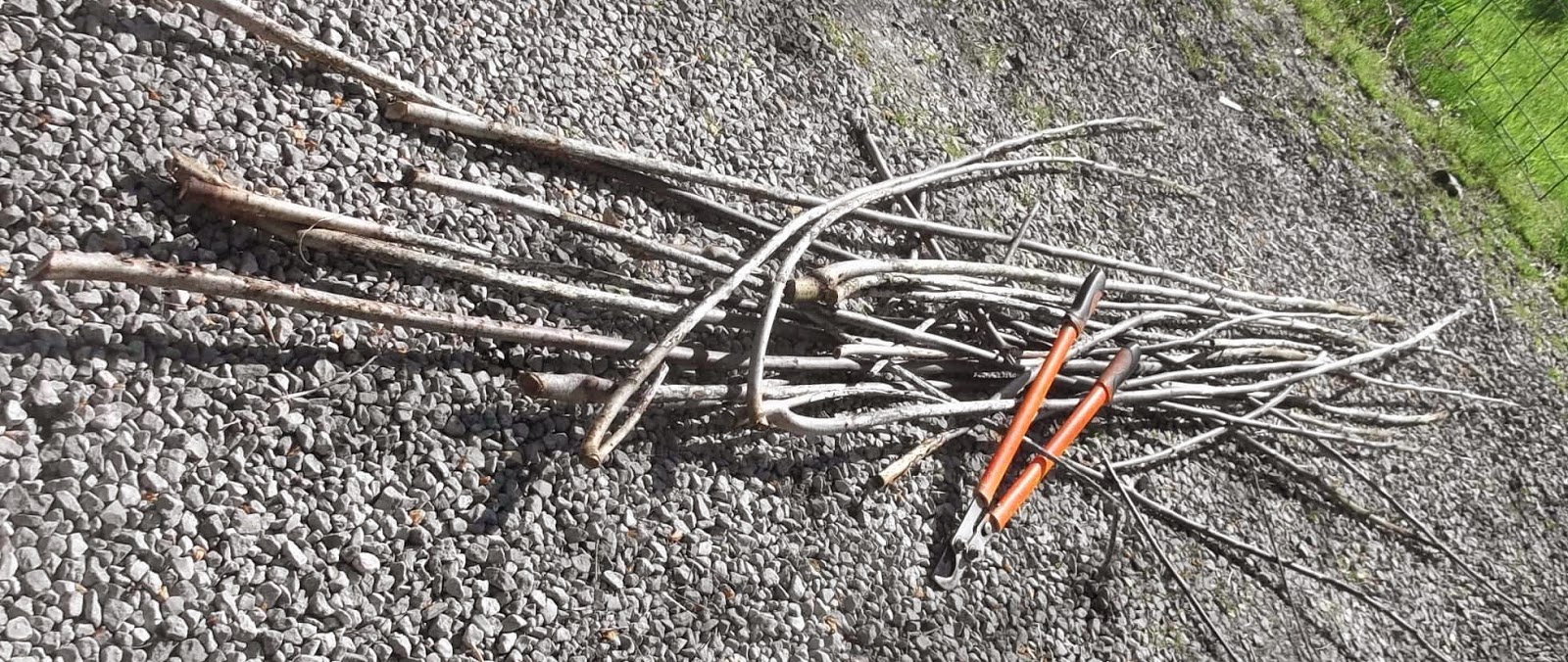
Sumac brush

Walnut and Box Elder brush

The ends were cut to make them pointy and to push into the ground easily

You cannot see it but this is a hop plantation.  The variety is "Sterling" which is a more disease resistant "Saaz" type suitable for pilsners.

Corn


I also planted the corn today.

Now that I am retired I can do many things for no better reason than those activities amuse me.

I crossed Silver Mine (seed parent) with Santo Domingo Pueblo (pollen parent) corn and have been selecting back for early ripening, large ears, white kernels and "QPM".  Santo Domingo has the "floury 1" gene.  Last year was a bust for the corn.  My free range chickens destroyed my planting.  This year I have three hens and they are confined.

This year I planted seven rows that are approximately 65 feet long.  Kubota helped me strip kernels the nine best ears that were left and he sorted out the white kernels for me.

Traditionally, farmers would choose a hundred of their best ears (for diversity and to avoid in-breeding depression) and they would select kernels from the middle third of the cob.  The kernels near the base of the cob set earlier and the kernels near the tip set later.   Kubota and I chose kernels from the third that was closest to the base since I am trying to shift this strain to an earlier ripening date.

This breeding project is nothing that I will ever be able to justify from an economic sense...but then neither can golfers justify hitting a little, dimpled ball with a silly-stick. Mrs ERJ tolerates my growing "field" corn because we have neighbors who are very good at growing "super sweet" sweet corn.  We pay them $4 a dozen and are happy to do it.

My goal is to develop an awesome strain of corn/maize for white cornbread that is adapted to the upper mid-West.

Immigration

"Heat" map for crime rates.  Image from HERE
Most people view "Immigration" the same way they view pain management drugs:  A wonderful thing as long as is managed with discernment.  We don't want every junky on the street to have access to opiates.  We don't want every person on earth to have unrestricted access to our country.

A common complaint about immigration is the effect it has on crime rates.  Folks, people who lack paid work steal things.  People who do not have to wake up in the morning have time for mischief.  IMNSHO, the problem is that we allow unemployable people in...not the color of their skin.  And the reason they come is in anticipation of amnesty.


Discernment


The key word is "discernment".  Our current method of blowing hot-and-cold invites the scoff-laws.  My proposal is pretty simple:
  • Total quotas set to achieve 2% annual population growth over the next 10 years.
  • Immigrants start with visas and must earn their way in by demonstrating work ethic. I consider 1600 hours of documented, paid work per year for five years to be sufficient evidence but I will not quibble if others have different bogeys.
  • Alternatively, starting/managing a business that pays at least two other people for two years would be enough evidence.

The demographics of Japan and Western Europe are like watching the heat death of the universe.  It does not have to happen.


Being anti-immigration is self-serving.  There are no evolved-in-place humans in the Western Hemisphere.  New-world megafauna had reasons to be anti-immigration, but that boat already sailed (for them).  Unless you are a German Shepherd reading this blog, your ancestors were immigrants.

First and second generation immigrants tend to be the hardest working and most patriotic citizens.  Their views are not clouded by ambiguity or second-hand feelings of guilt.  They get sh!t done.

We must tend our garden.  We can grow weeds or we can cultivate our garden by favoring productive people.  Our hot-and-cold policy shows too much favor for the weeds.

Wednesday, May 13, 2015

Diversity in Eaton Rapids

Today is a lawn mowing day so you get a short post.

Ducks.  Hmmmm!  Black ones and white ones.  No knockout games here.
Three mama cows and three calves.  Daddy is a Shorthorn.  White mama is mostly Charolais, the red mama with the black calf is mostly Shorthorn and the black mama has a goodly dose of Angus in her.  Eaton Rapids is what you call "diverse".
Volunteer Kale seedlings.  By the look of them, one of the parents was Red Russian and the other was Improved Dwarf Siberian.  A riot of leaf shapes but otherwise civil behavior by all concerned.
Red Oak seedling just popped out of the ground, maybe two inches tall.  The seed was collected from a precocious lass  near a big-box store.