Saturday, May 6, 2017

The first "No!" of the day

It was 8:30 in the morning when I told Mrs ERJ, "If I just get one thing done today, mowing the lawn, it will be a good day."

Mrs ERJ replied with, "Why yes, oh wise and handsome man of my life!  Great idea."  Note to readers:  A small amount of poetic license was employed.

To which I responded, "There is too much dew on the grass.  I will have to wait a few hours.  I think I will go out and take a few pictures."

Mrs ERJ said, "OK."

Pictures of some grafts pushing.  This is Enterprise apple.  Walking around and looking at grafts is a bit like unwrapping Christmas presents.  You just don't know what you will see.

A quince.

Another quince with the milk jug pulled.

A pear graft that is being stupid.  I don't get 100% takes.  Sometimes I take shortcuts and get caught.  I did not use parafilm on this graft. 

Here is a branch that I budded in August of last year.  It is pushing.
About 9:30 I suggested we go for a walk.  Mrs ERJ responded, "Fabulous idea.  Do you mind if we take the dogs?  They would like it too."

"Sure" I responded.
Our neighbors have some very large mushrooms growing in their yard.
A Flowering Dogwood (Cornus florida We don't have a lot of it around here but what we do have really stands out, especially against a back drop of spruce or pine.  420 Growing Degree Days (B42).  The next few days will be cool and dry.  The GDD will not add up very quickly.

This video is for Belladonna so she can see her dog who is perfect in every way.  He loves water.


After getting home I saw a box that had magically shown up in our garage.  Hmmm!  Plants.

"Mrs ERJ," I said, "I think I need to get those plants in the ground.  Are you OK with my putting off the mowing for about an hour?"

Mrs ERJ said, "Yeah.  It is probably a good idea to get those trees into the ground before they die."


This is a "Before" shot
This is an "After" shot.  Five filbert bushes were plugged into the space that was freed up.
This row of bushes is being flipped over.  Formerly, the species were raspberries, pawpaws, rugosa rose and Rose of Sharon.  There are 11 filbert bushes now.

Red leaves are a fairly common trait in filberts.  I am pretty sure it is a recessive trait.  This is a seedling of Estrella #1.  Moscow #2 and NY 398 are also likely to produce red leaved seedlings.  All three of these cultivars have some resistance to Eastern Filbert Blight.
I have to armor everything I plant due to rabbit and deer pressure.  Four of the five bushes I planted today came out of my nursery.  That is why it is leafed out.  It was fifty degrees (F) out and mostly cloudy.   I moved them with as much of a dirt ball as I could manage and watered them in really well.  This is the only one that is sulking.  As you can see, it is wilting.
I don't know how well this photo captures these nettles that have been browsed by deer.  This is the first time I can recall seeing that.  I wonder if this specimen is particularly low in irritating hairs or if they are simply less "stingy" in the early spring.
It took way longer than an hour to plant and armor the filberts.  About 1:30 I remembered that the Kentucky Derby was running today.

I went to Mrs ERJ and asked if she could find our bottle of "Ye Olde Kentucky's Finest Bourbon".  She said, "Yes I can."

I collected some shoots of mint.  I picked three.  Fresh greens are notable for vitamins.
Then after a tipple or two and a wee bite to eat I asked Mrs ERJ if she would mind if I took a short nap.  (I love being retired...what day is this, anyway?).

Mrs ERJ said, "You look like you have been in the sun and working hard.  I think a nap would do you good.  Sure, take a nap."

So I did.

Upon waking up, I started picking up sticks so I could mow.  Mrs ERJ was right there at my side matching me step-for-step.

We are still working on the tree the satellite/dish technician told us we had to cut down.  In retrospect, I am not sure we needed to, but there it is, on the ground.

The smaller stuff went on the burn pile.  The bigger stuff went into the barn to dry for firewood.

We knocked off at 8:00 in the evening.

I looked around, realizing that I had not even started the mower.

"You know, Mrs ERJ," I said "it would sure save a lot of work if we had sheep to mow our lawn.  Or maybe we could bring over the Captain's cattle."

That is the first time I heard her say "No." today.  I was just checking to see if she was listening.

Rimworld: Into the Green

I was a Beta reader.  I enjoyed reading Rimworld: Into the Green.

Things that I found notable were:

Many authors fall into the trap of making their hero *PERFECT*.  The hero of Into the Green, Ethan Fargo is very human and as imperfect as most of the people I know.  He steps into the fertilizer with commendable regularity.  He does not succeed because he knows 18 different forms of martial arts or because he has magical powers.  He succeeds because he is loyal, duty-driven and never gives up.

Another thing I liked about Into the Green is that it is not larded with gratuitous sex scenes.  Maybe I have a prudish streak, but it seems like many books (of every genre) use detailed bedroom scenes as the mortar-between-the-bricks, that is, every time the author is stumped for a transition.  Ethan Fargo is not a monk but bedroom doors are closed and S-E-X (spelling here in case any minors are reading this review) is not dripping from the trees.  Intimacy passes "Chekhov's Gun" test.  If it is there, it is there to advance the story.

Dialog sounds like real conversations between real people.  I don't write fiction because I cannot do dialog.  Mr Curtis does a great job with dialog.

It is mandatory to write something negative in order to give a well balanced review.

It was too short.  I hope there is a follow-up book.


Thursday, May 4, 2017

Chessfrog Farms

Some of you may remember my friend Marcus Brown from an earlier post on guerrilla grafting of apple trees in a Lansing park near the Lansing Yacht Club.

Well, he and Chitra, his wife, decided to go big.  They bought six acres and planned to plant an orchard.

Oops!  I blinked.  They planted the orchard...last weekend. They are into Getting Stuff Done.

It is on a lake.  All photos except the top one supplied by Marcus Brown.


The drainage is a bit of a challenge.  It has been a very wet spring.

The upside is that he will not need to install irrigation.
Marcus is a man-with-a-plan.  He is very organized and scientific.  You can see his Latin Squares design-of-experiment layout in the photo just above this text.
A close-up of his orchard map.  This is what he can afford to plant in his first year.  He did not randomize the varieties within each block due to the logistics of picking.

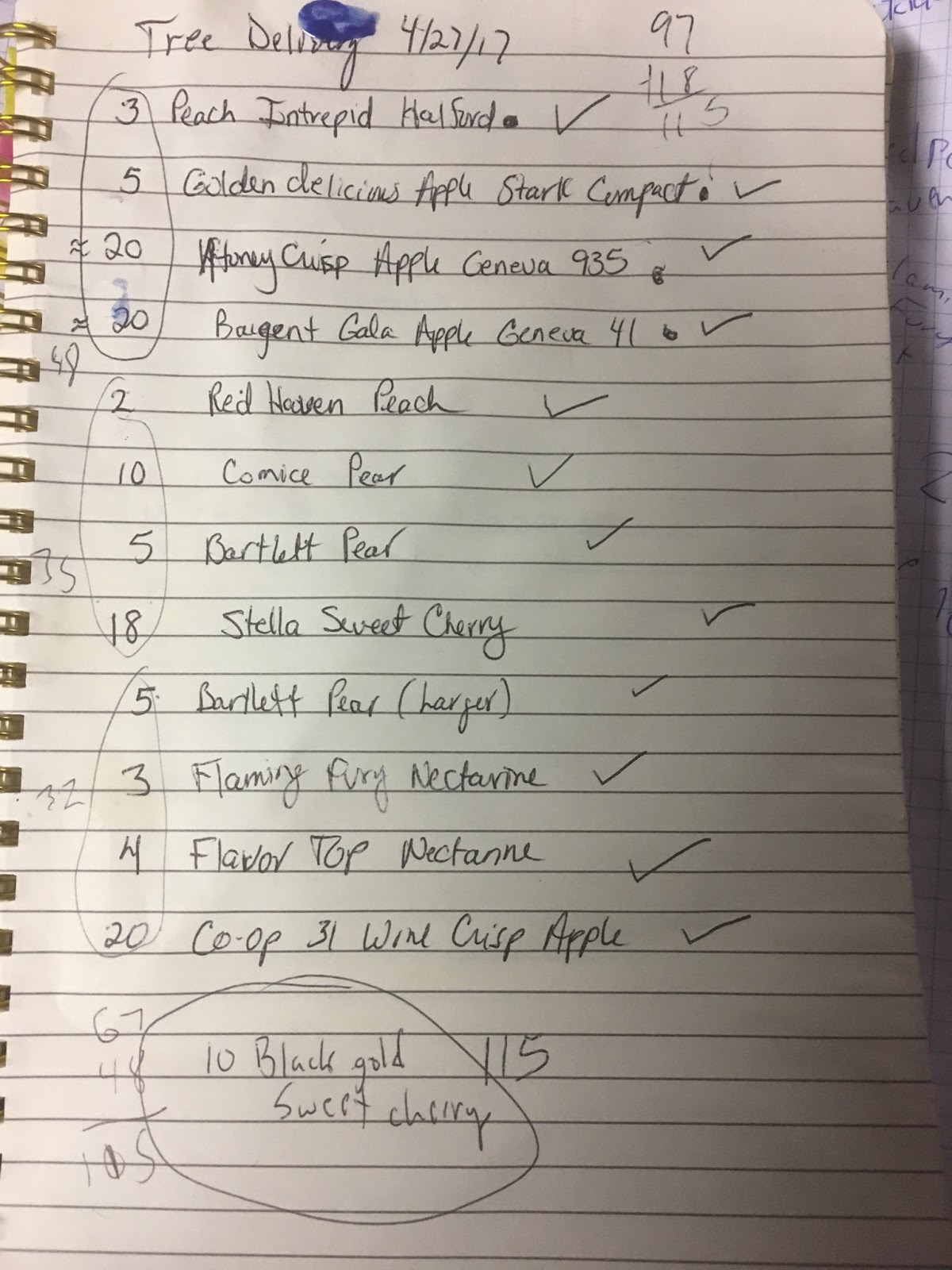
That is a bunch of trees to plant!  Just eyeballing it, I would guess that is about 115 trees.
OK, I cheated.
Adapt, overcome, improvise
Marcus asked me for some advice.  I told him that labeling trees is always an issue.  I also had a few suggestions regarding managing some volunteers he (might) have.  "Make it visual."

As you would expect from a Marine, he improvised and overcame.  He went to the local big-box store and bought several types of duct tape so each variety would have its own unique "flag"
Every reference he looked at emphasized that most fruit trees did not like "wet" roots.  He contacted several University experts and they advised him to choose some other site.  But there were some advantages to this site's location that were not negotiable.  More about that later.


They started with boxes like you would use for raised gardens.  If you cannot lower the water table then raise the surface of the soil.

He also took advantage of the fact that the new Geneva rootstocks were selected to thrive in "non-optimum" fruit growing sites.  It is less of a problem in Michigan, but it is widely recognized that great fruit growing sites are very attractive building sites due to slope, elevation (view) and proximity to large bodies of water.  The breeders at Cornell University realized that orchards were being pushed into non-optimal sites by simple economics.  They dialed in extreme prejudice against seedlings that were fussy about wet feet.

Then, in the interest of experimentation, they simplified.
They used cardboard boxes.  The intention is for the boxes to hold the soil near the tree in the event of heavy rains.  Their hope is that the tree roots will knit the soil together before the box bio-degrades.  Furthermore, they intend to "connect the dots" and make the raised mounds into continuous, linear berms.
The first year's planting before the soil was mounded.
A picture of Marcus and Chitra in front of their Lansing home.  They also run the micro-community center next door.
Here is the kicker


Marcus and Chitra are deeply concerned about "food deserts" in large cities.  They decided to do something about it.  Their orchard is on the northwest side of Flint, Michigan.

There are many big cities pimping local foods and community agriculture.  They tend to be in affluent communities with well-healed corporate sponsors like Portland, Oregon or hip, bleeding-edge communities like New Orleans, Louisiana.  Flint is a gritty, rust-belt city.  Local food is not 'fashionable' and 'hip'.  It is a necessity.

I am humbled by people like Marcus and his wife.  It is an honor to know them.  Sadly, there is only one or two of them for every thousand who protest and complain and march and demand that 'somebody' do something...people who then go home to watch TV and spend the rest of the year in their cozy, suburban homes.  Marcus and Chitra stay at home and get blisters.

If this is anything that interests you
If you want to contact Marcus, he can be reached via email at chess delete this blank frog@hotmail.com

Acknowledgements 
Chandra at Stark's Commercial Fruit Tree sales.  This all happened very suddenly and Stark's was extremely helpful in assisting Marcus and Chitra through the ordering process and figured out ways to minimize costs.  Because it was near the end of the planting season, they had many odds-and-ends in their stockroom.  My impression is that they help Marcus and Chitra choose trees that would highly likely to produce fruit as opposed to dumping their over-stock to make a quick buck.

Volunteers of note:
  • Melissa and Matthew Nickols
  • John and Brenda Brown
  • Ronald and Camille Baines
  • Sarita Williams
  • Marcus K.D.R. Brown (my son)
I suspect Marcus and Chitra will have volunteering opportunities throughout the year, so Chessfrog Farms can supply "volunteering opportunities" for NHS students and for students at private schools (like Flint Powers) in need of service projects.


I also expect that he will be planting more trees every April as cash-flow allows.  So far Marcus and Chitra have been funding this out of their own pockets.  They see an advantage to taking time and feeling their way along.  By late next winter they will have a better grip on the kinds of trees that will survive on their six acres.  They will have a better focus on tree spacing and how the will space various types of trees in the future.


For those who are interested in replicating Marcus and Chitra's experience...or if you are inspired to support them...$2000 is about what it would take to plant another 120 trees with boxes, raised beds and so on.

The value of High School AP/College Credit classes


At the time of this writing, the Net Present Value of one (high school) AP/CC credit is approximately $3,400 in the State of Michigan.

The Net Present Value of taking enough AP/CC classes to eliminate one year of University is approximately $100,000.

I got to thinking about the economic value of Advanced Placement/College Credit (henceforth AP/CC) classes. Part of my interest is due to the fact that Southern Belle received her Florida certification for teaching Advanced/Gifted classes and part is because the young man I transport each school morning is a junior in high school and is working on his Associates degree.

Most people focus on the avoidance of one year's worth of college tuition. While this might be a huge motivator to parents, it is rarely a major consideration to the students. After all, most of them expect their parents or the Government to pay that tuition. That may or may not be a realistic expectation.

The median (middle) tuition for a Michigan resident is very close to $10,000.

This analysis will show that the benefits of AB/CC classes is ten times greater than that.

Room and Board
For one thing, the cost of attending one year of college also includes room, board and miscellaneous expenses. For all practical purposes those costs double the cost of a year in college to $20,000 per year.

Opportunity costs
Graduating one year earlier means that the former student is making money, rather than spending money the year they would normally be a senior. According to one source the median annual salary for a new graduate with a Bachelor's degree is $50,500.

At this point a sophisticated analysis needs to start discounting future cash flows because a dollar today is worth more than a dollar earned/spent in the future.

For the record, I will use a discount rate of 6% and an inflation rate (where applicable) of 3%. These are solid, long-term averages and if anything reduce the estimated value of AP/CC classes.

Attrition
It is a sad fact that most regional Michigan Universities have a 6 year graduation rate of approximately 20%. I am going to be very generous and suggest that many of those students transfer to other universities and that the effective graduation rate is really 50%. That is, half of the students who start University graduate with a degree.

Using a smooth, exponential decay rate (a more sophisticated version of double-declining depreciation) of 0.84^years suggests that 60% of the students will complete their third year if 50% complete four years.  

Using the same calculations for 20%, then the formula would be 0.67^years and 30% would complete three years and attain their degree.

Promotional pay
I propose that most employees will receive a raise of 3% a year over the life of their career. In truth, they are likely to receive more than that early in their career and then they will flat-line five-or-ten years into their career unless they move up the ladder to a job with more responsibility. The art of analytical modeling involves the integrating of simplification and realism

This assumption means that the student who graduated one year earlier will always make 3% more (in any given calendar year) than their fellow student who did not opt for any AP/CC classes.

Career longevity
As a practical matter, many of the students will work until they reach a certain age. Both populations will be modeled as working until age 66. That is, the AP/CC students will work 45 years and the non-AP/CC students will be modeled as working 44 years. They will both be the same age when they retire.

Putting it all together
The Net Present Value of the future income/expense stream for the AP/CC student is $560,020.56 

This is much lower than you will see in most analysis because there is still a 40% chance the AP/CC student will drop out of University and because the future income stream is discounted at 6%. Furthermore, the three years of $20,000 per year (increasing by 3% per year) is also boiled into that NPV.

The NPV of the future income/expense stream for the non-AP/CC student is $405,857.55

The difference between the two...the Net Present Value...of taking enough AP/CC classes to eliminate one year of University is approximately $150,000

Weaknesses in the analysis

Admittedly, students who drop out of college will undoubtedly make something. They are dropped out of the first order analysis for computational simplicity. So, in the interest of being conservative, let us suppose that the student who started college but dropped out makes half of what the college graduate makes. 

Throwing that into the model lowers the NPV difference to $103,000

Smoothing
Students do not always take AP/CC credits in even increments of "30 college credit equivalents", i.e. one year of college. A critic might dismiss this analysis on that basis.

The response to those criticisms is that University students sometimes find themselves attending classes for less than a full load of credits, especially during their last year of studies. Whether one is attending college for one class or for a full load, the fact remains that they cannot be employed as a holder of a Bachelor's degree and earn the higher wages.

Whether they shave one full year off their college experience or some smaller fraction, it is valuable to quantify the NPV to the College Credit Equivalent. Knowing that they have a head start, class availability permitting, the intelligent student can arrange their schedules to graduate earlier than they might otherwise be able.

At the time of this writing, the Net Present Value of one AP/CC credit is approximately $3,400 in the State of Michigan. That is far, far more than most people usually estimate. I think many students would make different choices if they knew the many ways that AP/CC credits will positively impact their future income stream.

Anthropomorphizing

To anthropomorphize is to attribute human thoughts, emotions or other human attributes to non-humans.

I was guilty of anthropomorphizing when I claimed the Boston Terrier was "strutting".

Unofficially...

I think humans inadvertently selected for human-like display of emotions as they chose dams over the thousands of generations.  They chose mothers who exhibited facial expressions and body language that were near clones of our human ones.  We felt comfortable around those dogs.  They were easier to work with because we could "read" them.

Happy dog
Not just "happy" but remorseful, fearful, proud, enraged.

I was technically guilty of anthropomorphizing when I wrote the Boston Terrier was strutting...but he was clearly on an adrenaline high and prouder than heck.