Tuesday, December 3, 2019

Transit buses and the City of Detroit

I think everybody in Michigan wants to see Detroit peel herself off the mat and regain something of her past glory.

Public transit is a topic with high "leverage". Conservatives support it, within reason, because it helps people get to jobs and training. Liberals like it on principle.

Public transit has a critical mass feature. It stops being viable when the buses don't run often enough, or early/late enough or reliably enough, or if the routes are too far apart.

Unfortunately, too many resources have been squandered on monuments like light, commuter rail rather than the common, plebeian, diesel-powered, transit bus.

Avoidance vs. Evasion
There are several perverse incentives that make it difficult for cities like Detroit to bootstrap their way out of the wrong side of the critical mass.

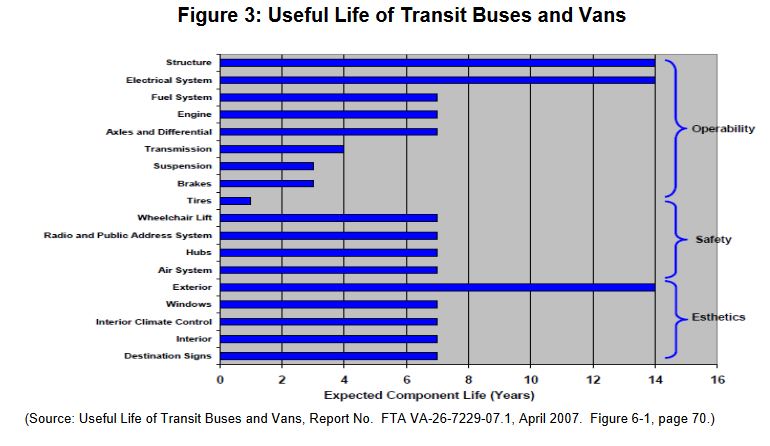
For one thing, the Feds subsidize new buses when 12 year old buses are retired. That sabotages the possibility of simply hanging onto their buses for an additional six years, thereby increasing the size of the fleet by 50%.

It is good economics to let maintenance slide the last couple of years when the 12 year cycle is cast in stone. For the record, a new, 40', conventional Diesel transit bus runs about $300k
Transit buses, the ones you see on city streets, are refurbished every eight years or 8000 hours of operation.


One possibility would be to SELL the powertrain of new units to a private company like AIS or Michigan CAT and then they lease-back and handle maintenance.

The private company gets the tax benefits of depreciating the equipment and can do the total powertrain/drivetrain rebuild for 60% of the $100k it costs the city to do it. That cost would be captured in the lease-back payments.

Run the business with the expectation that the buses will be kept in service for 18 years instead of 12.

When the bus turns 12, sell the rest of the bus to the private company for refurb. Retire it for a month and then put back into service in Detroit as a rental.

That should result in a 50% increase in the fleet of buses. There might also be an immediate gain if the outside service business can push the fleet availability above 95%.

Detroit residents trying to get a bus to their jobs get a bus every 20 minutes instead of one every 30 minutes, maybe. The City of Detroit gets some money back up-front. ATU Local 26 gets more jobs as drivers because there are more buses to drive. Michigan CAT or whoever gets jobs and sets up a bay dedicated to rebuilding transit bus powertrain/drivetrains.

Proper nomenclature: 4-Stroke, 2-Stroke and 1-Stroke IC motors

4-Stroke internal combustion engines are commonly called "4-Cycle" engines but that is not the preferred nomenclature, primarily because the word "cycle" is ambiguous. Cycle implies a complete rotation. Does the engine only fire every four complete cycles? Does it refer to the crankshaft which rotates twice for every firing cycle? Or perhaps it refers to the camshafts which only rotate once every firing cycle?

Nope. The piston strokes up-and-down. The engine fires once every four strokes, hence the clarity of the term "four stroke"

2-Stroke motors are magic. The rely on fluid dynamics, reed valves, piston position and pixie dust to work.

The piston uncovers the outlet port first and the hot, combusted gasses make a mad dash for the exit.

Visualize a "Slinky". The momentum of the slinky is outward bound. Then the piston uncovers the inlet port and the slightly pressurized, uncombusted air-fuel mix can enter...but typically is further pressurized by the combusted gasses leaking backwards.

Timing is everything. The back edge of the slinky, which has been pressurized by the erstwhile exhaust gas, makes a final jump into the combustion chamber like Indiana Jones sliding beneath the wall of stone about to seal his doom.

So, what does a 1-Stroke, Internal Combustion engine look like?


Monday, December 2, 2019

Conex based housing


Three of my four kids are more than half-way interested in tiny houses based on Conex shipping containers. It is probably because Mrs ERJ read The Boxcar Children series to my kids when they were wee tykes.

Working the math, two 8'X40' Conex containers run about $4500. A 24'X41' portable carport to shade them and protect them from precipitation runs about about another $4000.

In gross numbers that gives you interior space for $13.50 a square foot.

The exterior walls and ceiling need stud walls, insulation and drywall. Windows and doors need to be Saws-alled into the sides and installed. A hotplate and sink are enough for a kitchen. Add a composting toilet, a small LP heater vented to outside and a window air conditioner and you are living high on the hog.

You would want to wire for 60 Amp service and you need accommodations for grey water.

Source of image

Of course it is not a residential space. It would never meet code. It is a work-shop with a futon and a few amenities.

If you want a really tiny "shop" you can shrink down to an 8'-by-20' exterior shell but the price does not scale down proportionately.

Technically, there is absolutely nothing difficult about converting a Conex container into housing. It might even be the most effective way to deal with homelessness. The trick is finding somebody who is willing to let you park your "shop" on their property.

Sunday, December 1, 2019

Major Corporation announces they are leaving California: Stock jumps 15%

Charles Schwab announced they are leaving high-priced, over-regulated California for Texas.

Their price jumped 15% as the market "anticipated" the announcement.

I applaud Charles Schwab Management for taking care of their share holders. I predict an avalanche of other corporations to follow.

.32 Rimfire

From the ever-helpful Wikipedia

.32 Rimfire ammo trades for $2 a round, when it can be found.

7mm, U62 brass beads can be purchased for 3.4 cents a piece when purchased in lots of 32,000 (50kg).

There is exactly enough brass in a 7mm brass bead to make a .32 Rimfire, Long with 0.011" thick walls.


Specify brass beads be delivered in the annealed state. Impact extrude a cup with a 0.377" outside diameter. Neck down all except the rim to an OD of 0.318".  Trim to 092" length if necessary. Apply primer compound (can probably be done robotically as inside of casing is much more voluminous than a .22 rimfire). Sell for a 20X mark-up.

On a related note, if a major ammo company was willing to sell the drawn or extruded cups for the .22 Winchester Magnum Rimfire before the majority of the shell is sized down to 0.242" then the 0.29" cups have enough material in them to reform to .32 Rimfire Short. It would be necessary to use a rubber plug and a female die but it looks doable after annealing.

Just for fun

John James. So cool he could be a video game super-hero.

The 2020 race for Michigan's junior Senator's seat will be hotly contested.

The challenger, John James is a Republican

At 17, John made the decision to serve his country. After graduating from West Point in 2004, he became a Ranger-qualified aviation officer. John went on to serve with distinction in Operation Iraqi Freedom where he earned a Combat Action Badge (CAB) and two Air Medals, among other awards while logging 753.7 flight hours in theater leading two Apache platoons.
In the 2018 race he gave the senior Senator, Debby Stabenow, a scare and it was a very, very close race.

The national exposure of a political newbie almost taking an ancient Dragon in a "safe" state to the mat resulted in him being able to raise significant amounts of money. By some accounts, he is drawing 20% more in contributions that Gary Peters, the current junior senator.

Gary Peters is the one who looks like Elmer Fudd
I am not asking for readers to make a donation. Rather, if you have a few minutes, go to Google and type in "Gary Peters" or click HERE.  Select images. Scroll down until you see an image of John James (African-American, physically fit) and select it. Do the same for two or three more images of John James. That should start floating those images off the second and third pages up to the top page.

It will get inside their heads and mess with their minds.

In all fairness, Gary Peters did serve his country in the Naval Reserve...as an investment counselor. I wonder how many desks he flew back to base with bullet holes in them.

Don't call it "Medicare for all"

Medicare is partially funded by a 2.9% tax on payroll. Participants become eligible for Medicare AFTER about forty years of those non-voluntary deductions.

While not enough to fully fund Medicare, it is real skin-in-the-game for those whose paychecks were diminished by almost three percent.

Lets take a hypothetical person who has some skills. They start with wages of  $40,000 per year and their pay doubles to $80,000 over the first ten years of working. Then their wages stagnate.

If that 2.9% in lost wages had been made available to the employee and they rolled it into an IRA or 401-k, it would accumulate into a tidy sum. By my figuring, a real, 3% average annual return would put $164k in the account by the day they retired.

Don't call the Socialist's plan to control access to heathcare "Medicare for all". It is a straight-up give away.