Thursday, September 5, 2019

Sustainable?

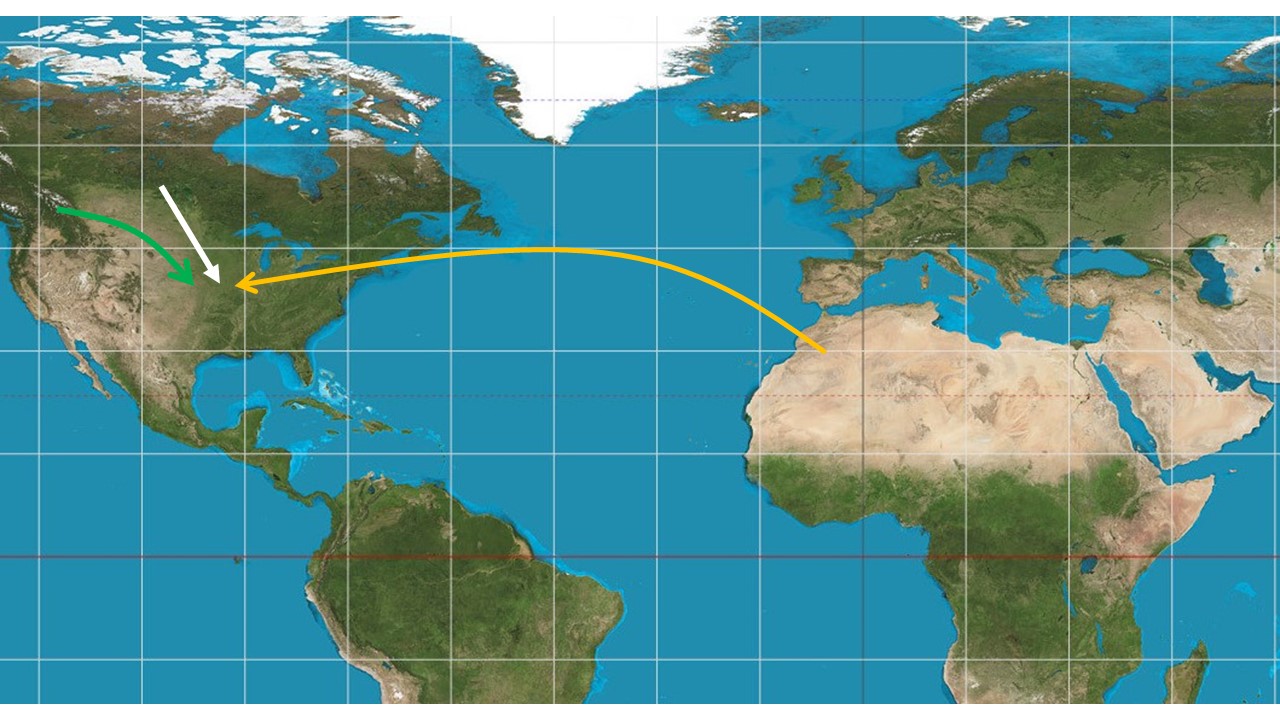
Phosphorous from West Africa (orange arrow), potassium from Saskatchewan (white arrow) and anhydrous ammonia from British Columbia (green arrow) are added to the soil on a farm near Elmo, Missouri.

The grain produced on the farm (yellow arrow) is shipped to the Netherlands along with Peruvian fish meal (black arrow) and petroleum based fuels from Kazakhstan (red arrow). The swine facility cannot stay in business unless they can prove they have a contract for a Polish farm to take their manure (white arrow) and other wastes and dispose of it in a "green" manner.

That manure contains the potassium, phosphorous and nitrogen originally mined or "fixed" in Saskatchewan, Morocco and British Columbia respectively.

Due to Byzantine European Union rules and the dynamics of high fixed-cost businesses, some of the pork is processed into ham salad and faux Spam by Turkish workers in The Netherlands and is shipped back to the United States labeled as "Dollar Store" products (pink arrow).

Our housewife in Elmo, Missouri buys some of the ham salad to make sandwiches because she works for H&R Block and it is tax season. She does not have time to make her own sandwich spread.

Does that make any sense at all?

The Shrewd King 7.4: As a matter of fact, you CAN unscrew a rabbit


Miguel Rodriguez and Quinn Spackle would have left the camp with nothing more than a couple of large dogfood bags and some orange, poly baling twine in Miguel’s pockets if Quinn had not made a point of taking their weapons.

Miguel pushed back about it but Spackle demanded it. “Look, I know guns are heavy and they can be a pain in the ass. But I know from personal experience that the time you need one will be a huge surprise and you won’t have time to run back to camp and get one...and I ain’t talking about bunnies, either.”

Had it been almost anybody else, Miguel would have blown him off.

But Quinn’s reputation had not suffered during his absence. All of the old timers were firm on having inflicted 1300 casualties on the enemy. With a force of thirty fighters, that was a bit more than forty enemy fighters engaged and taken out by every fighter. And the fighters all agreed, Quinn had big, brass balls. He led a fire-team in the hottest sector and was not shy about putting himself in harms what.

When a guy who had half of his ass shot-off and who had willingly put himself downrange of Berfa’s pattern tells you to take your weapon...you take your weapon.

“What are we hunting today?” Quinn asked. He was curious because they didn’t have any equipment he recognized as hunting equipment.

“Anything we can find, boss. Anything we can find.” Miguel said.

Quinn was surprised when Miguel took them across the bridge and out of Chernovsky’s Annex. Turning north (left) shortly after crossing the bridge, Miguel walked through the tall grass to a clump of young box-elder trees. Selecting a trunk that was about 2” in diameter near the bottom and clear of branches for the first eight feet, Miguel bent the trunk and severed it from the base with a couple of vigorous blows with his belt knife.

“The key is to put some bend into stem where you want to cut it.” Miguel said. “Then to make sure you are hitting the stem on the slant.”

Quinn knew that but kept his mouth shut. This was Miguel’s rodeo.

Miguel stripped all the leaves and tiny branches, he called them pins, from the stem. Then he trimmed the branches near the top. He did not cut them flush but left them about four inches long.

“It is better to leave these a little bit long because it is easier to cut them shorter than to find and cut another pole if they are too short.”

Miguel gave the tool a little shake and was satisfied with how limber it was and then rejoined Quinn on the paved road.

Miguel had Quinn carry the tool as they continued east. Coming to the edge of an abandoned field, Miguel again turned left and they moved through the woods that was lower in elevation than the field.

Miguel started giving Quinn some background.

“My grandfather’s family came up from Texas in 1940 to work the sugar beet fields.” Miguel said.

“My grandfather’s brother enlisted in December of 1941 and was stationed in Fort Custer over near Battle Creek. Needless to say, the family did not move back down to Texas.” Miguel said.

“The first few winters were hard. That is when my grandfather’s papa taught him how to hunt this way.” Miguel said.

Spotting some fresh sandy dirt and a hole, Miguel stopped. “I already know where most of the woodchuck holes are. I brought you this way so you would know what one looks like.”

“The first thing you do is you bend over and smell the hole.” Miguel said.

Quinn looked down at him and gave him a look that said “What kind of idiot do you think I am?”

“No, really. You don’t want to do this if there is a skunk down in that hole.” Miguel said.

Well, that made sense to Quinn.

There was no smell of skunks.

Miguel handed Quinn the pole.

“You learn by doing. Slowly push the pole into the hole and every six inches or so, give it a few, slow twists. That helps screw it past the roots and you will figure out if there is rabbit in the hole.” Miguel said.

Quinn figured that Miguel had a shovel stashed somewhere nearby and that they were going to dig a rabbit out of the woodchuck hole.

“I think I got to the end.” Quinn said.

“Push it in deeper and give it a couple short, quick twists.” Miguel said.

Quinn did so and the pole started quivering.

“Pull it out, pull it out!” Miguel said, excited.

Quinn yanked the pole out and was rewarded with a rabbit's distress squeal and a few rabbit hairs caught in the rough ends of the trimmed side branches.

“Rabbits have really loose skin.” Miguel explained. “Pushing that end into him” Miguel said as he pointed to the bristling stubs “and twisting the pole will get his hide all tangled up. Then it is just a matter of slowly keeping the twist going as you drag him out of the hole.”

“You are shitting me.” Quinn said.

“No, let me show you.” Miguel said.

In fifteen seconds Miguel was popping the complaining rabbit into the dog food bag.

“It is a knack.” Miguel said. “I can’t talk it into you. It is something you have to learn by feel and by practice.”

By the third woodchuck hole and at least twenty tries, Quinn was finally able to unscrew a rabbit out of the hole.

That is when Miguel showed him a cheat.

“I wanted you to be able to do this the way Grandfather taught me. Now, everything else will be easy.’ Miguel said.

Miguel had prepared for today’s lesson by stashing a short length of barbed wire by each woodchuck hole.

The piece by this hole was about thirty inches long. Miguel bent it into a loop and lashed the ends of the loop to the pole with the orange, poly twine he had been carrying. The resulting tool looked vaguely like an elongated lacrosse paddle after Miguel bent the loop of wire so it was about four inches wide at the widest point.


Miguel also trimmed the wooden stubs on the pole back to about an inch. "We don't need them now that we have the wire, but leaving a little bit of them helps keep the wire from slipping off."

“The barbs on the wire are way better than the points I can whittle into the soft wood.” Miguel assured him. “The wire will bite into and twist up any animal in the hole and the loop is almost like a finger trap. Anything that is down in that hole, we can catch...even the skunks.”

Next

Wednesday, September 4, 2019

Permaculture and cheap dates


Belladonna was at a Farmer's Market this week and is becoming interested in where food comes from and at what cost.

Permaculture
I have a deep admiration for most of the principles that fall under the Permaculture umbrella.

The single, most readable book on the topic is Bill Mollison's Introduction to Permaculture. Unfortunately that book is out of print and breath-takingly expensive.

As a person with no credentials in Permaculture and as someone who never went to a seminar, Permaculture appears to be a way to rearrange your home, gardens, orchards, pastures and woods into functional ecosystems that work toward your needs rather than thwart them.

For example, in industrial farming a chicken is seen as a black box where food and water is poured into one end and poop, eggs and carcasses flow out the other.

In Permaculture a chicken is seen as a design element that can eat bugs, weeds and weed seeds, can scratch up the surface of the soil, announce predators, are capable of roosting in trees and can produce eggs, meat, fat, feathers and fertilizer.

Additionally, to the Permaculture practitioner, chickens come in many different flavors. Some are far more capable of fending for themselves (Hamburgs, American game-hens, Ameraucanas/Araucanas and non-white Mediterranean breeds) while others are more efficient at turning garden and kitchen waste into human quality food (most brown egg layers). That suggests that chickens can be fill at least two distinctly different ecological niches: semi-wild pest control with eggs and occasional stewing chickens as a high-value side product .and. domesticated animal with eggs and meat as the primary output and the reduction of food waste being the side product.

Another factor that makes Permaculture valuable is that it recognizes that human's do not have unlimited ability to manage. That limit is often the factor that bottlenecks productivity. Permaculture's solution is to break the property into "zones" based on how often then need to be attended to and order them in rational ways.

For example, the path between your door and the mail box is walked at least once every day. It is the ideal place to plant everbearing raspberries and strawberries or edible flowers. Bringing in the mail would also mean bringing in a small basket of fruit for dessert or for your morning cereal.

Conversely, "the woods" might only get visited a few times a year for gathering nuts, hunting or cutting wood for fuel and construction.

Summary
Industrial agriculture is about simple systems. Few inputs. Few outputs.

Permaculture and Sustainable Agriculture is about nurturing ecosystems. It attends to flows and connections between systems.

Questions that should always bubbling up are "How can I use the waste and byproducts of one element of my system as the inputs for another part?" .and. "Is there a system already in place that already does that, one that only needs me to validate and protect it?" and "Is there a way I can make that system more productive by substituting one or two parts like replacing a hawthorn tree with a pear tree?"

Permaculture is Sustainable because it focuses on working with the flow rather than steamrollering it with fossil fuel based inputs.

I got my Shingles and MMR vaccine today

Recommendations from the CDC self assessment website 

I got my first shingles and MMR vaccinations today.

The nurse said that Shingrix vaccine seemed to have significant side-effects for many patients. The entire staff got the shot. She, personally, had three days of aches and pains and a 102 fever after the second of the two-part series.

I think the nurse flirted with me to take my mind off the shot.

She gave my deltoid a little pat and said, "Oh my. You have big muscles. I need to get a longer needle." Then she dashed out of the room for thirty seconds.

She probably just had to pass gas but it made me feel better.

She also gave me an MMR vaccination. It is also a two-part series but is administered subcutaneously.

The local drugstore offers the vaccination but it is not covered by my health insurance. The out-of-pocket cost for the four shots would be about $600.

I went to Ingham County Health Department.  They took my insurance info and will attempt to bill them. It will be interesting to see how that shakes out. I suspect we will get a bill much smaller than $600 as the health department gets various grants and volume discounts.

Vaccinations are considered a matter of public health. When a large portion of the population is vaccinated, epidemics can become self-extinguishing.

A partial match between the vaccine and the disease results in partial immunity. The person does not spew as many virus or bacteria as they would if their immune systems were totally naive thereby reducing the pressure on others who have not been infected.

One factor that rarely gets discussed with regard to influenza vaccinations is that it is impossible to count the number of people who did not get the flu. The vaccinated human population exerts selection pressure in favor of those strains and mutations that evade the vaccine and against those that don't evade the vaccine. By the end of the flu season the vaccine might have 20% effectiveness. But if there had been NO vaccine, how much higher would the effectiveness been against the non-selected influenza?

Facial recognition

Vertical axis is logrithmic. Absorbance coefficients of three types of chemicals found in the human body.
Don't discount the possibility that facial recognition technology might use near-infrared light to track features that are almost invisible to the human eye.

"Accuvein" is the brand name of a tool that uses NIR to help phlebotomists visualize blood vessel. The basic technology of the tool is to scan the skin surface with a near-infrared laser and record images of the resulting reflectance. The tool then replicates the pixel-image by projecting it back on to the surface using a visible laser.

The original NIR laser frequency is chosen based on high hemoglobin absorbance compared to water, skin and fat cells.

Given the mature state of fingerprint recognition, a relatively high degree of discrimination based on recognition of a vein print of your forehead or nose would not be technically challenging.

The Shrewd King 7.3: Life in an Observation Post


It is true what they say, you can never go home again.

In Quinn Spackle’s case it was because the defense force he had called his home no longer existed.

In the weeks he was convalessing, it morphed from the run-and-gun of street-ball to sitting on the bench and dream about the excitement of practice shooting free throws.

Chernovsky slid him into the half team that exhibited the worst discipline. Chernovsky was sure Spackle would stiffen their spines.

Chernovsky was wrong.

Spackle was the only member of the five who had been in Chernovsky’s original defense force.

The other four were constantly whispering behind his back and dissappearring.

Unwilling to leave the observation post unmanned, Spackle did not hunt them up.

Too proud to admit his lack of leadership ability, Spackle did not rat them out to Chernovsky. Somehow, enough “soldiers” always trickled back in time to meet Chernovsky’s standards. But as soon as Chernovsky and Gimp were out-of-sight, they disappeared again.

The watch was split into two, eight-hour shifts. By the end of the first eight hours, Spackle was climbing the walls. By the end of the second eight hours Spackle was stir-crazy.

He was ready to tear some new assholes but he was not in shape to chase them down even if he knew where to find them. The need to man the OP meant he couldn’t go looking.

To his surprise, there was half of a roasted rabbit waiting in camp for him. The four other guys were nowhere to be seen.

The second night there was a breaded and fried catfish

The third day, as Chernovsky was getting ready to leave, Spackle plastered a big smile on his face as he gripped gripped a fellow soldier by the belt so he could not slip away.

“What is the deal?” Spackle asked.

The young man spat out “Everything.”

“Explain.” Spackle said.

“If you were going to invade us and were coming across that bridge” the young man said pointing down at the river “what is the first thing you would do?”

Spackle thought for a second. “I guess I would look for the defenders and kill them.”

“Wrong.” Jason said. “You would send scouts across the river where it can be waded or send them in as customers at Steve’s Store. They would find us BEFORE they invaded. There wouldn’t be any looking for the post because they would already know where it was.”

That made a certain amount of sense to Quinn.

“So, what is the answer?” Spackle asked.

“You get to be the decoy. Two of us rove. Two of us are off.” Jason said.

“We split the first, eight-hour shift into two, four-hour shifts on roving. Then we split the second eight-hour shift into four, two-hour shifts.” Jason said.

Spackle frowned. “That’s weird.”

“We all got shit to do in the morning.” was all Jason said.

“I am supposed to be the leader here. The problem is I can’t lead if I don’t know what is going on. So we are all going to rotate through...what did you call it, “decoy”...so you can make me smarter. Because I think you might be on to a smarter way of guarding this bridge.” Quinn said.


***

The next morning Spackle followed Jason as Jason worked his set-lines, that is, lines with hooks and weights at one end and tied-off to convenient roots or the tips of saplings on the other. That is where the fried catfish had came from.

“It takes me about four-hours to run the lines and deliver the catch. If I have a big haul then I put part of it in that little creek and take most of the rest to Steve’s store. He is always happy to have fresh fish to sell.” Jason said. “That is why we have four-hour shifts in the morning. It don’t pay to stop in the middle of this.”

“I do a re-check and re-bait on my last two-hour off period.” Jason said. “Catfish and turtles bite better at night so I want to make sure I have fresh bait out there.”

“What do you use for bait?” Quinn asked.

“You will see tonight.” Jason said with a grin.

Quinn considered himself an outdoorsman but he had never spent much time on the river. Jason was very at home and pointed out several hazards that Quinn didn’t see, including tree roots that extended over the current and had holes that could catch and trip the unwary.

“Yeah, I had an uncle that drowned in the river when I was a kid.” Jason said. “He got his foot twisted in one of those holes and his girlfriend didn’t have a cell signal and wasn’t strong enough to hold his head out of the water. Damnedest thing, drowning within a couple of feet of the bank.”

The period when Jason and Quinn were ostensibly in the observation post were spent just below the military crest of the river bank. They moved very, very slowly. Quinn recognized this as “still hunting”. Move just a few steps until your sight vistas are not hemmed in with vegetation and then wait, watch and listen for anything unusual. Quinn had to admit that it was far less mind-numbing than sitting in the observation post.

Suddenly, Jason said “Hear that!” it was the sound of a Blue Heron calling.

“Yup.” Spackle said.

“That means Chernovsky is coming. We gotta haul-ass to the OP.” Jason said.

Jason and Spackle slid down the slope just before Chernovsky and Gimp came around the bend. Obviously, Jason had folks willing to be look-outs for him. In all probability, people who enjoyed fried catfish in addition to beans and cornbread.

That evening Spackle and Jason re-ran the set lines. Jason pulled the three lines closest to the Observation Post. "I like to keep setting new water." he explained. "By the time we get moved to the next OP, my lines will be half-way there."

"Aren't you worried about fishing out the river?" Spackle asked.

"Ain't never gonna happen." Jason said. "I got a couple of customers in the neighborhood but I never wanna catch more than twenty pounds to take to Steve's store. First of all, twenty pounds of fish gets pretty damned heavy when you are carrying it a mile and a half. The other thing is that he keeps them in a kiddie pool and he doesn't have room to keep more than twenty pounds of cats alive."

Smaller fish and turtles had pretty much stripped the lines of bait. Jason rebaited the hooks with the guts of the catfish they had saved for dinner. He also used some rabbit guts that Miguel Rodriguez had. When Jason ran out of offal, he waded into the shallow, gravel bottomed river and felt around for clams. Bringing a handful to shore, he smashed the shells with rocks and used the muscular clam-bodies for bait.

"I like using clams for bait!" Jason said. "They are tougher than hell and stay on the hooks real good."

Tomorrow Quinn was going to shadow Miguel.

Next
Tuesday, September 3, 2019

If you can't be good for anything else, you can always be a good "bad example"

Number seven and five are particularly chilling. Numbers one and two are also right up there for pucker factor.

There is also the usual assortment of bone-heads giving skinny girls guns to shoot that make grown men quake.

Hat tip Lucas Machias