Monday, February 9, 2015

Betchya didn't know food and water are considered medical care

One of my daily reads is Survivalblog.  They had a short article today from a person who identifies them self as a medical doctor in critical care.

Hugh:
The author of this article recommends a Living Will. These documents often express a patient’s wishes not to be kept alive by artificial means. Your readers should be aware that food and water are now considered medical care in all 50 states, rather than normal care of the sick. That means that people who sign Living Wills may be unwittingly authorizing their own starvation and dehydration. It is far better to express your wishes about medical treatment to a loved one whom you trust and instead sign a Durable Power of Attorney for Healthcare. That gives your loved one the ability to insure the best care for you in light of the specific medical circumstances. – Critical Care M.D.   (Bold added by ERJ)

It pays to read the fine print.  It is possible to cross off text in pre-printed documents, date and initial the crossed-off text.  It is also possible to add text, date and initial the additional wording.  The risk is that nobody will actually look at the document because they think they "know" what it says...at least they know what the hospital's pre-printed document says.

This is probably a case where it is worth the money to have the Living Will printed on Law Firm letterhead.  Even if it is mostly the same text as the hospital's Living WWill the letterhead will force them to read it.  Any additions can be highlighted with bold or underlining.

Any redactions should be stated in the positive and should be written as a stand-alone paragraph to call attention to the fact that you are deviating from the common, default text.  Example:

It is the desire of John Smedley Wockenfuss that John Smedley Wockenfuss be fed foods and liquids that are consumed orally.  It is the desire of John Smedley Wockenfuss that he be assisted in the oral consumption of foods and liquids if he is not able to hold straws and/or tableware. "Oral consumption" in this document is to be considered foods and liquids that are consumed by placement in the mouth and not delivered to the esophagus or stomach via a tube.

You pay your money and you take your chances.

Sunday, February 8, 2015

Berry Bullets, Target Hollow Points

I received my shipment from Powder Valley.  I did not make the call in time to get them to switch the order to Hornady XTPs.  I am looking at a box of about 1000, 124 grain, 0.356" diameter, Target Practice Hollow Point, part number 32871.


This is a fairly blunt bullet.  The flat area on top is 6.5mm across.  The bullet is 14.3mm long, the same length as the Speer Golddot and 0.1mm shorter than the Remington hollow point of the same weight.


The hollow point is 3.5mm in diameter, straight sided and 6mm deep.  The sides of the cavity are not pre-scored or pre-segmented.


Straight sides and no pre-segmenting suggests that it will exhibit sub-par terminal ballistics if the target is covered with heavy hair (like a boar or a bear) or denim.  The cavity fills up with "fiber".  The packed fiber does not exert pressure on the sides of the cavity and, therefore, it does not initiate expansion.  Mentally picture stuffing the cavity with a spit wad that you allow to dry out.  That is how a cavity packed with fiber behaves.


Tapered sides perform better than straight sides because the packed fiber acts as a wedge.

An elastomer plug bulges when compressed which should disrupt the sides of the tip, initiating expansion.

There is a way to "save" the straight sided cavity design.  Hornady has been designing innovative bullets with "flex tips".  The actual flex tip is a stiff elastomer.  Elastomers act like liquids.  Pressure on one surface generates pressure on all surfaces that attempt to contain it.

Picture from HERE
These look promising.  Soft beads.  An additional advantage is that they glow in the dark which will make it easy for the coroner to locate since they will not show up on X-rays.

Note added later:  Rainier LeadSafe plated, 124 grain 9mm hollow-point bullets do expand when fired into test media at 1100fps.

Are bigger vehicles safer?

First, a few qualifiers:
  1. The biggest factor influencing safety is the awareness and caution of the driver
  2. Back-of-envelop calculations have limits
Having gotten that out of the way, what can we learn from some simple back-of-the-envelop type calculations?

The test


Note that the car is pitching forward.


The simplest test is to run a vehicle into a flat, vertical, immovable barrier at some speed that will stress the vehicle structure and safety systems.  The Federal government decided that speed would be 30 miles per hour.

That is a reasonably accurate simulation of a head-on collision between two identical vehicles with a closing speed of 60 miles per hour (30 mph per vehicle) with neither driver attempting to avoid the accident or hitting the brakes.

Let's look at what happens in a collision between America's best selling automobile and best selling truck.

Delta Velocity


America's best selling passenger car has a curb weight of about 3300 pounds (1500kg).  America's best selling light truck has a curb weight of 6000 pounds (2730 kg).  Imagine a head-on collision between these two vehicles.  Imagine that both are traveling at 30 mph when they collide.

The center of gravity of the system (car + truck) is traveling in the same direction as the truck at 8.7 mph before they hit.  It is also traveling at 8.7 mph in the direction of the truck's original travel after they collide.  This is known as conservation of momentum.

Assuming the vehicles stick together and do not rebound, then the truck went from 30 mph to about 9 mph forward velocity.  The passenger car went from 30 mph to traveling in the reverse direction at 9 mph.  So the truck saw a change in velocity of 21 mph and the car saw a change in velocity of 39 mph.

The function of the restraint system is to safely dissipate the kinetic energy of the occupants.  Kinetic energy is 1/2 * mass * velocity * velocity.  That means that the restraint system of the passenger car must cope with more than three times as much kinetic energy as the passenger in the truck for the same collision.

Heights
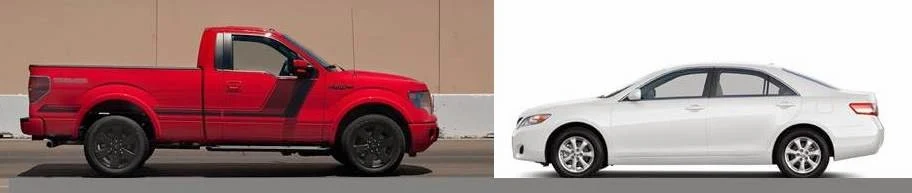


Not to scale.

Another factor to consider is the relative heights of the primary motor rails.  The motor rails on the passenger car are centered about 18 inches (470mm) above the ground while the truck's frame rails are about 4 inches (100mm) higher.

At the instant of contact, the vehicles have a closing speed of 26.8 mm/ms or very close to one inch per millisecond.  The bumper and frame of the truck kiss the top of the passenger car's bumper and frame.  It will be at least 20 milliseconds before they encounter anything substantial.

The bumper of the truck crushes the fascia, front of the hood and the headlamps.  The structure of the passenger car's bumper encounters....air.

Then the bumper of the truck slices through thin (about 0.028" thick, half the thickness of a well worn penny) steel that comprises the sides of the engine compartment, the fenders and the fender rails.  It crumples like paper.  Empirical studies by Magee and Thornton suggest that the most important factor for retaining force during axial crush is the metal's thickness.  Factors like yield strength and the size of the section are much less significant. 

The structure of the car's bumper encounters.....more air.

Which brings us to the air bags.  The little black box that triggers the air bags has an accelerometer in it.  The processor is looking for a very specific acceleration trace before firing the air bags.  A huge amount of effort was expended in engineering a system that reliably discriminates between "deploy" and "non-deploy" events.  Many of the "non-deploy" events were "suggested" by the Insurance Institute.  For example, one of the "non-deploy" events involves hitting a 160 pound deer at 45 mph.  That deer produces an acceleration trace very similar to the early part of the truck collision because it is bending up the same metal.

Eventually, the truck hits the strut caps and generates enough decell to trigger the passenger car's air bags.

The air bags


Energy is dissipated by squeezing a fluid through small holes.  This is what you would see if you took a shock absorber apart.  The air bag dissipates energy by squeezing hot gasses through the holes in the porous cloth as the occupant's head is slowed down.  The bag quickly inflates....like a shotgun shell going off...and is deflated by the force of the occupant's head hitting the bag.

Two things interact to derail this plan.  The forces generated within the passenger car ramp up very quickly so the air bag deploys late in the event.  There is a fairly high chance that the occupant will hit the air bag while it is still inflating.  Then, instead of dissipating energy that "shotgun shell" will add energy to the occupant's head.

The other thing that is happening is that the passenger car experiences negative pitch.  The forces exerted upon the passenger car are at a higher elevation than anticipated.  That negative pitch and the effect of the strut caps being driven back in the structure can result in the air bag being below the path of the driver's head rather than centered in its path.


Conclusion


Are full sized trucks "safer" in collisions than a typical passenger car?  You betchya.  The physics of momentum are ruthless and "star ratings" rarely inform the shopper that most of those tests simulate collisions between identical vehicles.

Federal Motor Vehicle Safety Standards for passenger cars mandate that both front and rear bumpers protect a zone from 16" above the ground to 20" above the ground.  Those standards could be amended to raise the front bumper zone to 18"-to-22" to increase the chances of triggering an airbag deploy in the event of a collision with a taller vehicles.  An alternative would be to require that the "protection zone" be raised to from 20" to 22" in the area immediately in front of each motor rail.

Additionally, it would make sense to lower the FMVSS requirement for rear bumper bars by two inches to negate the effect of braking-induced-pitch.  In a typical, real life, rear-end collision, the bullet car submarines beneath the target car due to braking-induced-pitch.

Saturday, February 7, 2015

Pre-Grieving


Elisabeth Kübler-Ross identifies four stages of grieving.

Denial, Anger, Bargaining and Acceptance.  I see a fifth stage:  Pre-grieving.

Belladonna is pre-grieving the end of High School.  She knows that there are some friends who she will never see after June.  In fact, there is a chance that one or two kids might die this summer.

Different kids pre-grieve in different ways.


Some kids act as if their senior year was a credit card that expires June 1...and the balance does not roll over.  Perhaps they are reveling in the last bit of their life when they will not be held accountable.  Perhaps they won't be held accountable to the laws of Man.  But they forget that they will will be held to the laws of Physics, Biology and Epidemiology.

Stress does not create character.  It reveals it.

It takes energy to maintain a facade. Stress drains our energy so we let the facades slip.   Facades are dead weight.  Needless overhead. 

Pre-grieving is a time of stress, a time when the artificial is stripped away and we get to look in and see what the core is made of.

I am pleased to report that Belladonna is beautiful to the core.

Purchased from Hastay's greenhouse.  Three primrose plants and a basket for less than $30.


One of her buddies has a birthday today.  Bella likes their family almost as much as she likes her friend.  She spent many a "sleep-over" at their house.  Soon Bella and her friend will be going to different Universities.

Belladonna bought her some flowers for her birthday.  She picked up a basket of primroses.  Her buddy's mom is quite the gardener and  in April her buddy's mom can plant the primroses in her garden where they will re-bloom every May.  BAM!  Two gifts for the price of one.


Friday, February 6, 2015

Barriers to Entry and Natural Monopolies

One way to assess a business opportunity is to weigh the market's barriers-to-entry and any natural monopolies the new business might enjoy.

Barriers-to-entry

Barriers-to-entry make it difficult for new players to enter a market.  They allow the businesses that are already serving the market to charge higher prices than might otherwise be the case.

Most businesses require some degree of investment to enter a market.  Sometimes those investments are purely financial.  Other times those investments include sweat equity like getting a medical degree of some other form of certification.  Sometimes it is a matter of physical gifts like beauty or being physically fit.


Some of those investments can be recovered when the participant leaves the market.  You might be able to recover ninety cents on the dollar for certain types of equipment like injection molding machines.  It would be even smarter, of course, to lease that kind of equipment.  Recoverable investments are porous barriers to business entry provided credit is available and accountants can perform simple math.


Other investments are lost.  A medical degree loses much of its value if the degree holder enters a businesses outside of medicine.  Sports apparel branded with the losing Superbowl contestant has little value.  Investments that cannot be recovered are barriers that are supremely effective at limiting the entry of new supplies into a market.

Often, barriers-to-entry are a legacy of the guild system which sought to integrate an orderly supply of well trained artisans, the needs of the market, maintain institutional knowledge and the desire to maintain a fee structure.  A mathematical modeler would call this a damped response, much like the shock absorbers on your truck.  Damping a response reduces or eliminates overshoot at the cost of a slower response time.  The elimination of supply overshoot helps avoid price wars and the resulting business death spirals.

For reasons that are beyond the scope of this essay, local and Federal government agencies run in parallel with the guild system (now called "Unions").  That results in the business person attempting to serve multiple masters:  The customer, the guild and the government.  It is a case of the proverbial "One foot on the dock and the other foot planted in the canoe."  It is not a comfortable place to be.

One ramification of this triad of masters is that the lack of coherence between them makes it impossible to perform meaningful business planning.  Perhaps even more toxic to business formation is lack of coherence within a cluster of masters.  Consider a business regulator who sends different inspectors to a work site.  They will tie the business owner into knots if they cite the owner for wildly differing infractions.

Another risk that is inherent in external regulation is the gravitational pull for governmental agencies to become "activist".  It is an inflationary mindset.  You are falling behind if you are not moving forward.

Natural Monopolies


A natural monopoly is a specific type of barrier-to-entry.  Natural monopolies allow businesses to charge higher prices than would otherwise be the case.

Rail map, mid-West.  Image from HERE
Natural monopolies come in a wide range of flavors.  Many are geographic.  Some areas are blessed with hydroelectric potential, other places can grow lemons,  still other places are blessed with good harbors, navigable rivers and others (like Chicago) are located where natural features funnel traffic.


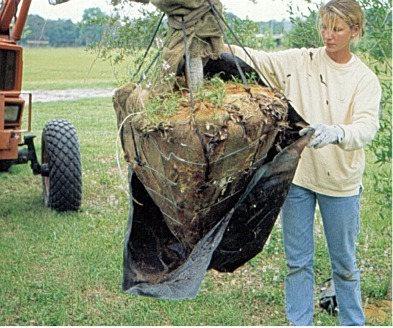
Some natural monopolies are created by the nature of the product.  Some products are very perishable.  Raspberries are fragile.  The root-balls of large shade trees are both heavy and fragile.    Iron ore, coal and limestone are heavy and bulky. Children don't always transport well.

Consequently, fertile soil near sophisticated populations are wonderful places for growing tender, gourmet foods.  Tracts of land that will be subdivided in 8-to-15 years are wonderful places to establish nurseries for shade trees.  Pittsburgh was a great place to smelt iron.  And there is a need for daycares near employers, schools and in bedroom communities to minimize incremental travel with the wee-ones on board.

Image from HERE
Another form of natural monopoly involves intellectual property.  The bronze casting guild had the institutional knowledge of how to mix clay, sand and flour to make the molds.  They knew how to bake the mold to drive out moisture before pouring the molten metal.  They knew how to mix different base metals to produce alloys with the desired characteristics.  It was simply more efficient to go to the bronze caster for your belt buckles and spear points than to try to reinvent that knowledge on your own.  This is less of a factor than it used to be as we have a much better understanding of the science of reverse-engineering.

A third form of natural monopoly occurs when a single business is able to saturate the market.  A town may be large enough to support one florist.  A second florist would cause both to fail unless the second florist was subsidized by outside resources.


Image from HERE

For reasons that are difficult to understand, bars and churches seem to be immune to the saturation effect.  It may be that sinners find solace in the fact that we are sharing the same laundry basket with the same kind of dirty laundry.

Image from HERE

A fourth kind of monopoly involves breaking into a family business. One might think one could marry into "family".  However, it did not do Carlo Rizzi or Saddam Hussein's sons-in-law any good.

Yes, I am a drug dealer

That would be Oxytocin, not Oxycontin.  Image from Wikipedia

One of the remarkable differences between dogs and wolves is their burning need for human interactions.  Specifically, they need to be petted.  Can anybody doubt that dogs are addicted to the Oxytocin rush released by cuddling?

Zeus in nominally Kubota's dog.  Kubota is a busy young man and I am an old, retired guy.  I have become Zeus's "main man" for his Oxytocin fix.  Good luck trying to type on the laptop in the morning.  His nose goes under it and it flips off onto the floor. "Pet me.  Pet me.  PET ME!!"  Drink coffee at your own risk.

Drug addiction: Never a pretty sight.

Another thought


I wonder if anybody has every considered using the filling found in Little Debbies as an embalming fluid.  It has the shelf life of Egyptian royalty and a flesh-like luminescence. 

Then people would not be perjuring themselves when they eulogized the deceased as a sweet, old man (or woman). 

I wonder if it is too late for me to write that into my will?