Some of my readers share my addiction to sending small objects out-bound at high rates of speed. And no, I don't mean hitting golf balls.
Smokeless powder is one of the components used to reload ammo. Supplies of smokeless powder have been spotty.
hi-techammo has CSB-1 on sale, four pounds for $80.
Scroll about half way down THIS page. Shipping and HazMat charges apply.
More information about CSB-1 powder HERE.
hi-techammo advises the use of Hodgdon Universal loading data for CSB-1. Universal burn rate is between Alliant Unique and Alliant Power Pistol.
Also, Graf's has Re-15, limit four pounds.
http://www.grafs.com/retail/catalog/category/categoryId/3512
Good hunting!
Monday, June 23, 2014

Birds and Black Walnuts
Birds
I have a goodly number of berries that are at peak ripeness right now: Mulberries (Morus), Juneberries (Amelanchier) and Cherries (Prunus). These berries are irresistible to birds and they make the trees jiggle and shake as they jockey around the crown spearing the ripest fruit.
I once visited a restaurant that was landscaped with a half dozen Juneberry trees that were completely loaded with strings of perfectly ripe fruit. My birds consume the fruit well before it is ripe. A single ripe fruit is a rarity, much less clusters of them.
Much to the dismay of my daughters, I took advantage of the wait-time to eat a few handfuls of fruit. It was a rare treat for me. Juneberries are especially delicious if you completely grind the fruit with your molars. The seeds have a unique almond taste.
The restaurant was near O'Hare airport. I am mystified by the lack of birds. House cats? Toxins? Deliberate control due to the proximity of the airport? Noise? How can humans live in a place that is so inhospitable that even sparrows and starlings cannot or will not live there?
Orioles
 |
| Picture from HERE |
I saw my first Baltimore Oriole this morning. Orioles are one of the last migratory birds to arrive in the North. They are fruit eaters and apparently wait for the first fruits to ripen. The certainly look like tropical birds!
Nearly all birds feed their young a diet heavy in bugs. Bugs supply the protein and fats needed by the growing young. It may be that the only reason Orioles leave the warmer regions is that there is too much competition for the bugs they need to feed their young.
I saw the Oriole as I was walking down my driveway to get the mail. He/she was flying toward the mulberry tree beside the drive and flared when he saw me. I got a nice look at his breast.
Black Walnuts
I grafted the last of my Black Walnuts for this year. Black Walnuts are reliable growers for me.
Mrs ERJ is not as happy with Black Walnuts as I am. She remembers the first few gardens we had as a married couple. There was a Black Walnut tree on the neighbor's property. That tree killed tomato plants. The angry-making part was that the tomato would thrive when first put in the ground, only to wilt and die shortly before the first tomato ripened. The broccoli was made of sterner stuff. They lived but the stunted heads did not taste very good.
My property has a wealth of walnut seedlings. Some I planted. Most are naturally occurring.
About 8 years ago I bought some scionwood from a gentleman who was selling on eBay. He shipped me three varieties of scionwood: Emma K, Sparrow and Drake. I had heard of the first two and they are highly rated by many walnut growers. I had never heard of "Drake". I was able to coax one graft each of Emma K and Sparrow. I had many, many takes of Drake. Consequently, I had an ample supply of Drake scionwood as those grafts grew.
 |
| Drake and Sparrow are near the head of the class. Emma K is back-in-the-pack. One study, one location. Data from Reid, Coggeshall and Hunt |
As time has gone by more information has been scanned into the internet. This article not only mentions Drake but mentions it in a favorable light. Drake produced the most pounds of nut meats per tree of the 21 cultivars tested in Chetopa, Kansas. It is reassuring to learn that Drake is not a complete dog.
I still intend to graft more Emma K and Sparrow. Emma K pollen shed is optimum for pollinating most other walnuts. Sparrow is a heavy producing walnut that cracks out well and has good resistance to leaf diseases.
Gratuitous Eye Candy

 |
 |
| Sparrow is impressive for its thin shell, thin husk, heavy production and overall foliage health. It is notable that Sparrow is the most "renamed" Black Walnut cultivar. Whether accidental or intentional, more nurseryman have claimed Sparrow as their own work than any other Black Walnut. |
All photos from HERE.
One of the breeding goals that will support increased production of salable nut meats is to reduce the size of the walnut husk. That will reduce the metabolic resources that are diverted to growing a non-valued-added product.
This graph shows the actual nut volume (meat + shell) divided by the total nut volume (meat + shell + husk) for a few, select cultivars.

Sunday, June 22, 2014
Man from Snowy River
Man from Snowy River is an outstanding movie. And before the movie there was a poem. It was written by Banjo Paterson and first published in 1890.
There was movement at the station, for the word had passed around
That the colt from old Regret had got away,
And had joined the wild bush horses - he was worth a thousand pound,
So all the cracks had gathered to the fray.
All the tried and noted riders from the stations near and far
Had mustered at the homestead overnight,
For the bushmen love hard riding where the wild bush horses are,
And the stockhorse snuffs the battle with delight.
There was Harrison, who made his pile when Pardon won the cup,
The old man with his hair as white as snow
But few could ride beside him when his blood was fairly up -
He would go wherever horse and man could go.
And Clancy of the Overflow came down to lend a hand,
No better horseman ever held the reins;
For never horse could throw him while the saddle girths would stand,
He learnt to ride while droving on the plains.
And one was there, a stripling on a small and weedy beast,
He was something like a racehorse undersized,
With a touch of Timor pony - three parts thoroughbred at least -
And such as are by mountain horsemen prized.
He was hard and tough and wiry - just the sort that won't say die -
There was courage in his quick impatient tread;
And he bore the badge of gameness in his bright and fiery eye,
And the proud and lofty carriage of his head.
But still so slight and weedy, one would doubt his power to stay,
And the old man said, "That horse will never do
For a long a tiring gallop - lad, you'd better stop away,
Those hills are far too rough for such as you."
So he waited sad and wistful - only Clancy stood his friend -
"I think we ought to let him come," he said;
"I warrant he'll be with us when he's wanted at the end,
For both his horse and he are mountain bred.
"He hails from Snowy River, up by Kosciusko's side,
Where the hills are twice as steep and twice as rough,
Where a horse's hoofs strike firelight from the flint stones every stride,
The man that holds his own is good enough.
And the Snowy River riders on the mountains make their home,
Where the river runs those giant hills between;
I have seen full many horsemen since I first commenced to roam,
But nowhere yet such horsemen have I seen."
So he went - they found the horses by the big mimosa clump -
They raced away towards the mountain's brow,
And the old man gave his orders, "Boys, go at them from the jump,
No use to try for fancy riding now.
And, Clancy, you must wheel them, try and wheel them to the right.
Ride boldly, lad, and never fear the spills,
For never yet was rider that could keep the mob in sight,
If once they gain the shelter of those hills."
So Clancy rode to wheel them - he was racing on the wing
Where the best and boldest riders take their place,
And he raced his stockhorse past them, and he made the ranges ring
With the stockwhip, as he met them face to face.
Then they halted for a moment, while he swung the dreaded lash,
But they saw their well-loved mountain full in view,
And they charged beneath the stockwhip with a sharp and sudden dash,
And off into the mountain scrub they flew.
Then fast the horsemen followed, where the gorges deep and black
Resounded to the thunder of their tread,
And the stockwhips woke the echoes, and they fiercely answered back
From cliffs and crags that beetled overhead.
And upward, ever upward, the wild horses held their way,
Where mountain ash and kurrajong grew wide;
And the old man muttered fiercely, "We may bid the mob good day,
No man can hold them down the other side."
When they reached the mountain's summit, even Clancy took a pull,
It well might make the boldest hold their breath,
The wild hop scrub grew thickly, and the hidden ground was full
Of wombat holes, and any slip was death.
But the man from Snowy River let the pony have his head,
And he swung his stockwhip round and gave a cheer,
And he raced him down the mountain like a torrent down its bed,
While the others stood and watched in very fear.
He sent the flint stones flying, but the pony kept his feet,
He cleared the fallen timber in his stride,
And the man from Snowy River never shifted in his seat -
It was grand to see that mountain horseman ride.
Through the stringybarks and saplings, on the rough and broken ground,
Down the hillside at a racing pace he went;
And he never drew the bridle till he landed safe and sound,
At the bottom of that terrible descent.
He was right among the horses as they climbed the further hill,
And the watchers on the mountain standing mute,
Saw him ply the stockwhip fiercely, he was right among them still,
As he raced across the clearing in pursuit.
Then they lost him for a moment, where two mountain gullies met
In the ranges, but a final glimpse reveals
On a dim and distant hillside the wild horses racing yet,
With the man from Snowy River at their heels.
And he ran them single-handed till their sides were white with foam.
He followed like a bloodhound on their track,
Till they halted cowed and beaten, then he turned their heads for home,
And alone and unassisted brought them back.
But his hardy mountain pony he could scarcely raise a trot,
He was blood from hip to shoulder from the spur;
But his pluck was still undaunted, and his courage fiery hot,
For never yet was mountain horse a cur.
And down by Kosciusko, where the pine-clad ridges raise
Their torn and rugged battlements on high,
Where the air is clear as crystal, and the white stars fairly blaze
At midnight in the cold and frosty sky,
And where around The Overflow the reed beds sweep and sway
To the breezes, and the rolling plains are wide,
The man from Snowy River is a household word today,
And the stockmen tell the story of his ride...
Poetry is as good as money. In fact:
Darned classy of those Australians.
There was movement at the station, for the word had passed around
That the colt from old Regret had got away,
And had joined the wild bush horses - he was worth a thousand pound,
So all the cracks had gathered to the fray.
All the tried and noted riders from the stations near and far
Had mustered at the homestead overnight,
For the bushmen love hard riding where the wild bush horses are,
And the stockhorse snuffs the battle with delight.
There was Harrison, who made his pile when Pardon won the cup,
The old man with his hair as white as snow
But few could ride beside him when his blood was fairly up -
He would go wherever horse and man could go.
And Clancy of the Overflow came down to lend a hand,
No better horseman ever held the reins;
For never horse could throw him while the saddle girths would stand,
He learnt to ride while droving on the plains.
And one was there, a stripling on a small and weedy beast,
He was something like a racehorse undersized,
With a touch of Timor pony - three parts thoroughbred at least -
And such as are by mountain horsemen prized.
He was hard and tough and wiry - just the sort that won't say die -
There was courage in his quick impatient tread;
And he bore the badge of gameness in his bright and fiery eye,
And the proud and lofty carriage of his head.
But still so slight and weedy, one would doubt his power to stay,
And the old man said, "That horse will never do
For a long a tiring gallop - lad, you'd better stop away,
Those hills are far too rough for such as you."
So he waited sad and wistful - only Clancy stood his friend -
"I think we ought to let him come," he said;
"I warrant he'll be with us when he's wanted at the end,
For both his horse and he are mountain bred.
"He hails from Snowy River, up by Kosciusko's side,
Where the hills are twice as steep and twice as rough,
Where a horse's hoofs strike firelight from the flint stones every stride,
The man that holds his own is good enough.
And the Snowy River riders on the mountains make their home,
Where the river runs those giant hills between;
I have seen full many horsemen since I first commenced to roam,
But nowhere yet such horsemen have I seen."
So he went - they found the horses by the big mimosa clump -
They raced away towards the mountain's brow,
And the old man gave his orders, "Boys, go at them from the jump,
No use to try for fancy riding now.
And, Clancy, you must wheel them, try and wheel them to the right.
Ride boldly, lad, and never fear the spills,
For never yet was rider that could keep the mob in sight,
If once they gain the shelter of those hills."
So Clancy rode to wheel them - he was racing on the wing
Where the best and boldest riders take their place,
And he raced his stockhorse past them, and he made the ranges ring
With the stockwhip, as he met them face to face.
Then they halted for a moment, while he swung the dreaded lash,
But they saw their well-loved mountain full in view,
And they charged beneath the stockwhip with a sharp and sudden dash,
And off into the mountain scrub they flew.
Then fast the horsemen followed, where the gorges deep and black
Resounded to the thunder of their tread,
And the stockwhips woke the echoes, and they fiercely answered back
From cliffs and crags that beetled overhead.
And upward, ever upward, the wild horses held their way,
Where mountain ash and kurrajong grew wide;
And the old man muttered fiercely, "We may bid the mob good day,
No man can hold them down the other side."
When they reached the mountain's summit, even Clancy took a pull,
It well might make the boldest hold their breath,
The wild hop scrub grew thickly, and the hidden ground was full
Of wombat holes, and any slip was death.
But the man from Snowy River let the pony have his head,
And he swung his stockwhip round and gave a cheer,
And he raced him down the mountain like a torrent down its bed,
While the others stood and watched in very fear.
He sent the flint stones flying, but the pony kept his feet,
He cleared the fallen timber in his stride,
And the man from Snowy River never shifted in his seat -
It was grand to see that mountain horseman ride.
Through the stringybarks and saplings, on the rough and broken ground,
Down the hillside at a racing pace he went;
And he never drew the bridle till he landed safe and sound,
At the bottom of that terrible descent.
He was right among the horses as they climbed the further hill,
And the watchers on the mountain standing mute,
Saw him ply the stockwhip fiercely, he was right among them still,
As he raced across the clearing in pursuit.
Then they lost him for a moment, where two mountain gullies met
In the ranges, but a final glimpse reveals
On a dim and distant hillside the wild horses racing yet,
With the man from Snowy River at their heels.
And he ran them single-handed till their sides were white with foam.
He followed like a bloodhound on their track,
Till they halted cowed and beaten, then he turned their heads for home,
And alone and unassisted brought them back.
But his hardy mountain pony he could scarcely raise a trot,
He was blood from hip to shoulder from the spur;
But his pluck was still undaunted, and his courage fiery hot,
For never yet was mountain horse a cur.
And down by Kosciusko, where the pine-clad ridges raise
Their torn and rugged battlements on high,
Where the air is clear as crystal, and the white stars fairly blaze
At midnight in the cold and frosty sky,
And where around The Overflow the reed beds sweep and sway
To the breezes, and the rolling plains are wide,
The man from Snowy River is a household word today,
And the stockmen tell the story of his ride...
Poetry is as good as money. In fact:
A. B. "Banjo" Paterson and "The Man From Snowy River" poem are commemorated on the Australian 10 dollar note [1]. The full text of the poem is printed several times in microprint as one of the note's security devices. (Link)
Darned classy of those Australians.
Saturday, June 21, 2014
Iraqi Politics
Population Growth
 |
| Data from HERE. Many "peak oil" writers use the 1900 census figures as a reasonable proxy for the carrying capacity of a country deprived of the agricultural and logistical benefits of modern technology. If so, Iraq overshot its carrying capacity by a factor of 15. |
Food Security
From the UN Office for the coordination of Humanitarian Affairs (Link)
Domestic agricultural production - already affected by reduced rainfall (2009) - has also been hit by a lack of government support and lax controls on cheap food imports, with which farmers cannot compete in some cases, she said.
On 31 August, the UN Food and Agriculture Organization (FAO) said Iraq had its worst cereal harvest in a decade and that its wheat harvest was set to fall to one million tonnes, from an average of 3.5 million tonnes per annum over the past decade. Domestic rice production also fell from an average 500,000 tons a year to an estimated 250,000 tons this year.
Iraq imports more than 80 percent of its food needs, al-Mousawi told IRIN.
It must be noted that it is difficult to work in the fields when under rifle fire or when you fear that you will come back to your home only to find that it has been pillaged by the other side.
Religion
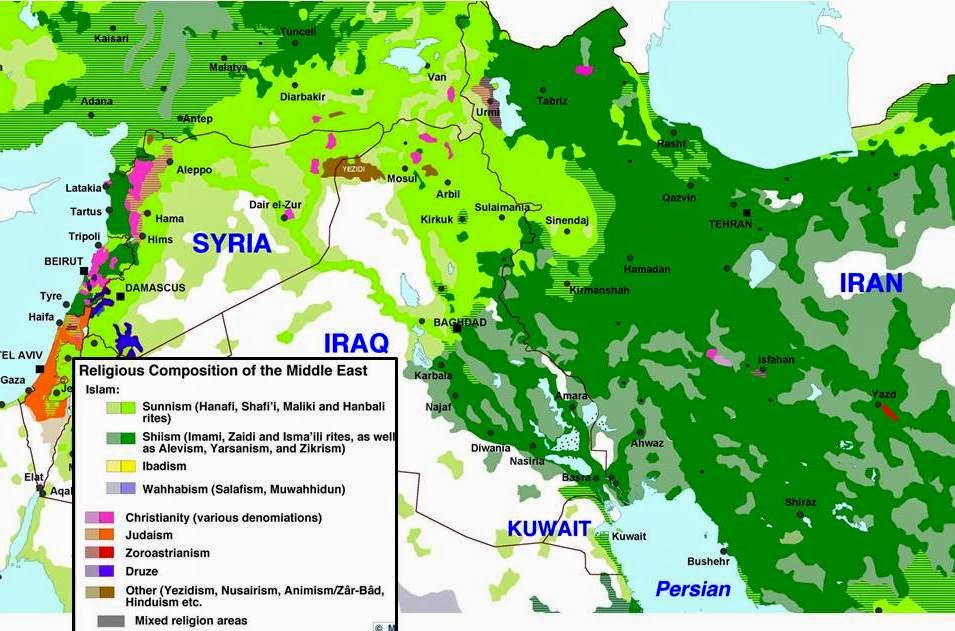 |
| Map from HERE. Corner of Iraq nipped by key is desert and is very sparsely populated. |
Communication: Ontogeny....
Mrs ERJ and I took a stroll this morning. It is a great way to start a morning. We chit-chat, plan, talk about kids, talk about or frustrations. Many of our best talks occur during these walks.
Kubota is going into 9th grade next year and it is a great relief. Eaton Rapids has Middle School for 6th, 7th, and 8th graders. High School is comprised of 9th, 10th, 11th and 12th grade students.
Middle School sucks.
One reason, I believe, that Middle School is particularly harrowing is because the kids are pushing away from their family and joining little cliques (Hitler Youth were Middle School age for a reason).
Quick, what has 16 arms, 16 legs, 8 heads and one brain?
Answer: A table of seventh graders.
Running in parallel with that social development is the development in communication. Young children are extremely literal communicators. They take every word at it exact, literal meaning...unless, of course, they spend a lot of time with Grandpa.
The next step in communication is "sarcasm" where there is still little nuance. The message is the exact opposite of the literal meaning. Sarcasm is decoded via the not-the-least-bit-subtle tone, facial expression and body language. Sarcasm also fits this stage because it is integral to pecking order/dominance sorting.
Many people wish there was a special font dedicated to sarcasm because it is difficult to inform readers of social media when one starts to use sarcasm and feelings are frequently hurt as a result. I try to avoid sarcasm because it tells the listener that you are functioning at the cognitive/emotional level of a 6th grade girl. Few bosses have appreciated me after I called this to their attention.
Most of Kubota's clique have graduated from sarcasm and are now lying. Finally, some subtly and nuance. Mrs ERJ is quite disgusted with the bunch of them. I take it in stride. Having a well calibrated BS indicator is a valuable thing. It is all about practicing decoding.
There is one kid in Kubota's band-of-brothers who Mrs ERJ is most concerned about. He is a facile, fluent and enthusiastic liar. His mother trained him. She directed him to tell the waitress that he was 12, even when he was 13, 14 and now 15. She gets the kiddy discount.
He is a pretty big boy. I have seen him dunk a basket ball. His mother still has him lying to waitresses. She is quite distressed that he lies to her and she is absolutely baffled as to why she cannot trust him.
We reap what we sow.
My kids are not perfect. Retiring has given me more time for introspection and I see, more and more, the hand I had in creating some of their imperfections. I wish I had such clarity of vision when I was parenting. It is certainly easier to see in other people's kids.
Kubota is going into 9th grade next year and it is a great relief. Eaton Rapids has Middle School for 6th, 7th, and 8th graders. High School is comprised of 9th, 10th, 11th and 12th grade students.
Middle School sucks.
One reason, I believe, that Middle School is particularly harrowing is because the kids are pushing away from their family and joining little cliques (Hitler Youth were Middle School age for a reason).
Quick, what has 16 arms, 16 legs, 8 heads and one brain?
Answer: A table of seventh graders.
Running in parallel with that social development is the development in communication. Young children are extremely literal communicators. They take every word at it exact, literal meaning...unless, of course, they spend a lot of time with Grandpa.
The next step in communication is "sarcasm" where there is still little nuance. The message is the exact opposite of the literal meaning. Sarcasm is decoded via the not-the-least-bit-subtle tone, facial expression and body language. Sarcasm also fits this stage because it is integral to pecking order/dominance sorting.
Many people wish there was a special font dedicated to sarcasm because it is difficult to inform readers of social media when one starts to use sarcasm and feelings are frequently hurt as a result. I try to avoid sarcasm because it tells the listener that you are functioning at the cognitive/emotional level of a 6th grade girl. Few bosses have appreciated me after I called this to their attention.
Most of Kubota's clique have graduated from sarcasm and are now lying. Finally, some subtly and nuance. Mrs ERJ is quite disgusted with the bunch of them. I take it in stride. Having a well calibrated BS indicator is a valuable thing. It is all about practicing decoding.
There is one kid in Kubota's band-of-brothers who Mrs ERJ is most concerned about. He is a facile, fluent and enthusiastic liar. His mother trained him. She directed him to tell the waitress that he was 12, even when he was 13, 14 and now 15. She gets the kiddy discount.
He is a pretty big boy. I have seen him dunk a basket ball. His mother still has him lying to waitresses. She is quite distressed that he lies to her and she is absolutely baffled as to why she cannot trust him.
We reap what we sow.
My kids are not perfect. Retiring has given me more time for introspection and I see, more and more, the hand I had in creating some of their imperfections. I wish I had such clarity of vision when I was parenting. It is certainly easier to see in other people's kids.
Friday, June 20, 2014
Dangerous Intersections
 |
| Casualties distinguished by gross amounts of generalized trauma. This intersection occurs with depressing regularity in all human organizations with populations greater than 1. |
 |
| We have all worked with people like this. Casualties distinguished by penetrating trauma in the rear thoracic region. Wounds occur as multiple punctures. |
Thursday, June 19, 2014
Carbon-cycling in Lakes and Streams (long)
One of the things that aggravate me are scientists who dummy-down or over-extrapolate their findings to make them more "reportable" in the press.
This story about the carbon source for the food chain in a Canadian lake severely impacted by acid rain.
Carbon is "dated" by the ratio of the isotopes in the sample. "Dated" is in quotes because it is really a measure of when the sample stopped having free-and-rapid exchange with atmospheric carbon (CO2).
There are four generic sources of carbon that make their way into surface water.
The first source is from spring water. Spring water is highly influenced by the rocks and aggregate it percolated through on the way to the surface. The water will dissolve various organic materials as the rain and snow-melt works its way down through the upper soil levels. Those materials tend to make the water slightly acidic and are given the umbrella description of "humic acids".
The low pH (acidic) water then diffuses through the geographic strata on the way to the spring. If it percolates through sedimentary rock....especially limestone...it picks up large amounts of carbonate (usually paired with Ca++ ions, but sometimes Mg++) as it dissolves some of the limestone or shells embedded within the sedimentary rock. Note that the "date" of the carbon sequestered in the carbonate ions is "ancient". The water becomes alkaline as it absorbs these minerals and is highly buffered, i.e., highly resistant to further changes in pH.
Sidebar: Runoff in arid regions is often alkaline simply due to salts in the soil. Surface runoff in arid regions does not need to percolate through the ground to become alkaline and highly buffered.
The second source of carbon is from the exchange between the atmosphere and the surface of the water. Atmospheric carbon is "young" carbon. Water that is higher pH (alkaline) will absorb additional carbon dioxide from the air. That is one reason why "limestone" trout streams are so fertile. There is a super abundance of dissolved CO2 supporting photosynthesis.
Larger lakes and lakes that are more exposed to wind will have more aggressive exchange with the atmosphere due to the churning of the surface and the mixing effect bringing deeper water up to the surface.
The third source of carbon is man-made waste. One of the metrics of wastewater (which is how much of this carbon enters the system) is Biological Oxygen Demand. The organic wastes require oxygen to decompose. The decaying waste is more efficient at scavenging oxygen than fish. The fish die. Additional man-made sources of are of agricultural origin. Cows will poop into streams or rain will wash top soil and poop into streams. These carbon sources are fairly "young".
The fourth source of carbon is due to surface vegetation falling or blowing into lakes and streams.
The conventional wisdom in Southern Michigan is to minimize the surface vegetation mechanism. According to Don Garlock, formerly a limnology specialist at MSU, everybody wants to plant weeping willows next to their pond. It is huge part of most pond owner's mental image of how ponds ought to look. It may be a side-effect of eating from blue-and-white tableware.
Southern Michigan has sedimentary geology, high human and agricultural activity. The surface water is inherently fertile. In the autumn, the leaves fall into the pond and between the decay of the seaweed and the additional leaves, the Biological Oxygen Demand causes a fish-kill. The fish kill is worse the longer the ice covers the water and separates it from atmospheric O2.
Carbon is a necessary element, but too much of a good thing is always bad....unless it is good whiskey 8-)
From wikipedia
To paraphrase, the lake basin was sterilized with acid rain (sulfuric acid) from the nickel smelting operation. The water currently running into the basin has nutrient content identical to rain water running off a granite grave stone. The water running into the basin is acidic and absorbs virtually no CO2 on the way in. The low pH of the water also makes exchange via the surface problematic. There is no agriculture in the region and wastewater is disposed of appropriately.
Well of course leaves blowing into the lake are major source of carbon. Daisy Lake is a special case.
Back to the original article.
And that is not to bang this article in particular. Many other news outlets (like BBC) picked up the story and it was streamlined for mass consumption by pruning out all of the ifs, ands, buts that suggested that throwing a bunch of organic trash into the water might not be universally applicable.
Snags are large limbs, stumps, roots and tree trunks that are partially or fully submerged. There is much research that documents that snags are a critical component of the underwater habitat. They are of particular importance for young fish. They provide cover that is critical for evading predation. They also supply substrate and habitat for all of those tiny little critters that are food sources for those baby fish.
It is difficult to see how the Daisy Lake research was able to untangle the effects of snags from leaves blowing in because the presence of snags is highly correlated with trees on the banks.
This story about the carbon source for the food chain in a Canadian lake severely impacted by acid rain.
Background
Carbon is "dated" by the ratio of the isotopes in the sample. "Dated" is in quotes because it is really a measure of when the sample stopped having free-and-rapid exchange with atmospheric carbon (CO2).
There are four generic sources of carbon that make their way into surface water.
The first source is from spring water. Spring water is highly influenced by the rocks and aggregate it percolated through on the way to the surface. The water will dissolve various organic materials as the rain and snow-melt works its way down through the upper soil levels. Those materials tend to make the water slightly acidic and are given the umbrella description of "humic acids".
The low pH (acidic) water then diffuses through the geographic strata on the way to the spring. If it percolates through sedimentary rock....especially limestone...it picks up large amounts of carbonate (usually paired with Ca++ ions, but sometimes Mg++) as it dissolves some of the limestone or shells embedded within the sedimentary rock. Note that the "date" of the carbon sequestered in the carbonate ions is "ancient". The water becomes alkaline as it absorbs these minerals and is highly buffered, i.e., highly resistant to further changes in pH.
Sidebar: Runoff in arid regions is often alkaline simply due to salts in the soil. Surface runoff in arid regions does not need to percolate through the ground to become alkaline and highly buffered.
The second source of carbon is from the exchange between the atmosphere and the surface of the water. Atmospheric carbon is "young" carbon. Water that is higher pH (alkaline) will absorb additional carbon dioxide from the air. That is one reason why "limestone" trout streams are so fertile. There is a super abundance of dissolved CO2 supporting photosynthesis.
Larger lakes and lakes that are more exposed to wind will have more aggressive exchange with the atmosphere due to the churning of the surface and the mixing effect bringing deeper water up to the surface.
The third source of carbon is man-made waste. One of the metrics of wastewater (which is how much of this carbon enters the system) is Biological Oxygen Demand. The organic wastes require oxygen to decompose. The decaying waste is more efficient at scavenging oxygen than fish. The fish die. Additional man-made sources of are of agricultural origin. Cows will poop into streams or rain will wash top soil and poop into streams. These carbon sources are fairly "young".
The fourth source of carbon is due to surface vegetation falling or blowing into lakes and streams.
The conventional wisdom in Southern Michigan is to minimize the surface vegetation mechanism. According to Don Garlock, formerly a limnology specialist at MSU, everybody wants to plant weeping willows next to their pond. It is huge part of most pond owner's mental image of how ponds ought to look. It may be a side-effect of eating from blue-and-white tableware.
Southern Michigan has sedimentary geology, high human and agricultural activity. The surface water is inherently fertile. In the autumn, the leaves fall into the pond and between the decay of the seaweed and the additional leaves, the Biological Oxygen Demand causes a fish-kill. The fish kill is worse the longer the ice covers the water and separates it from atmospheric O2.
 |
| Picture from HERE. Aerators on catfish ponds are a common sight in much of the South. O2 availability is a greater limitation to fish survival than food availability in eutrophic waters. |
Carbon is a necessary element, but too much of a good thing is always bad....unless it is good whiskey 8-)
Daisy Lake, Ontario
From wikipedia
Daisy Lake Uplands Provincial Park is a provincial park in the Canadian province of Ontario. Surrounding Daisy Lake in the city of Greater Sudbury, the park serves to protect a recovering ecosystem scarred by pollution from the city's mining industry; one of the industry's first roasting beds in the region was located just east of the park boundaries.[1] The park's ecosystem includes white birch trees, grasses, sedges, rock barrens and bog vegetation. Link to Source
The current surface expression of the (Canadian) Shield is one of very thin soil lying on top of the bedrock, with many bare outcrops. This arrangement was caused by severe glaciation during the ice age, which covered the Shield and scraped the rock clean.
The lowlands of the Canadian Shield have a very dense soil that is not suitable for forestation, but it also contains many marshes and bogs. The rest of the region has coarse soil that does not retain moisture well... Link to Source
To paraphrase, the lake basin was sterilized with acid rain (sulfuric acid) from the nickel smelting operation. The water currently running into the basin has nutrient content identical to rain water running off a granite grave stone. The water running into the basin is acidic and absorbs virtually no CO2 on the way in. The low pH of the water also makes exchange via the surface problematic. There is no agriculture in the region and wastewater is disposed of appropriately.
Well of course leaves blowing into the lake are major source of carbon. Daisy Lake is a special case.
Extrapolating
Back to the original article.
"It's
estimated that freshwater fishes make up more than 6 per cent of the
world's annual animal protein supplies for humans – and the major and
often only source of animal protein for low income families across
Bangladesh, Indonesia and the Philippines," added Tanentzap.
"While we've only studied boreal regions, these results are likely to bear out globally. Forest loss is damaging aquatic food chains of which many humans are a part."
- See more at: http://www.thefishsite.com/fishnews/23391/forest-run-off-creates-larger-stronger-fish#sthash.IQDTIdr9.dpuf
"While we've only studied boreal regions, these results are likely to bear out globally. Forest loss is damaging aquatic food chains of which many humans are a part."
- See more at: http://www.thefishsite.com/fishnews/23391/forest-run-off-creates-larger-stronger-fish#sthash.IQDTIdr9.dpuf
"It's
estimated that freshwater fishes make up more than 6 per cent of the
world's annual animal protein supplies for humans – and the major and
often only source of animal protein for low income families across
Bangladesh, Indonesia and the Philippines," added Tanentzap.
"While we've only studied boreal regions, these results are likely to bear out globally. Forest loss is damaging aquatic food chains of which many humans are a part."
- See more at: http://www.thefishsite.com/fishnews/23391/forest-run-off-creates-larger-stronger-fish#sthash.IQDTIdr9.dpuf
"While we've only studied boreal regions, these results are likely to bear out globally. Forest loss is damaging aquatic food chains of which many humans are a part."
- See more at: http://www.thefishsite.com/fishnews/23391/forest-run-off-creates-larger-stronger-fish#sthash.IQDTIdr9.dpuf
"It's
estimated that freshwater fishes make up more than 6 per cent of the
world's annual animal protein supplies for humans – and the major and
often only source of animal protein for low income families across
Bangladesh, Indonesia and the Philippines," added Tanentzap.
"While we've only studied boreal regions, these results are likely to bear out globally. Forest loss is damaging aquatic food chains of which many humans are a part."
- See more at: http://www.thefishsite.com/fishnews/23391/forest-run-off-creates-larger-stronger-fish#sthash.IQDTIdr9.dpuf
"While we've only studied boreal regions, these results are likely to bear out globally. Forest loss is damaging aquatic food chains of which many humans are a part."
- See more at: http://www.thefishsite.com/fishnews/23391/forest-run-off-creates-larger-stronger-fish#sthash.IQDTIdr9.dpuf
"It's estimated that freshwater fishes make up more than 6 per cent of the world's annual animal protein supplies for humans – and the major and often only source of animal protein for low income families across Bangladesh, Indonesia and the Philippines," added Tanentzap.
"While we've only studied boreal regions, these results are likely to bear out globally. Forest loss is damaging aquatic food chains of which many humans are a part."
- See more at: http://www.thefishsite.com/fishnews/23391/forest-run-off-creates-larger-stronger-fish#sthash.IQDTIdr9.dpuf"It's estimated that freshwater fishes make up more than 6 per cent of the world's annual animal protein supplies for humans – and the major and often only source of animal protein for low income families across Bangladesh, Indonesia and the Philippines," added Tanentzap.
"While we've only studied boreal regions, these results are likely to bear out globally. Forest loss is damaging aquatic food chains of which many humans are a part."
- See more at: http://www.thefishsite.com/fishnews/23391/forest-run-off-creates-larger-stronger-fish#sthash.IQDTIdr9.dpuf
"It's estimated that freshwater fishes make up more than 6 per cent of the world's annual animal protein supplies for humans – and the major and often only source of animal protein for low income families across Bangladesh, Indonesia and the Philippines," added Tanentzap.
"While we've only studied boreal regions, these results are likely to bear out globally. Forest loss is damaging aquatic food chains of which many humans are a part"
And that is not to bang this article in particular. Many other news outlets (like BBC) picked up the story and it was streamlined for mass consumption by pruning out all of the ifs, ands, buts that suggested that throwing a bunch of organic trash into the water might not be universally applicable.
A final note
Snags are large limbs, stumps, roots and tree trunks that are partially or fully submerged. There is much research that documents that snags are a critical component of the underwater habitat. They are of particular importance for young fish. They provide cover that is critical for evading predation. They also supply substrate and habitat for all of those tiny little critters that are food sources for those baby fish.
It is difficult to see how the Daisy Lake research was able to untangle the effects of snags from leaves blowing in because the presence of snags is highly correlated with trees on the banks.
---End of Rant---
t's estimated that freshwater fishes make up more than 6 per cent of the world's annual animal protein supplies for humans – and the major and often only source of animal protein for low income families across Bangladesh, Indonesia and the Philippines," added Tanentzap. - See more at: http://www.thefishsite.com/fishnews/23391/forest-run-off-creates-larger-stronger-fish#sthash.IQDTIdr9.dpuf
Subscribe to:
Posts (Atom)