Two packages into the mail.
One to Jimmi in Ludington, returning a beach towel that ended up in the Cavalier. There may also be a belated birthday present or two.
One to R in Baton Rouge. Mostly some fleece jackets and such. She plans to attend a Turkey Shoot next weekend and wants to be able to dress for the weather. Looks like a fun time and I wish I could go.
Mrs ERJ commented that the dogs coming into the house with too much dust in their coats. Kubota and I rototilled the dog-run, raked it out and spread shredded hardwood mulch. It looks nice but the mulch is not nearly thick enough. It looks like I need another two yards. I learned that shredded pallets (oak) are free so I will investigate that source of mulch. We also put fresh wood shavings in the big dog house after raking out the remnants of last year's straw. I think Mrs ERJ will be pleased.
Then I went and gave blood. I am currently replacing with another red fluid. No, it is not Dexron III.
Four chicken quarters are in the oven at 325, coated with a mix of corn meal, salt, brown sugar, black pepper and garlic. Mrs ERJ and Belladonna are expected home in 45 minutes. I will "let" them pick the vegetable.
Encourage one another and build one another up. Pray without ceasing. Test everything. Keep what is good. Avoid all evil. -1 Thess 5:11,17,21,22
Monday, September 23, 2013
Sunday, September 22, 2013
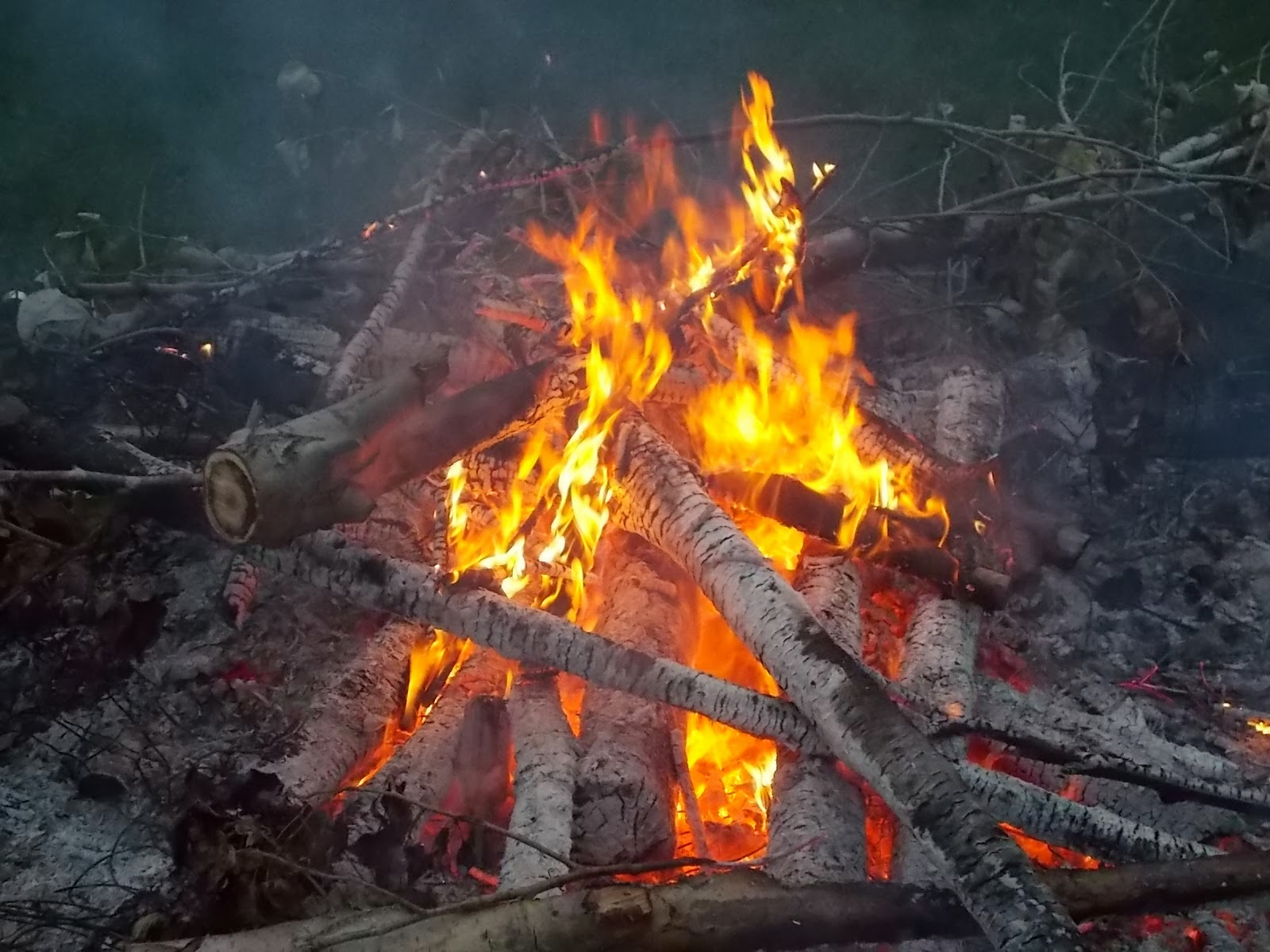
Campfires
Campfires fulfill many primal needs. The need for warmth. The need for safety. The need for human connection.
It is a rare person who has not revealed more via a text message, email or social media than was prudent. The flicker of the 60Hz screen replaced the flicker of burning wood for most of us. Most of the time.
Cooler weather is upon us. Yesterday, I went for a six mile run and pushed too hard. Today, I hurt.
Burning the pile of trash wood was a task I felt up to. Most of the wood is the same kind that Noah used for the Ark, Gopher wood. As in, throw an armload on the fire and Go-fer some more.
We used to have a Border Collie. Border Collies are hardwired with the instinct to stalk and control animals. They are able to manipulate flocks of sheep that outweigh them 500 times over by way of domination and intimidation. They stare.
Staring at an animal is a hostile action. It translates to: "You will be my dinner."
Somehow, the Northern European culture morphed staring, eye contact, with telling the truth.
But our bodies know differently.
It is easier to be intimate, to risk and to share when we do not have to look into another's eyes. It is easy to be intimate when we feel safe, when we are warm.
Campfires are the prototypical space of warmth, safety and intimacy. Our first arch-myths were forged in monosylabic grunts beside the fire, safe from the roaring lion...those same myths were retold by Homer and are retold by Hollywood today.
The flicker of a laptop or smartphone is a sad, pale substitute for the genuine article.
I lament for those who will never experience the real thing.
Saturday, September 21, 2013
A Scot's Dream
Word spread around town like wildfire.
Angus, the most stoic and dour of Scots was in the pub and crying.
Iain, a fine, brave lad stepped forward and volunteered to question Angus, a notable brawler. A crowd gathered outside the door.
"Angus, why are you tearring up? Do you have sometin in yourrr eye?" asked Iain.
"Nay, laddie. Tis worrse than that. Ya know me two Clydesdales, Billy and Ben?" said Angus.
"Aye, Angus. They be the two bonniest horses in the county."
"Well, laddie. They up and died on me." said Angus.
A collective gasp arose from the crowd assembled outside.
"NO!" exclaimed Iain. "Twatt a terrrrible shame."
"Tis worrrse than you know." said Angus. "Not only werrre they the two finest horses in the county, but I was training them not to eat 'n I'd a had em down to nothing in another week."
Substitute US economy for Clydesdale and Socialist for Scot.
Now you are crying too.
Angus, the most stoic and dour of Scots was in the pub and crying.
Iain, a fine, brave lad stepped forward and volunteered to question Angus, a notable brawler. A crowd gathered outside the door.
"Angus, why are you tearring up? Do you have sometin in yourrr eye?" asked Iain.
"Nay, laddie. Tis worrse than that. Ya know me two Clydesdales, Billy and Ben?" said Angus.
"Aye, Angus. They be the two bonniest horses in the county."
"Well, laddie. They up and died on me." said Angus.
A collective gasp arose from the crowd assembled outside.
"NO!" exclaimed Iain. "Twatt a terrrrible shame."
"Tis worrrse than you know." said Angus. "Not only werrre they the two finest horses in the county, but I was training them not to eat 'n I'd a had em down to nothing in another week."
Punchline
You think you heard the punchline but did not.Substitute US economy for Clydesdale and Socialist for Scot.
Now you are crying too.
Vice
One of the most fundamental, one can even say foundational, question at the start of any project is "How do you hold it?"
I coughed up the dough and bought a decent sized vice for Kubota's work bench. I expect that I will use it more than he does.
I have no idea why he insisted on painting the top of his bench red.
-Joe
I coughed up the dough and bought a decent sized vice for Kubota's work bench. I expect that I will use it more than he does.
| There is money in vice. It is what we call, "A New Pair-a-dime". |
-Joe
Friday, September 20, 2013
Self Love vs. Self Esteem
From Brigid, a fellow blogger at mausersandmuffins:
It is cliché that Eskimo have scores of words for snow. Snow is used for a multitude of structural and other life needs by the Eskimo. Snow-ice comes in a spectrum of graduations, each with varying suitability for each of those end uses. Hence the need to discriminate between fluffy new snow, granular older snow, stiff snow with the granules fused together, opaque ice with good impact properties and the clear ice that shatters easily. Eskimo are intimately familiar with each type of snow, its properties, its limitations and its suitability for substitution. They have a vocabulary that captures those distinctions because their lives depend upon that knowledge.
Unfortunately, we are not as careful with the terms self love and self esteem. They are as similar yet as different as water and food.
Self love is unconditional. It is the internalization of the unconditional love that we most often associate with our mothers. Our mothers proudly taped our creations to the refrigerator door no matter how ineptly they were executed. Self love is needed because even the best of us get kicked in the teeth, even the best of us don't always come in first. Self love tells us that we have innate worth independent from our accomplishments.
Self esteem is earned. It is the earned recognition that we internalize and is often associated with fathers. It is a little more nuanced than self love. It is also more politicized.
Self esteem is why our reach will always exceed our grasp. If self love allows us to believe we are OK even when we fail, self esteem allows us to hold our heads high because we know we tried our best. Our need for self esteem guarantees that our reach will always exceed our grasp and that we strive to get better.
If self esteem is modeled on the earned recognition that is wrestled from a tired dad, then dad is no longer expendable after donating his DNA. Dad cannot be replaced by a check or a village or a woman. The contention that self esteem is rooted in earning Dad's recognition and approval makes this definition of self esteem a non-starter in many circles.
Let us put political ideology aside and play with the idea.
If self love and self esteem are not interchangeable, then one will be left with a void, a hunger if one attempts to fill the one need with the other. It is trying to satisfy hunger with ice water. It may temporarily mask the pangs but they will come back in ever more insistent waves.
If the need for food is not met, then anything that is a close approximation will be pressed into service. Pets, cadavers, sawdust, motor oil, leather, paper, clay, mice....
The prevalence of gangs in inner cities is evidence that young people, especially young men, have a burning need for self esteem. They are denied the normal, healthy "Dad" source so they find other men who can knight them with a quest and earned recognition. Men who do not have the young man's best interests at heart.
Your dad may not have been an iron fisted man's man. He may not have been a fire breathing, steel eating specimen of manhood who walked in a billowing cloud of testosterone fumes. But he was a MAN. He went out into the adult world like a knight in the days of yore. He survived. He brought home the bacon.
Most families had measures of manliness. It may have been shooting hoops, or who could catch the most bluegills. It may have been playing Scrabble, shooting clay birds or arm wrestling. It could have been cracking hickory nuts with your fist, or how quick could you swap out a set of spark plugs. It was a way you could measure yourself against "the old man" and judge your readiness to go forth in the world. It was a great and notable day when you beat "the old man."
Our culture tried to substitute self love for self esteem and it failed. It is time to man up.
For my parents still allowed us room to make our own mistakes, to achieve on our own merit. They weren't the kind of parent that has their child ...(get) praise and accolades for pretty much showing up, further fostering the self absorbed entitlement that is your personal burden and their future failure.There is a school of thought that contends that much needless suffering results from the inability to discriminate between self love and self esteem.
It is cliché that Eskimo have scores of words for snow. Snow is used for a multitude of structural and other life needs by the Eskimo. Snow-ice comes in a spectrum of graduations, each with varying suitability for each of those end uses. Hence the need to discriminate between fluffy new snow, granular older snow, stiff snow with the granules fused together, opaque ice with good impact properties and the clear ice that shatters easily. Eskimo are intimately familiar with each type of snow, its properties, its limitations and its suitability for substitution. They have a vocabulary that captures those distinctions because their lives depend upon that knowledge.
Unfortunately, we are not as careful with the terms self love and self esteem. They are as similar yet as different as water and food.
Self love is unconditional. It is the internalization of the unconditional love that we most often associate with our mothers. Our mothers proudly taped our creations to the refrigerator door no matter how ineptly they were executed. Self love is needed because even the best of us get kicked in the teeth, even the best of us don't always come in first. Self love tells us that we have innate worth independent from our accomplishments.
Self esteem is earned. It is the earned recognition that we internalize and is often associated with fathers. It is a little more nuanced than self love. It is also more politicized.
Self esteem is why our reach will always exceed our grasp. If self love allows us to believe we are OK even when we fail, self esteem allows us to hold our heads high because we know we tried our best. Our need for self esteem guarantees that our reach will always exceed our grasp and that we strive to get better.
If self esteem is modeled on the earned recognition that is wrestled from a tired dad, then dad is no longer expendable after donating his DNA. Dad cannot be replaced by a check or a village or a woman. The contention that self esteem is rooted in earning Dad's recognition and approval makes this definition of self esteem a non-starter in many circles.
Let us put political ideology aside and play with the idea.
If self love and self esteem are not interchangeable, then one will be left with a void, a hunger if one attempts to fill the one need with the other. It is trying to satisfy hunger with ice water. It may temporarily mask the pangs but they will come back in ever more insistent waves.
If the need for food is not met, then anything that is a close approximation will be pressed into service. Pets, cadavers, sawdust, motor oil, leather, paper, clay, mice....
The prevalence of gangs in inner cities is evidence that young people, especially young men, have a burning need for self esteem. They are denied the normal, healthy "Dad" source so they find other men who can knight them with a quest and earned recognition. Men who do not have the young man's best interests at heart.
Your dad may not have been an iron fisted man's man. He may not have been a fire breathing, steel eating specimen of manhood who walked in a billowing cloud of testosterone fumes. But he was a MAN. He went out into the adult world like a knight in the days of yore. He survived. He brought home the bacon.
Most families had measures of manliness. It may have been shooting hoops, or who could catch the most bluegills. It may have been playing Scrabble, shooting clay birds or arm wrestling. It could have been cracking hickory nuts with your fist, or how quick could you swap out a set of spark plugs. It was a way you could measure yourself against "the old man" and judge your readiness to go forth in the world. It was a great and notable day when you beat "the old man."
Our culture tried to substitute self love for self esteem and it failed. It is time to man up.
Eaton Rapids Joe Pear Breeding Project
I decided to try my hand at pear breeding.
Most modern fruit breeding involves having grad students carefully bag flower buds with gauze bags, then removing the bags at the proper time, surgically remove the petals and anthers, brushing on pollen from selected male specimens, rebagging, coring out fruit, growing seedlings in a greenhouse and then selecting.
There is another model. It is called Mass Selection.
The advent of DNA testing revealed that many of the controlled crosses....were not. Somehow, mother nature and/or an enterprising pollinator circumvented the best laid plans of the major professor.
The idea behind mass selection is that since controlled pollination is partially fiction, why not plant prodigious quantities of seeds that are likely to have the desired parents?. In the case of my pear experiment, the maternal parent is Potomac and the likely pollen parent is Olympic. These trees are planted close together. In fact, the branches interlace (it is like when I am walking so close to my wife that I can put my hand in her pocket). They bloom at the same time. Many of the fruit on each tree were likely to be pollinated by the other tree.
My goal is to select pears that are precocious (produce fruit early in life), resist most common pear diseases, ripen late, taste great and keep in common cold storage until February.
But I used to work with very large databases using an antiquated Time Sharing computer and my project were assigned back-burner priority. I learned a few lessons about efficient sorts.
The first lesson is to thin the herd as quickly as possible. I might have four criteria to sort on. One criterion might weed out 5%, another criterion might remove another 10%, the third criterion might remove 20% and the last criterion might remove 99%. Sorting through five million records required 17.4 million actions if sorted in the order listed. Reversing the order reduced the number of actions to 5.2 million actions or about one third of the inefficient way.
One might think that a plant breeder would be extremely protective of his creations. Well, we cannot afford to be; at least in the early stages. The watch words are to kill them quick and kill them cheap.
I placed an email to Joseph Postman, one of the curators at the Pear Germplasm reserve in Corvallis, Oregon. I asked him if there was a quick, easy way to sort through the seedlings to determine if, in fact, they were the assumed cross: Potomac X Olympic?
He responded in less than an hour.
He said to look at the edges of the leaves and I would see that the Olympic was saw-toothed and the Potomac was smooth. Seedlings of the two will show the saw-toothing but Potomac by other pollen parents will likely not.
I love competent, helpful people.
Most modern fruit breeding involves having grad students carefully bag flower buds with gauze bags, then removing the bags at the proper time, surgically remove the petals and anthers, brushing on pollen from selected male specimens, rebagging, coring out fruit, growing seedlings in a greenhouse and then selecting.
There is another model. It is called Mass Selection.
The advent of DNA testing revealed that many of the controlled crosses....were not. Somehow, mother nature and/or an enterprising pollinator circumvented the best laid plans of the major professor.
The idea behind mass selection is that since controlled pollination is partially fiction, why not plant prodigious quantities of seeds that are likely to have the desired parents?. In the case of my pear experiment, the maternal parent is Potomac and the likely pollen parent is Olympic. These trees are planted close together. In fact, the branches interlace (it is like when I am walking so close to my wife that I can put my hand in her pocket). They bloom at the same time. Many of the fruit on each tree were likely to be pollinated by the other tree.
My goal is to select pears that are precocious (produce fruit early in life), resist most common pear diseases, ripen late, taste great and keep in common cold storage until February.
Efficient sorting:
Efficient sorting is considered an obsolete subject. Everybody has huge amounts of computing power and massive amounts of storage capability.But I used to work with very large databases using an antiquated Time Sharing computer and my project were assigned back-burner priority. I learned a few lessons about efficient sorts.
The first lesson is to thin the herd as quickly as possible. I might have four criteria to sort on. One criterion might weed out 5%, another criterion might remove another 10%, the third criterion might remove 20% and the last criterion might remove 99%. Sorting through five million records required 17.4 million actions if sorted in the order listed. Reversing the order reduced the number of actions to 5.2 million actions or about one third of the inefficient way.
One might think that a plant breeder would be extremely protective of his creations. Well, we cannot afford to be; at least in the early stages. The watch words are to kill them quick and kill them cheap.
I placed an email to Joseph Postman, one of the curators at the Pear Germplasm reserve in Corvallis, Oregon. I asked him if there was a quick, easy way to sort through the seedlings to determine if, in fact, they were the assumed cross: Potomac X Olympic?
He responded in less than an hour.
He said to look at the edges of the leaves and I would see that the Olympic was saw-toothed and the Potomac was smooth. Seedlings of the two will show the saw-toothing but Potomac by other pollen parents will likely not.
![]() |
| Olympic leaf on left, Potomac on right |
A First Rate Madness
Yesterday was not only Talk Like a Pirate Day. It was my brother Jimmi's birthday.
I had a great day in Ludington, Michigan as I was able to combine my increased "More Interesting" family duties with hanging out with Jimmi and his lovely wife Kim.
We spent much time walking about town and talking. I told him about the book I started reading, A First Rate Madness. AFRM is based on the premise that crisis leadership is so different from steady-state leadership that it requires different leaders. In fact, the traits that make crisis leaders effective are considered symptoms of mental illness during steady-state times. The author performs case studies on several leaders and discusses their lives during the times of crisis (successful) and non-crisis (often dismal failure). He also performs clinical assessments of their mental health.
One of the strengths that mentally ill bosses can bring to a crisis is "Divergent Thinking", generating many unusual solutions to problems.
It triggered a memory of a boss Jimmi had early in his work life. He was in his very early twenties and was a $4/hr manual labor guy. The boss told him to go around and change out the wall sconces in a Victorian mansion-converted-to-offices building.
My brother dumped the circuit (turn on lights and, one-at-a-time un-screw fuses to find the circuit). Then he started changing out the sconces.
Note that this is not work typically given to 20 year old, non-electricians. One could even suggest that Jimmi's boss was mentally ill (or at least possessing severely impaired judgment) to give that kind of a job to an unsupervised 20 year old.
Part way through the job my brother got seriously whacked by a live wire that was wired through one of the junction boxes.
Be aware that wiring standards in the 1920s were a little more casual than today's National Electric Code. Also, the insulation was braided fabric and vulnerable to wearing through.
My brother was stymied. He could not dump the power to the entire building because there were four active offices that would be royally POed if the power went down.
He went to the boss and explained his dilemma.
The boss said, "Let me show you how this is done."
The boss went to the offending junction box. He stood to the side, took a large screwdriver, laid the shaft of the screwdriver against the edge of the metal junction box and vigorously started stirring.
"There. The stray circuit is dead. Just stir every box before you jump in. Make sure you swap out all the blown fuses when you are done. I will field any calls from the other four offices. Now hop-to-it."
And that is as fine of an example of "Divergent Thinking" as I have ever stumbled upon.
The problem is the solution to the problem.
Thanks Jimmi!
I had a great day in Ludington, Michigan as I was able to combine my increased "More Interesting" family duties with hanging out with Jimmi and his lovely wife Kim.
![]() |
| Jimmi and Kubota walking on pier. Jimmi 'splaining stuff to Kubota |
One of the strengths that mentally ill bosses can bring to a crisis is "Divergent Thinking", generating many unusual solutions to problems.
It triggered a memory of a boss Jimmi had early in his work life. He was in his very early twenties and was a $4/hr manual labor guy. The boss told him to go around and change out the wall sconces in a Victorian mansion-converted-to-offices building.
![]() |
| Mansion similar to this one |
![]() |
| Wall Sconce |
Note that this is not work typically given to 20 year old, non-electricians. One could even suggest that Jimmi's boss was mentally ill (or at least possessing severely impaired judgment) to give that kind of a job to an unsupervised 20 year old.
Part way through the job my brother got seriously whacked by a live wire that was wired through one of the junction boxes.
Be aware that wiring standards in the 1920s were a little more casual than today's National Electric Code. Also, the insulation was braided fabric and vulnerable to wearing through.
My brother was stymied. He could not dump the power to the entire building because there were four active offices that would be royally POed if the power went down.
He went to the boss and explained his dilemma.
The boss said, "Let me show you how this is done."
The boss went to the offending junction box. He stood to the side, took a large screwdriver, laid the shaft of the screwdriver against the edge of the metal junction box and vigorously started stirring.
![]() |
| POW! |
And that is as fine of an example of "Divergent Thinking" as I have ever stumbled upon.
The problem is the solution to the problem.
Thanks Jimmi!
Subscribe to:
Posts (Atom)