Monday, August 5, 2013

Don't eat the red jelly beans!

Many little pieces to the day.

I let my youngest daughter drive me around the block in our 2000 Chevy Cavalier.  It has a manual transmission.  The one pointer that she really took to heart was to give the car a bit of gas as she was letting out the clutch.  The car is a 2 door and is very sporty, which kind of makes up for the lack of a radio and the manual everything.  I will probably see her again when the gas tank is on E.

I recently received a replacement printer. The old one had some hardware issues.  Brothers kindly sent a replacement via UPS.  I put the defective printer in the box and delivered it to the UPS store in Lansing.

From there, I went to East Lansing to inspect some small trees in the Michigan Avenue median, across from Brody Complex.  I hoped to find some plum trees.  There had been some there about 30 years ago.  Alas, all I found were Cornelian Cherry.  Cornelian Cherries are actually a kind of dogwood.

Not only do they look like luscious cherry jelly beans, they are almost exactly the same size.

I had read that Cornelian Cherries are edible, so I gave one a try.

It was beyond sour.  It was eye-popping, teeth-crackingly sour.  I put several in my pocket to share with the family (snicker).

I wrote a first draft of our generic shopping list.  More details on that later.

I burned the brush pile that was pictured a few days ago.  Key points on burning large brush piles are to have a hose and shovel handy, to start the fire on the leeward (downwind) side so it burns more slowly.  Also, stay hydrated.

And remember the Boy Scout motto:  Be prepared (marry a Girl Scout).

Now my wife is off to a sleep study.

Rodent graveyard

It was an enduring myth at the turn of the previous century:  The Elephant Graveyard.

It produced a picture of a massive jumble of  pachyderm bones...and tusks.  The belief was that King Kilimanjaro could sense his impending doom and would make a final pilgrimage to some high, isolated valley.  There, he would die a dignified death in a place where his worldly remains would be un-nibbled by mice and un-pillaged by humans.

I can only add a wee bit to the lore of The Elephant Graveyard.  I found the mouse graveyard.

Much like the fabled Elephant Graveyard, it was an isolated place of high elevation.  It was above the drop ceiling in our basement bedroom.

No pictures will be posted.  I don't want to tempt vandals who might violate the sanctity of their resting spot by rending it apart to harvest the ivory of their front incisors.

Sunday, August 4, 2013

Barn Owls

Knock, knock.
Who is there?
Owlsgo.
Owlsgo who?

Yup.  That's right.

I lives smack-dab in the center of some prime raptor forage area.

I watched, year after year, as the large, hip-roofed barns in the neighborhood got flattened by high winds.  That includes our own barn that was creamed on October 26, 2001.  I remember the day because it was the anniversary of the day I proposed to the future Mrs ERJ.  I had a dandy dinner planned.  We ended up eating it in the basement as a tornado waltzed through our back yard.

One of the quirks of Barn Owl nesting boxes is that they are almost the optimal size for feral bees to hive up in. Reports vary, but anywhere from 25% to 80% of Barn Owl boxes will host feral bees in a give season. Bees or Barn Owls, I like them both.

Planning ahead.  Cleats on side to slide top-bars into.

This is the front.  It will be hinged for easy access.  The hole is 3.5" by 5".

Two by fours scabbed on outside to screw the hinges into and to not obstruct installation of top bars and to facilitate the easy harvest of top bars once they are combed up.
The color was a Menard's Exterior Paint mis-tint.

I will never use OSB for this application again.  It is like working with warm Velveeta.

The second generation will be modeled after this, Link.  This guy invested a lot of sweat into sorting out what worked and what did not work.

"An important attribute about this box is that the design has been tested in use by thousands of owls, an extremely unique situation.This provides comfort that the solutions presented here are not anecdotal  but are applicable to a high percentage of Barn Owls.
...farmers were grateful for the owl boxes because in the few months between egg hatching and fledging,a clutch of six owletsconsumes on average nearly 70 pounds of rodents.
His personal monitoring of Barn Owl boxes (currently 200 annually at 8 sites) has led to an enormous amount of data on year round behavior, reproductive habits, diet, predators, habitat requirements, and nest box preferences. Simmons calculates he has climbed over 400 miles on his ladders.
For years Simmons has monitored hundreds of these Barn Owl boxes and banded over 14,000 owls to date. Working with students from the University of California at Davis, Washington State University, California State University at Chico, and the California Polytechnic University, he has noted Barn Owl courtship behavior, deciphered their diet, observed the competition between owls and other avian species, and experimented with variations in siting, mounting and designs of the box."

Saturday, August 3, 2013

Laundry continued

It occurred to me that some people may need a tutorial on hanging laundry to dry.

There are more than a thousand ways to do it.  Most are pretty good.  A few are not.

This is what works for me.

Start by reviewing the weather.  A large spread between the dew point and the predicted temperature is good (low relative humidity). A low probability of precipitation is also good.  Sun is great.  A breeze is good.  Gale force winds are not good.  There is not much drying power in the first two or three hours of daylight in Michigan.  That may not be true in Arizona or Western Oklahoma.

Your success rate will vary.  Get used to the idea.  Day length varies by time of year.  I was able to get 6 loads washed, hung, dried and back into the house today.  But today was an exceptional day.

Start by washing the items that are large, heavy and/or cotton.  Things like towels, sweat shirts, and jeans.  Hang these closest to the poles.  Hanging them close to the supports will minimize the chance of them dragging on the ground.  Washing them first gives them the longest time to dry.

Overview

Large, heavy items close to the support.  I can pack more per foot of line by hanging long-way down.  I can hang short-way down in the middle of the span where the line sags.

Minimize overlap.  The clothes pin is pinching four layers of cloth together and this will be the last part of the item to dry.

Undies merit special consideration.  Do not hang them like this.
You don't want to be like this guy.


Turn those rascals inside out to most fully expose the discolored portions.  And then hang them up-side down.  This is one time when being azzbackwards is an advantage.
People brag about "We don't air our dirty laundry."  That tells me worlds about their priorities.
Sunlight is great at sanitizing.  Ultraviolet light (which gives you a suntan) shreds viruses like hepatitis, influenza and others.  The goal of "airing dirty laundry" is to expose discoloration to UV light.  So hang your undies like this.  Note, shade of discoloration changed to avoid offending those sensitive souls who cruise the internet.

This is one place where you do not try to minimize the amount of fabric pinched by the clothes pin.  You want to fully expose the 'discolored" area to the sun as possible.  Note that pin is not centered on the article of clothing.  That is OK.
Hang jeans and trousers up-side down.  The waistband is the thickest part of the trousers so it dries the most slowly.  Pinning the trousers to the line by the waistband just slows it down even more.  Pin them to the line by the bottom of the legs.  You can tell the curious that it helps the water run out of them.

Socks can be hung two-at-a-time.

You don't have to line dry everything to kick OPEC in the teeth.  My washing machine can wash a "Super" load in 40 minutes.  It takes 90 minutes to dry.  I can un-bottleneck the drier by washing a mix of large, slow-to-dry items with each batch of small, synthetic, pain-in-the-butt items.  Then I hang the slow-to-dry items on the line and pitch all those itty, bitty items into the drier.

Laundry

Laundry is one of those unavoidable tasks.  It also happens to be one of the largest users of electricity.

Graphic courtesy of NASA
As "the retired guy" I am doing more of the kid laundry and I am seeing some patterns.

One particular item has been showing up in every laundry cycle.  It is a fleece lined hoodie and it must way 2 pounds dry.  It is unusual for a cool weather item to show up so frequently during the middle of the summer.

Looks like a road kill, doesn't it?

What can I say.  Big is comfortable.

Well, it was cool last night and I got chilled.  So I put the hoodie on (hey, the kids are not around to see me wearing their hand-me-ups) and figured out the issue.


At two pounds it sponges up enormous amounts of water and takes forever to dry.

This item is heading to the landfill.  In a perfect world I would sew in a new zipper and my kids would wear it.  But it is not a perfect world.

Oh, I and I am going to have a little talk with the kids about not just dumping problems into the dirty laundry.  That does not solve problems.

Thoughts on mowing

Apologies for the delayed post.

The big news is that the two younger children are off visiting.  The daughter is in the UP (Upper Peninsula) camping with some friends.  The son is visiting cousins in Frankenmuth. 

Yesterday I mowed grass.  I also beat back another three hundred square feet of encroachment.  Two slightly different views.

An unbelievable amount of trash can accumulate in 300 square feet if it is not visible.
Burn pile.  This pile is over 6 feet high.
The dogs will appreciate the improved breeze. 


I also disassembled an old sand box in another part of the lawn.  My youngest son is 14 so the sand box is not used.  I got permission from the beautiful and talented Mrs ERJ to disassemble it beforehand.  She opined that we can always build another if we are so lucky as to have local grand kids.

Mowing in straight lines is productive.  Turning tight corners is not.  I figure that I can push a mower at about 6-to-8 feet per second when things are going well.  It takes almost two seconds to turn a 90 degree corner.  Every path around an obstruction requires four 90 degree turns.

I use the "shadow" method of mowing.  I go back and forth and make only 180 degree turns.  That means there is a "shadow" of unmowed lawn behind every object I can not move and is more than 24 inches wide.

After mowing the entire width of the lawn, I make a second pass to clear up the shadows.

For shadows shorter than 40 feet I don't even turn the mower around.  I simple drag the mower backwards.

One of my goals is to remove an item that creates a "shadow" every time I mow the lawn.

One of my other goals is to push back the encroachment which will offset my productivity improvements by giving me more square feet to mow.

Thursday, August 1, 2013

Greens, bees and roses


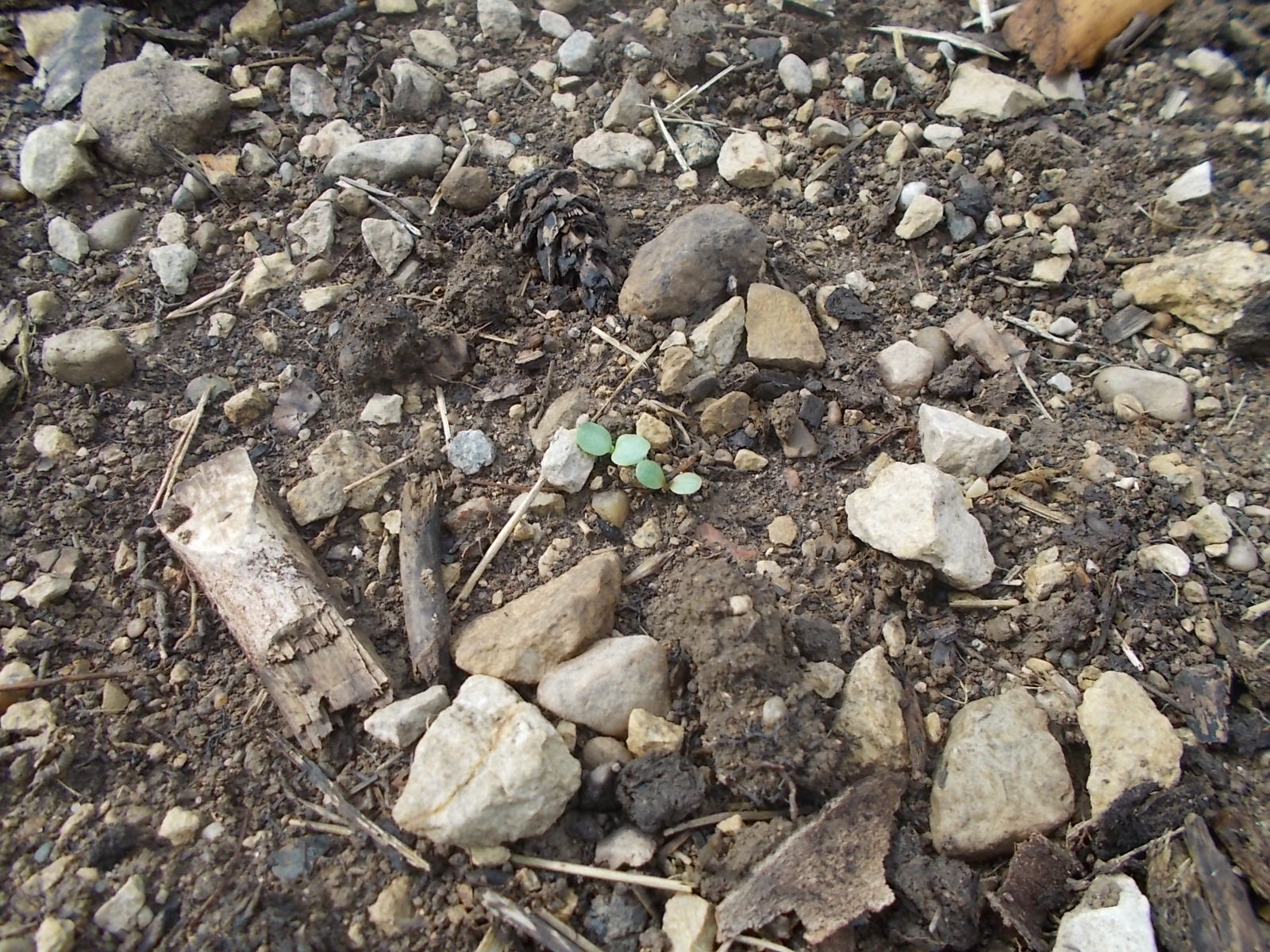
The seeds I planted along the road are starting to pop up.  I sowed a mix of chicory, kale and mangels.  My intention is to pick greens and to have this planting become self-sustaining.  The soil ranged from OK to road-gravel.
Seeds germinating on OK soil

Seeds germinating in road-gravel
Just to the east of this planting I have a feral bee hive.  The bee swarm settled into the hollowed out heart of an old utility pole that had been used for a fence end-post.  I almost blasted this post with wasp spray.  I had seen the bees and assumed they were yellow-jackets.  I took a few extra seconds to observe them before annihilating them (probably looking for the best places to blast) and they just did not quite look like yellow jackets.  They were too brown, too fuzzy and did not fly quite the same. 

I later put the bucket over the top of the hollow post to provide winter protection.  The "official" bee hive top was added later.  So far the bees have been totally ignoring the "official" part, preferring the funky old post.  I believe the post is rotted out to below ground level.  There are a few, heavily laden bees that enter to post at ground level.

Video is 28 seconds long. Turn up the sound and appreciate the excitement of living in the country.

I also tied up some rose bushes.

Rosa canina, Dog rose.  This rose is a weirdo because it has 35 chromosomes.  It is a quintiploid.
My preference in roses is toward climbers and species roses that can fend for them selves.  I also like roses that have edible hips.  These roses are also along the road.  I tied them up because they do not have other guild members (like willow or dogwood bushes) to scramble over.


Dortmund rose.  A climber that has good looking hips.  Ties are on the diagonal because positioning shoots upward promotes vigor.  Positioning shoots horizontally promotes branching and fruiting.  Positioning shoots diagonally promotes a balance of both.  This works for fruit trees as well.  Do you have a fruit tree (like a pear) that is shy about coming into bearing?  Bend the branches down closer to horizontal and see if it tips into bearing.