Sunday, March 16, 2014

How to Take the Fun out of Shooting

There is a thread going on over at 24hourcampfire:  What takes the fun out of shooting?

My List


When shooting with kids I know that the joy ends when they are ready to be done.

They also enjoy reactive targets far more than shooting at paper.  It does not need to be fancy.  It can be charcoal briquettes, eggs, empty shotgun shells, those cheap plastic soldiers.

If they are shooting at paper, having some kind of "story" makes it more fun.  A hostage or terrorist scenario, for instance.

Also, too much gun.  And poor hearing protection.  And crappy eye protection.  Those take the fun out RIGHT NOW.

Targets that are too small.  Maximum motivation seems to occur when about half the shots are "hits".  Too hard steals the joy much more quickly than too easy.  So tune the target size so "hits" are between 65% and 95%.  Once they get to 95%, consider making it more challenging.

From the campfire


http://www.24hourcampfire.com/ubbthreads/ubbthreads.php/topics/8640661/all/Top_ten_ways_to_take_the_fun_o

1. Living where there isn't quick and easy access to a place to shoot.
2. Shooting something that kicks so much it isn't fun to shoot.
3. Having rifles that are just too expensive to shoot, due to costly brass, boutique bullets or using half a can of powder per shot.
4. Trading rifles too much- Trading away guns that are fun to shoot just because you have the urge to trade, and ending up with a gun that isn't as good as the one you traded away.
5. Not trading rifles when you should-Keeping something in the gun safe that you never shoot and that has no sentimental value and is not an investment- Maybe it would be better to go trade that for something you would shoot, be it an air rifle, muzzleloader, BAR or even a shotgun, as much as I hate those things.
6. Just focusing on one kind of shooting- It's easy to get wrapped up in shooting groups, because rifles are so accurate these days, but there's lots of other fun stuff- shooting ground squirrels, plinking clay birds off hand, shooting a handgun for a change, trying some kind of competition, formal or not.
7. Not having a shooting partner- A shooting partner will get you out more often and offer some good advice, perhaps. Also, consolation on bad days and congradulations on good days is not a bad thing.
8. A very general concept- Getting to caught up in the minutia of shooting- Trying to wring the last 10 fps out of a load, or measuring groups to the 1/1000 of an inch.

Saturday, March 15, 2014

State Champs!

Belladonna texted me that Eaton Rapids women won the Class B basketball championship.

I know some of the young ladies who are on the team.  And I know some of the parents who coached them in their earlier years. 

Part of the magic is that this group stayed together since first grade.  Their parents did not move away from Eaton Rapids.  The girls played as a team for so long that they could pass with their eyes closed, knowing that Allie or Bailey or whoever would be THERE to pick it up.

Some of those parents coached my kids.  They are absolutely top drawer coaches and people.  I cannot tell you how much I have learned by watching them.  But I will try.

My first coaching experience was in U8 girl's soccer.  Two of the other teams were coached by the dads of three of the girls on that basketball team.  Those teams absolutely waxed my girl's backsides, four times in the fall and three times in the spring.  One of the high points of my life is that my girls tied one of those teams in the last game of the spring season.

Coaching really does throw a long shadow.  It is a pity that the parents who coached a thousand games and drove a million miles will get little credit.


Seed Vaults

I was a little bit worried earlier today.  Perhaps frustrated would be a more accurate word.

I wanted to start my onion seeds.  I bought two types for my project:  Trailblazer and Newburg.

I keep most of my seeds in a metal trash container in the basement, under the steps.  That trash container is the official Eaton Rapids Joe seed vault.  The onion seeds were not there.

Then I looked in the drawer in the refrigerator that Mrs ERJ sublets to me.  No onion seeds there.

Then I looked in the downstairs freezer...and there they were.

Plasticity


Plasticity is the concept that organisms can adapt to environments without changing genetically.  Identical twins can be separated at birth, one to grow up in Bolivia the other in New Jersey.  The twin in Bolivia will have measurable greater lung capacity and hemoglobin density.

Plasticity is highest in our youth.  That is why aerobic exercise (or actual, physical work) is most beneficial to growing kids.  Their larger, healthier hearts and larger diameter arteries will serve them a lifetime.

One of my pet theories is that "multiplier" onions are genetically no different than regular onions.  Onions are typically considered biennials.  That is, they put on much growth the first year, store their excess production in the bulb over the winter. Then they put on a final sprint early the next year and produce seeds. 

But what happens if the organism's attempts to procreate are stymied?  Suppose that there is not enough light or if the flower/seed shoot is pinched out each time it pushes out.  Might the organism lose plasticity over time and lose the urgency...the need to breed?

I intend to find out.  Trailblazer is a modern hybrid selected for storage ability, bolting resistance (resistance to prematurely producing seeds) and disease resistance.  It also tends to produce multiple (mutiplier) centers.  Producing a new strain of virus free, disease resistant multiplier onions would be a fine legacy.

The key to contentment is to to have humble dreams.  I am a humble guy.  It comes easily to me.

Birth Parents

All of our children are adopted.  At some point, they make contact with their birth parents.  Today was Belladonna's turn.

I drove her to Grand Rapids, about 75 miles away.  We ate lunch with her birth (biological) dad.

He did not even know that he had fathered her until 2009.  At the time of her conception, he and Belladonna's mother had a falling out.  Belladonna's mother made a mistake in timing regarding her birth father.

Belladonna's actual birth father would likely not have signed off on giving Belladonna up for adoption. 

I could see the pain, the grieving, in his eyes as I talked about being able to watch her play basket ball and do other, normal kid things.

By all appearances, Belladonna's birth dad is a solid guy in more than one way.  While eating lunch he mentioned that he has been wasting away as he advances in the years (he is about 40).  He can only benchpress 300 pounds.  I threw my arm around him when we were doing pictures.  He was not bull zhitting.  He has the muscle mass to bench 300.  Belladonna came by her strength honestly.

Belladonna was delighted to learn that he had played professional football for three years.  I was delighted to learn that he used to drive a Cavalier.

Sometimes things happen.  His loss was our gain.

He now works down in Mississippi so visits are likely to be infrequent.

While pictures were taken none will be shared.  It was Belladonna's moment and her birth father's moment.  It will stay that way.


There is no Substitute for Cubic Inches

Cartridges that evolved during the blackpowder era have a great deal of flexibility in terms of the propellant.  In fact, the actual quote (which I subsequently stole) was that "One could load them with chicken poop and charcoal and they would still get the job done."

Given the precarious state of the smokeless powder market, I thought I would test that out.  I am not being an alarmist.  I simple have a curious mind and some spare time on my hands before the garden thaws out.

Black Powder


Black powder traditionally consists of Potassium Nitrate (Saltpeter), Charcoal and Sulfur.  Discussions for the remainder of this post will list ingredients in that order, Nitrate-Charcoal-Sulfur

Even a very cursory read of what is on the internet will turn up a very wide range of compositions.  The default composition is one that the US cobbed from Great Britain: 75-15-10.  Other compositions range from 40-30-30 to 79-18-3 to 70-30-0.

Let's talk briefly about what each ingredient does.

Nitrate:  KNO3 decomposes under heat and pressure such that each molecule yield KO-1/2N2-O2  It is the O2 that interests us.  That is the oxygen that combine with the fuel to provide energy.  If you know much about chemistry you can see that it takes a lot of molecular weight (101) of KNO3 to provide that O2 molecule.

Charcoal: Charcoal is carbon.  Carbon combines with oxygen.  The reaction that provides the most energy is 1C + O2 = CO2   Carbon has an atomic weight of 12.  A stoiciometric (balanced) reaction would start with 101 parts of saltpeter and 12 parts (by weight) of carbon.

One reason that one might want to run heavy on the carbon (more than stoichiometric) is that carbon's availability is a limiting factor in combustion.  The entire event occurs over a very short time.  Going "heavy" on the carbon means that you can still generate good power even if all of the carbon is not fully consumed.

Sulfur: So why the sulfur?  Again, the problem is that carbon is not very reactive.  It has a vaporization temperature of 6500 degrees Fahrenheit.  This is common knowledge amongst everybody who ever had to light a charcoal grill when their in-laws were hungry.  The sulfur lowers the temperature that kicks off the reaction making the powder much easier to touch off.

That was doubly important back in the 1800s for a couple of reasons.  One reason is that the ignition systems were less robust, especially with the flintlock systems that were prevalent in the early part of the 1800s.  The other reason is that the saltpeter of the day was likely a mix of potassium, sodium and calcium nitrates and nitrites.  Potassium nitrate is far and away the best component because it is not hygroscopic, that is, it attracts little moisture out of the air.  The other combinations really suck in the moisture and become very hard to ignite.

Simple powers:


I am not going to make "Gunpowder".  I am going to make "propellent".  It will be a simple mixture of potassium nitrate, a common fertilizer available for about $2 US a pound at the time of this writing and of charcoal.  I am excluding the sulfur because I want this stuff to be difficult to ignite for safety reasons.  I figure that I will be saved by the purity of the potassium nitrate and the quality of modern primers.

Potassium nitrate is a commodity chemical.  All of the magic (that is, room for errors) is in the charcoal.

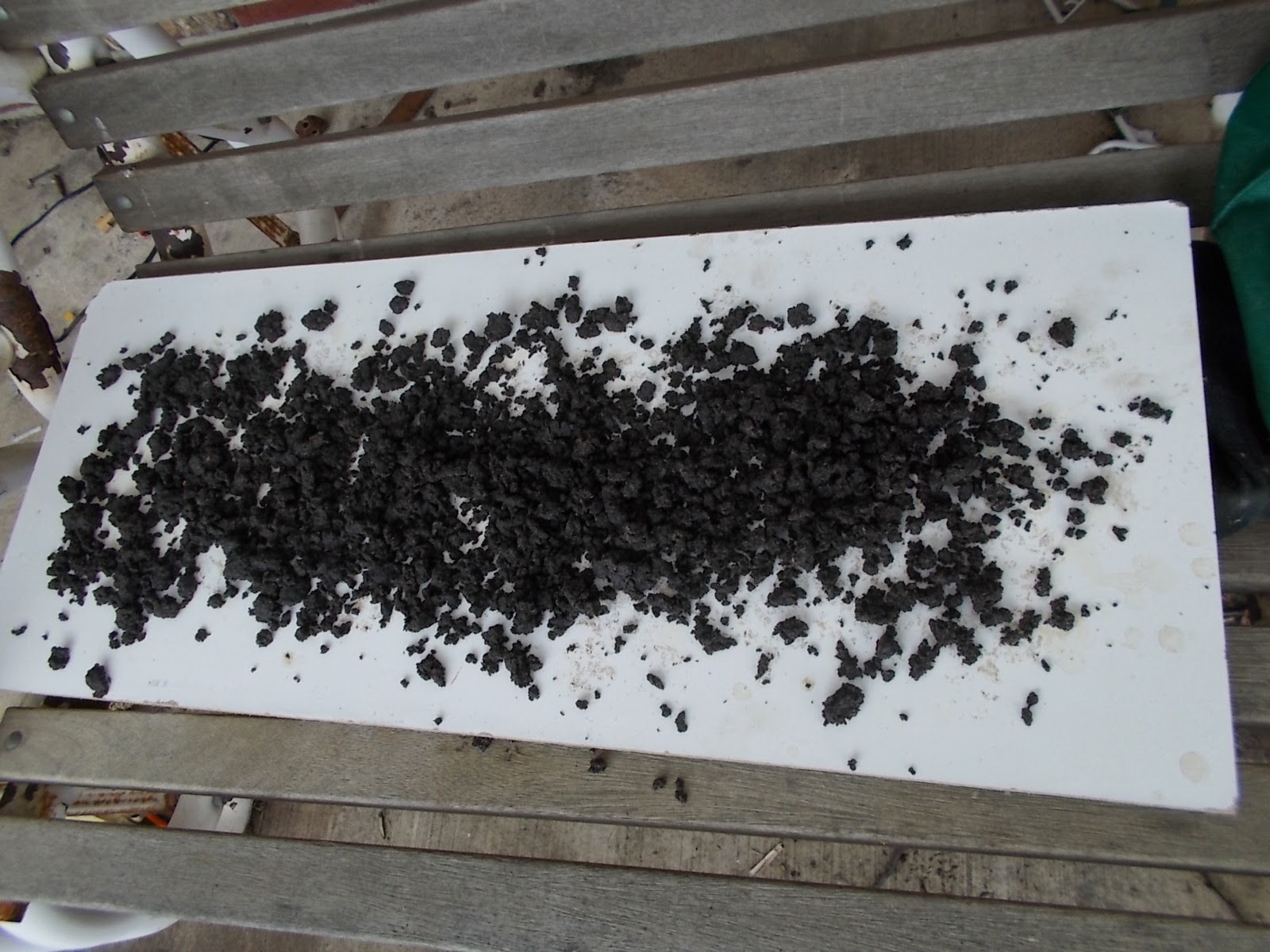
My first error was to try to make my charcoal in an small container.  I chose to use corn starch as my raw material because it is very pure and is already a powder.  I thought it would be very easy to mill the "clinker" back to a fine powder.  Well, the stuff expands like a burning marshmallow as it starts to char.  I was making it outside as I wish to remain married.  The concrete apron I was 'spermenting on looked like it was covered with snow after run 1.0

Run 2.0  Not fully carbonized.  16 oz of starch (or cellulose) would yield about 6.5 oz of charcoal if fully carbonized.  I weighed out 11 oz out of the original 16 at this stage of "browning".


The next time I used a deep, cast iron dutch oven (Mrs ERJ's carmel pan) and I scrape/stirred with a spatula on a regular basis.  I stopped when my batch looked like burned popcorn.  The corn starch shows a strong tendency to stick together as it chars.

It milled well through my grain mill.  I passed it through 3 times.

I opted for 4 ounces of charcoal for each 16 ounces of potassium nitrate (25 parts charcoal per 100 parts nitrate) based on the information HERE.  I also intend to try 5 oz and 6 oz per 16 ounces.

My next mistake was to use too much 70% isopropyl alcohol to "corn" the powder.  I was going by feel.  I think the correct amount is about 6-to-8 oz for this size of batch.  I had alcohol puddling up in the mixing container that I could not mix back into the dough.


The first batch is dehydrating on our front porch.  I still need to break apart the clinkers and then sift it.

I will be tickled if I can get 70% of the power of commercial black powder.

The .303 British in the Lee-Enfield was the ".223-M-16" of the black powder era..  It boasted a 215 grain bullet at a blistering 1800 feet per second using a special compressed black powder.  By comparison, the US fought the Civil War 25 years earlier with .58 (vs. .31) diameter projectiles that weighed +500 grains (vs. 215 grains) at a velocity of 950 fps (vs 1800 fps).

People who have screwed around with this stuff claim they can get 1500 feet per second with heavy cast bullets out of the .303 British using commercial black powder.  70% of that power would be 1250 feet per second. There is not a deer alive, including moose, that will survive a 200 grain cast .308 bullet at 1250 fps in the ribcage.  It might not fall over in a cloud of dust, but it will not run a quarter mile, either.

The .308 Win has virtually identical powder capacity as the .303 British.  The 8mm Mauser has 20% more powder capacity and the 30-06 has approximately 40% more.  The 30-30 has approximately 75% as much capacity.

I will keep you posted.

Continued

Friday, March 14, 2014

Sunday Thoughts: Touch of the Master's Hand

No comments to be added except that the artist is Sally Rogers.  She is blessed with a hauntingly, beautiful voice.  Her website is HERE.


The Touch of the Master's Hand

'Twas battered and scarred, and the auctioneer
Thought it scarcely worth his while
To waste much time on the old violin,
But held it up with a smile:
"What am I bidden, good folks," he cried,
"Who'll start the bidding for me?"
"A dollar, a dollar"; then, "Two!" "Only two?
Two dollars, and who'll make it three?
Three dollars, once; three dollars, twice;
Going for three----" But no,
From the room, far back, a gray-haired man
Came forward and picked up the bow;
Then, wiping the dust from the old violin,
And tightening the loose strings,
He played a melody pure and sweet
As a caroling angel sings.

The music ceased, and the auctioneer,
With a voice that was quiet and low,
Said: "What am I bid for the old violin?"
And he held it up with the bow.
"A thousand dollars, and who'll make it two?
Two thousand! And who'll make it three?
Three thousand, once, three thousand, twice,
And going, and gone," said he.
The people cheered, but some of them cried,
"We do not quite understand
What changed its worth." Swift came the reply:
"The touch of a master's hand."

And many a man with life out of tune,
And battered and scarred with sin,
Is auctioned cheap to the thoughtless crowd,
Much like the old violin.
A "mess of pottage," a glass of wine;
A game--and he travels on.
He is "going" once, and "going" twice,
He's "going" and almost "gone."
But the Master comes, and the foolish crowd
Never can quite understand
The worth of a soul and the change that's wrought
By the touch of the Master's hand.
                 --Myra Brooks Welch


Any infringements are purely accidental and are solely the responsibility of Eaton Rapids Joe.

I Hate City Driving

I hate city driving.

I have been making frequent trips to Auburn Hill this past week.  Middle of the night was not so bad.  There is almost no traffic at three in the morning.  6:30 pm stinks for traffic.

I can see that people who make that kind of commute every day can get smart about which lane to stay in and how long.  Those of us who are infrequent visitors do not have that intelligence.

It has been a bad season for pot holes.


I hate city driving.

It is difficult to gauge when to leave home.  Sometimes it is a 1:50 trip.  Other times it is 3:00.

I hate city driving.