Wednesday, February 3, 2016

Eating wild-caught fish


I asked Mrs ERJ if she would consider cooking and eating wild-caught fish that I might bring home.  She, in turn, asked me to look into contamination issues.

The State of Michigan publishes a Guidebook in an attempt to address those concerns.

It is pretty well put together.  It defines portion size in a realistic and usable manner.

These portion sizes are generous compared to what you see in most dieting books but I think they are very realistic when you look at the amounts that people actually put on their plates.
It speaks to exceptions


 and it provides defaults to keep it manageable

The higher up the food chain the fewer servings you should eat per month.

One way to sort it out is that if you usually catch your fish with worms on a #8 hook, then you can eat eight servings a month.  If you catch them with small minnows on a #6 hook they you are limited to six servings a month.

Carp are an exception because they vacuum up everything in the path, live a long time and get huge.  You are allowed fewer servings of carp.  This does not square with how Europeans eat carp.  They turn up their noses at any carp that are larger than 2.2 pounds as not edible.

Here are one of the recommendations specific to Eaton county.  You can see that Carp are not recommended and that the limit for Suckers is one quarter of the default.

The guide also lists major bodies of water for each county.  Some bodies of water, like the Kalamazoo river, are DO NOT EAT due to various types of contamination.  Other watersheds are broken down by stretches based on historical risk of contamination and varying test results.


Employment-resistant personalities

From The Spectator in the UK

Dr Adam Perkins, a lecturer in the neurobiology of personality at the Institute of Psychiatry, Psychology and Neuroscience at King’s College London. Like Chagnon, Perkins is a social scientist whose research findings pose a direct challenge to one of the central planks of left-wing ideology.

Over the past five years, he has accumulated a mass of evidence about the personalities of welfare claimants and concluded that individuals with aggressive, rule-breaking and anti-social tendencies — what he calls the ‘employment–resistant personality profile’ — are over-represented among benefit recipients. He also found that their children are likely to share those traits, which helps explain why poverty has a tendency to be passed down from one generation to the next.

Perkins published his findings last November in a book called The Welfare Trait (Palgrave Macmillan, £19.99), but you won’t have heard about it or seen it reviewed in any UK newspaper anywhere because his research has been judged to be off limits by the self-appointed guardians..

Colleagues with whom Perkins had collaborated in the past warned him off publication, worried about being associated with such a heretic...

You have to love it.  "Employment-resistant personality".  

One question that needs to be examined is the degree to which welfare attracts people with those characteristics and the degree to which welfare creates those personality clusters in otherwise employable people.

It is interesting the degree of energy Dr Perkins' research generated, even to the degree of the establishment black-balling anybody who assists Dr Perkins with peer reviewed research.  Heck, it is not like he is giving nuclear weapons to unstable, terrorist nations.

Tuesday, February 2, 2016

Hidden Lake Gardens, a few select conifers

I made a field trip to Hidden Lake Gardens today to gather pictures for my series "Trees of Eaton Rapids".  My primary mission was to collect pictures of species that homeowners might use instead of Eastern White Pine and Blue Spruce.

I ran into several fantastic people, most notably Paul Pfeifer and Gerry Donaldson.  Even though I dropped in unannounced and they did not know me from anybody, they took time out of their day to help me out.

Both men have the agile minds and demonstrated the ability to talk intelligently about a very wide range of topics.  Not only could they talk about those topics, they were able to calibrate their conversation to my layman's understanding of things.  Not only did I enjoy talking with them, they make me a smarter person.

Unfortuntately...


Unfortunately the pictures came out overexposed.  There were three things that may have contributed to that. 

A low haze blew in and the light was about what you would expect if you were taking pictures from inside a fluorescent light tube. 

The second factor is that I had switched from rechargable batteries to disposable alkaline batteries.  For some reason this model of camera wants the user to tell it what kind of batteries you are using.  I had neglected to tell my camera.  I don't know why that would make a difference but it might have.

A third factor might be that I took some of the photos in "text" mode.  I think aperture, exposure and all of the other stuff might be biased to produce overexposure to maximize contrast to make light==>be==>white and not-light==>be==>black.

With no further ado... crappy photos of our candidates

Eastern White Pine substitutes


All of these substitutes for Eastern White Pine (Pinus strobus) are reputed to have resistance to White Pine Blister Rust.


Korean Nut Pine.  This specimen was planted in 1963.  It is approximately 60 feet tall and very wide.  It is multi-stemmed.  Paul in foreground reading the ID tag.
Cone with shells of pine-nuts scattered around it.  It looks like Secret Squirrel was here.

A close up of the shells to provide size reference.
This specimen is much bushier than a typical Eastern White Pine. 


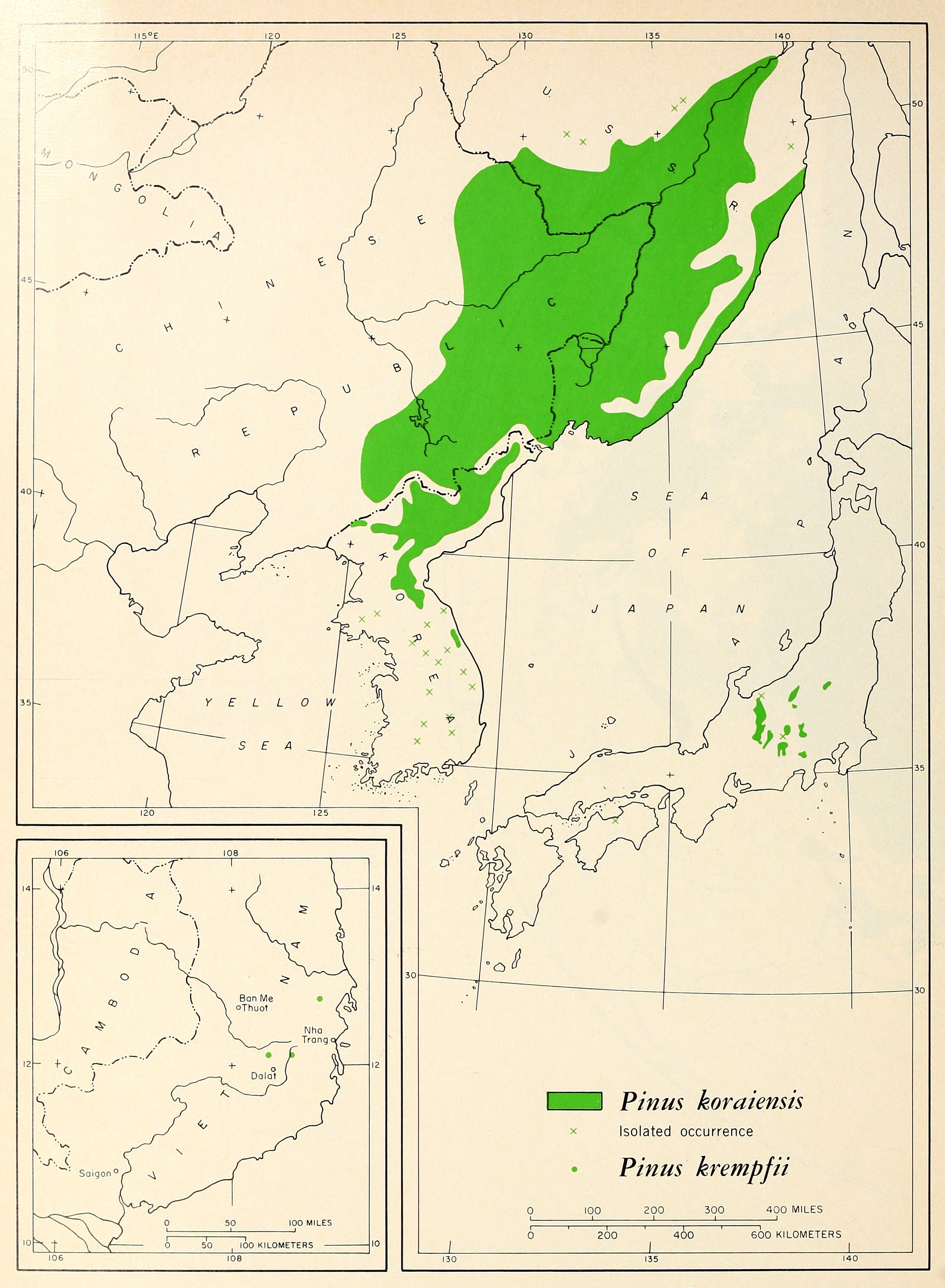
Range map.  Image from HERE
One has to be careful because this species has a very large range and there is little information about the provenance of most of the specimens we have over here.  What we may think of as "typical" may be just a very small portion of how the species might present.
This is a clone of Korean Pine named "Eye of the Dragon".  The needles are a bit crinkled and it gives the tree a presence reminiscent of an Old English Sheepdog that has just been bathed and blow-dried.
Japanese Red Pine.  This is not really a substitute for the Eastern White Pine because it is a medium sized conifer but it would be a striking focal plant for a Mediterranean style house, providing a splash of color against the whitewashed stucco and dark red tiled roof.  There might be variation in the brightness of the red trunks, so either buy a grafted selection or buy a tree old enough where you can see the color developed.  Discretely pruning away lower branches helps the stems be more visible.  
Japanese White Pine (glauca group) is similar to Eastern White Pine but the cones are shorter.
Swiss Stone Pine.  Like the Korean Pine, this is one of the nut pines.  This is a cultivar named "Chalet" that was selected for its dense canopy and good color.  A very nice write-up of medium sized conifers can be found HERE.


Blue spruce substitutes


Three separate Concolor Fir.  Concolor Fir loses its sharp triangle and its shape softens as it ages.  But then, so did my shape.  Structurally, the tendency to split into multiple stems should make it more vulnerable to ice and wind damage but you rarely see Concolor Fir with broken stems. 

On the plus side, Concolor is a tree for lovers.  The needles are soft and have a better aroma than spruce.  Spruce needles smell like pine and paint thinner.  Fir needles smell like Christmas, citrus and clean, mountain air.


I will go back in the spring as the trees are throwing out a new flush of growth and take more pictures.  Hopefully I will pick a sunny day.

Sophomores

The word "Sophomore" is the combination of two rootwords.

The first part, "Soph..." from Sophism:  a fallacious argument, especially one that is intricate and  used deliberately to deceive. 

Hmmm.  
  • Likes to argue. (Check)  
  • Arguments are complex and convoluted (Check) 
  • and have logical holes big enough to drive a truck through. (Check)  
  • It is all about getting their way. (Check)


The second part is "...more" derives from the same root as "Moron".  Lloyd aptly demonstrates the lack of awareness exhibited by sophomores in this scene from Dumb and Dumber.  Yes, sophomores are really this oblivious to how others perceive them.

Based on the etymology of the word "Sophmore" we have a argumentative idiot who thinks they are slickly deceptive.


The good news is that it is only supposed to last a year.

Free money!

Swiss government proposes paying everyone £1,700 ($2450) a month whether they work or not... -Daily Mail (UK)

Allegedly to fight poverty but the cynic in me wonders if it is to fight deflation.  Notice it is "per person" not "per household".

 Do I get extra if I have multiple personalities?


Monday, February 1, 2016

A walk about town (with pictures)

I went into town to pick up Kubota at school but he had an essay he was wordsmithing.  So I took the opportunity to walk around town and take pictures.

State Street bridge looking upriver toward Onondaga.
Worry not.  We are prepared if those rascals from Ingham County attempt to invade us.  Eaton Rapids is flooded when the water reaches the muzzle of the cannon on Island Park.  Folks can canoe down Main Street when the cannon is completely submerged.
Also seen on Island Park.  A pleasant surprise for February 1.
Still waters run deep....and that is where the fish are.  Most fish will loaf where fast water sheets into deeper water.  They let the current bring the food to them.  One way to find that transition is to note where open water transitions to ice.  Open water = current.  Ice = still water.
Current flows left-to-right in this photo.  I will be in great shape as long as the red car does not move in the next six months.
Some young buck feeling his oats.  This was on school property.  They will probably write him up if anybody saw him.
Hmmm.  Slap fights and hair pulling.....probably hair from a doe.
This was a surprise.  Everything about the bush, the posture, branching, buds.....suggested "willow".  But I have never seen a willow with hairy twigs.  They were not prickly.    Just hairy.  I will go back after this leafs out and see if it really is a willow.  These hairs look enough like the aerial roots on Poison Ivy to give me the heebie-jeebies.
This is what Wintergreen looks like.
A close up

Even closer.
Lowbush Blueberries
Highbush Blueberries
More Highbush Blueberries.  Many of the most interesting plants like Wintergreen and Blueberries cannot compete well in highly fertile soil.  You will find them growing on sand and gravel.
Three Sassafras trees by the entrance to the Calvary Lutheran Church on Plains Road.  They have beautiful fall color.
Another mystery plant to key out.  Stalks are eight feet tall, approximately thirty to the crown.
Stalks are square and approximately 1/2 on a side.  I thought it was Compass Plant but none of my sources comment on the extreme squareness of the stems.    Added later:  Here we go, Cup Plant
Grass moguls.  These just looked interesting.

Teacher Evaluations, Part 3

The art of managing by the numbers involves the intelligent balancing to two conflicting criterion.

We want the identification process to be timely.

We want the identification process to not falsely identify deficient teachers.

This essay will show one method of reconciling that balancing act.

Null hypothesis


Let us suppose for the moment that the teacher has absolutely no influence on the student's performance.  We know this is not true because we would not pay teachers more than minimum wages if any random, custodial adult was just as effective as a trained teacher.

If the teacher has absolutely no influence then in any given cycle the chances of that individual teacher ending up in the lowest performing 10% is exactly 10%.  The chances of their ending up in the lowest 10% two cycles in a row is 1%, while their chances of ending up in the lowest 10% three cycles in a row is 0.1%....one chance in a thousand.

But we do know that teachers strongly influence student's ability to learn.

The effect of requiring multiple "failures" of a minimum performance criterion is highly protective of teachers who are on, near, or better than the bubble. 

Choice in how many cycles and how to define under-performance is influenced by scarcity of data.  Teachers at the elementary level tend to have fewer students (say, a classroom size of 25) and have those students for the entire year.  Teachers at the high school level might have 5 classes of 25 and three tri-mesters a year.  Clearly the teachers at the high school level generate about fifteen times as many data samples per year as the elementary school teachers and it makes sense to have different under-performance benchmarks for different types of teachers.

How might it work in real life?


Teacher XYZ scores in the lowest 10% (lets call it the under-performance zone) of the teacher population based on the measurement system described in the last post.  The administration informs the teacher of the fact.

If Teacher XYZ scores in the under-performance zone in the next cycle, they are place on an improvement plan.

If Teacher XYZ scores in the under-performance zone the third cycle (one chance in a thousand in our null hypothesis) they are released to seek job opportunities that are more in line with their capabilities.

Tuning the system


Natural attrition runs somewhere between 3% and 5% per year.

It seems reasonable that an additional 1%-to-2% per year of non-performance based attrition will not cause undue hiring stresses.  If historical data is available, then adjusting the size of the under-performance zone to put 1%-to-2% of the teachers at risk every year is probably good business.

While 1%-to-2% per year seems like a glacial pace to parents angry about school district performance the program throws a very long shadow.

Some teachers will resign when they see the handwriting on the wall.

Most teachers will step up their game to stay out of the 10% non-performance zone.  It is like the old joke about out running a grizzly bear.

Finally, eliminating the bottom 10% is HUGE.  It is almost impossible for a student to avoid the bottom 10% during their 13 years of education.  Clearing out that bottom 10%, even if it takes five or ten years, is a huge step forward.

The non-performance zone


There are some teachers who are so toxic to the system that the school district cannot afford three cycles.  There are many reasons why teachers, heck, any employee, can become toxic.
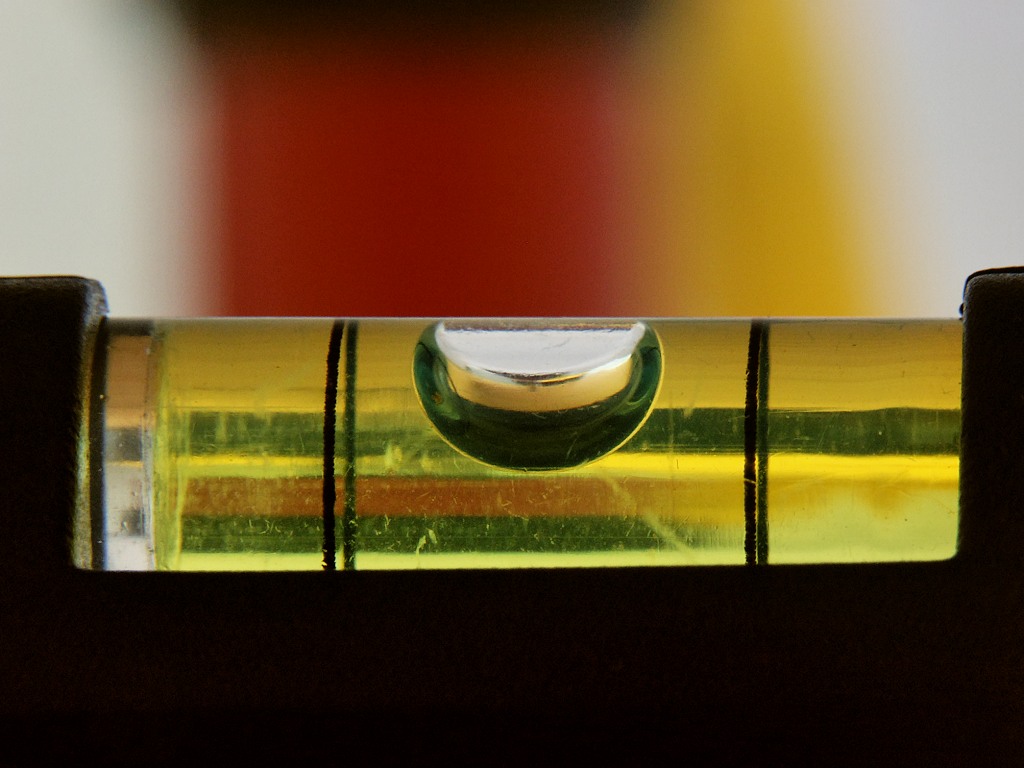
Approximately 5% of the US population suffers from severe mental illness and highly dependent on medicine to keep the bubble centered.  Things are usually OK as long as they take their meds.

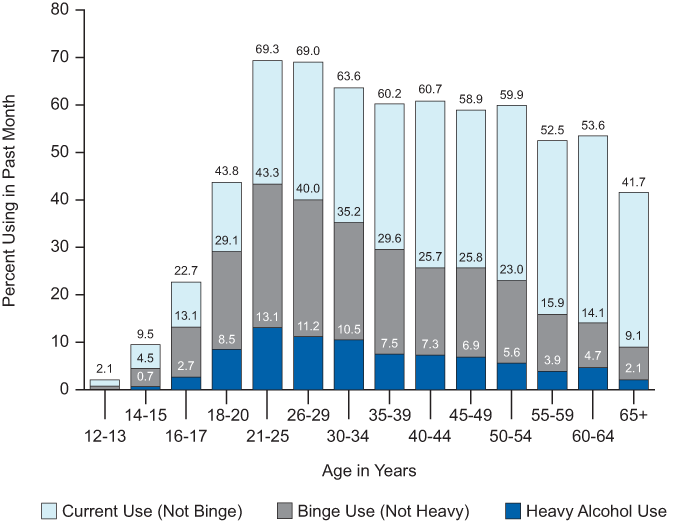
In round numbers, between 6% and 10% of the population identify as heavy alcohol users. That does not even consider prescription drug abusers and other recreational drug users.


Approximately 3% of the population between ages 25 and 45 are undergoing a divorce at any given time.
These are all stresses that can put even the most dedicated professional "in the ditch".

Any incursion into the non-performance zone demands attention.  Tolerating abysmal non-performance is enabling and is not doing the teacher, or the students any favors.

Perhaps they need counseling.  Perhaps they need a 12 step process.  Perhaps they need a leave of absence to get their head back together.  Regardless, they need help and they need it quickly.