Friday, May 16, 2025

Engine cooling air flow stymied by mouse nest


I was putting gas into the back-up mower's tank when I spied pink through the holes in the top of the recoil starter.

"Oh, crap!"

Removing the shroud that directs the cooling air over the cooling fins on the head and the top of the cylinder (right side of mower as shown above) I saw that mice had packed it with fiberglass. The flywheel also functions as the magneto and a cooling fan...hence the curved fins in the top.

Removing that fiberglass, I exposed two vent-holes in the bottom half of the shroud/duct.


 That hole is plenty big-enough to allow mice to play house.

I know the picture is busy. The hole is outlined in yellow highlighter in this image.

I bet the motor runs cooler now!

I remember a major truck manufacturer whose early 6.2l diesel engines had an air intake that was PERFECT for House-sparrows to use as an entrance to a nesting box. There are millions of English Sparrows in midwestern towns. Those diesel engines didn't breath very well after inhaling a bird-nest.

The fix was very simple. The air-intake was an injection molding. It is easy to add material to injection molds. They added  multiple, vertical bars across the opening and the problem went away.

You would think major manufactures would know to avoid holes of certain sizes.


Thunderbolts and lightning, very, very frightening...

We had a band of T-storms sweep through about midnight last night.

Radar saw rotation. A tornado warning was called. Mrs ERJ woke me up. We went into the basement. I went back to sleep. Mrs ERJ woke me up again. I went back upstairs and finished my slumber in our bed.

Heavy blue trace is gage in feet. Thin blue trace is flow-rate with scale on the right side of the chart. Low-water is between 200 and 300 cubic-feet/second. By this afternoon, flowrate will be up over 1000 cubic-feet/minute. Source

200 cubic-feet/second is an acre-foot every 3:40 minutes:seconds

We got about an inch of rain. The river was really roaring yesterday before the rain so fishermen better beware. Guys, if you get a snag and the river is running high, break it off and tie on another lure. Lures are cheap. Death is not.

Walking around the property I saw very little evidence of wind. I had some tall pots that had not been knocked over.

Speaking of wind...

Yesterday afternoon the wind was out of the south. About mid-afternoon, I saw a seed from a Silver Maple "Helicopter" out of the sky into my yard. Winds were about 10mph.

The closest, mature Silver Maple is 900 feet to the south. I am sure that is not even close to a record, but it caused me a "Where could THAT have come from?" minute.

Thursday, May 15, 2025

"Settled Science", 1900s edition (Long, Geek alert)

Between 1880 and 1920, plant breeding was HUGE business. They named cities after plant breeders (Burbank, Ca. Hazen, N.D.). It was a very big deal.

Wealthy apple. Plants from the mid-West tend to be have a lot more red.

At the beginning of that same timeframe Peter Gideon, an apple breeder near Lake Minnetonka, Minnesota released the Wealthy Apple. He reported the pedigree as Sops-of-Wine and "Cherry Crab" which was a generic name given to a swarm of similar Malus X robusta  hybrid crabapples.

Gideon went on to be the head of the apple-breeding effort in Excelsior. That venture, which was associated with the University of Minnesota went on to release about 30 apple varieties including the Honeycrisp apple. 

The story

Breeders typically report the parents of the apple they release. Unless they are using mass-breeding techniques, that isn't too hard to do. The breeder (or his grad students) bag unopened apple blossoms. When they open, they gently move pollen from the flower of the chosen male parent to the pistil of the female parent. The bag is replaced and they move on to the next bunch of blossoms. Typically, a colored twist-tie will be used to identify the male parent.

As a percentage of seedlings planted, what do you suppose the "misidentification rate" be? Consider that sometimes blocks of seedlings might get intermingled. 1%? 5%? 20%? 0.01%?

The majority of the data cited in this post came from this article

DNA testing suggests that the failure rate might be enormous.

Cultivar

Year Introduced

Reported Pedigree

DNA Pedigree

Wealthy

1868

Sops-of-Wine X Cherry Crab

Jonathan x Dutchess*

Haralson

1922

Malinda open-pollinated

Malinda x Wealthy**

Wedge

1921

Ben Davis open-pollinated

(Malinda x Duchess) X Northwest Greening

Folwell

1921

Malinda open-pollinated

Duchess x (Alexander x Golden Russet)

Chestnut

1949

Malinda open-pollinated

Wealthy x (Kewick Codlin x Ukn.)

Minnehaha

1920

Malinda open-pollinated

Wealthy x (Ben Davis x Snow)

Victory

1943

McIntosh open-pollinated

McIntosh x Wealthy

Beacon

1936

Malinda open-pollinated***

(Malinda x Duchess) x (Malinda x Tetofsky)

Frostbite

2008

Unknown

(Duchess x Utter’s Large Red) x Ukn.

Redwell

1946

Scott Winter open-pollinated

Wealthy x (Alexander x Ukn.)

Minjon

1942

Unknown

Wealthy x Malinda

Oriole

1949

Unknown

Wealthy x Ukn.

Lakeland

1950

Malinda open-pollinated

Wealthy x Malinda

Fireside

1943

Unknown

Wealthy x Northwest Greening

Prairie Spy

1940

Unknown

Wealthy x Northwest Greening

Northland

1957

McIntosh x Dolgo

McIntosh x Dolgo

Regent

1964

Duchess x Red Delicious

Harlason x McIntosh

Centennial

1957

Dolgo x Wealthy

Dolgo x Chestnut

Red Baron

1970

Duchess x Golden Delicious

Duchess x Golden Delicious

Keepsake

1978

Frostbite x Northern Spy

Frostbite x Northern Spy

Honeygold

1970

Golden Delicious x Haralson

Golden Delicious x Haralson

Sweet Sixteen

1977

Frostbite x Northern Spy

Frostbite x Northern Spy

State Fair

1977

Mantet x Oriole

Mantet x Haralson

Honeycrisp

1991

Macoun x Honeygold

Keepsake x (Duchess x Golden Delicious)

Wildung

2006

Fireside x Sharon

Fireside x Sharon

Minnewashta

1998

State Fair x MN1691

State Fair x MN1691

Minneiska

2006

Honeycrisp x Minnewashta

Honeycrisp x Minnewashta

MN55

2016

Honeycrisp AA44

Honeycrisp x AA44

MN80

2021

Honeycrisp x Liberty

Honeycrisp x Liberty

DNA evidence suggests that eleven of the twenty-eight releases (almost 40%) were reported to have pedigrees that DNA testing disproved.

Those disproved pedigrees are in the Bold Red font and Pink font in the reported pedigree column. 

Wealthy, shown in Bold Green font shows up in far more crosses than it was credited with. How could that happen?

Malinda apple

Suppose you are a grad student and one of the projects you have been assigned is to produce 100 seeds of Malinda (which shows up in many pedigrees) crossed  by Ben Davis (a fairly disease resistant apple). You figure that you will get 5 seeds per apple so you pollinate the "king blossom" in twenty clusters and call it good.

When it is time to harvest the apples you can only find five good apples. What do you do? You make up the difference with apples from the tree next to it! One thing I remember about Wealthy apples is that they can sit on the ground for weeks and not be rotten.

Or maybe  the row of Malinda the five trees in that were closest to the lane were actually Wealthy. Or maybe the professor leading the breeding was intentionally misinforming his competitors regarding the pedigrees of his "home runs".

Why this information might matter

Old-time breeding programs tested very few seeds because of the expense of raising a tree to fruiting. While a program in 1920 might think 100 seeds of a cross was plenty, modern programs can easily rip through 100,000 seedlings. That much larger number allows the researchers to find and select for mutually-reinforcing recessive genes and for interactions between genes.

The modern researcher gets around the economics by culling at incredible rates while the seedlings are still tiny. They can cull for phytophthoria before the seedling has its first true leaves. They can cull for fireblight resistance at three weeks of age. They can cull for cold hardiness at eight weeks of age.

They test for phytophthoria by submerging the emerging seedlings in water that has been inoculated with several strains of the causal agent for collar-rot and letting them sit for a week. 

They test for fireblight by running a sand-blaster to expose growing tissue beneath the bark and spraying the injured seedlings with a solution with three-to-five strains of the most virulent strains of fireblight.

They can test for coldhardiness by putting the survivors into a chiller set at 30F for two days to acclimate them, then by submerging the above-ground stems into a slurry of antifreeze-and-water at -40.

Tough? You darned betchya!  But it is extremely economical compared to releasing a variety and having farmers plant hundreds of acres of it only to have it collapse due to some biotic or climate stress.

So, just scanning through the list of what was released, if I were a betting man I would do a remake on the Wealthy x Northwest Greening and use modern, intensive culling techniques to see what happened.

* Published articles claim Wealthy is Jonathan x Duchess. I pulled the SSRI data from the ARS/GRIN website for those three apples. The Jonathan is a solid match. The data for Duchess is not. One of the issues that can happen with Heritage/old apples is that there can be a swarm of seedlings that have been marketed as "Duchess" and it is possible that the sample pulled for the ARS/GRIN SSRI data was not the Duchess used by the breeder who created Wealthy.

**Convention lists the maternal/seed parent as the first in a cross with the paternal/pollen parent second. In mammals, it is possible to determine which was the maternal parent based on the RNA in the mitochondria. That RNA is not present in the sperm. In plants (to the best of my knowledge) it is not possible to determine which parent was maternal and which was paternal.

***Listed in pink because neither parent was actually Malinda. They may have been tentatively labeled "Improved Malinda" but that is just one more way things can go south in the breeding orchard.

Things I didn't know "were a thing"

Finger tatts

Tatts are not my cup-of-tea, but to each their own

Tatts on hands are very subject to blurring and fading. Bright colors are worst. Black is probably safest.

Bird feeders with cameras

Examples


 Boys named Suh


Seems to make them ferocious

Wednesday, May 14, 2025

White Liberal Women are the Worst


Here we go Round the Mulberry Bush....

It is good to have a system

My friend Lucky in Kentucky sent me a care package of mulberry scion to graft. He considers my high regard for Illinois Everbearing Mulberry to be borderline quaint. He admits it is a good mulberry, but there are others that offer more...more flavor...more disease resistance...with the same, prolonged fruiting season.

Here are his descriptions for the scion he sent me:

-Corral - a random seedling that popped up here in the blueberries, moved it to the barnlot to provide shade to cattle in the working pen; just turned out to be a good, tasty bearer.  Comparable to Illinois Everbearing... which I thought was its parent, but Chris Homanics says that Illinois Everbearing is a sterile triploid, so who knows who mama or daddy are.
-Harmony Grove - a productive pure M.rubra; original ortet is ~ 2 miles from my house.
-Kip Parker Morus rubra from northern Ohio. Scions sent to me by Weston Lombard.  First year fruiting for me, and they're not  yet ripe, but I'll hopefully have a report later in the season. (Joe notes: very short internodes on the twigs)
-Orlinda - a heavy-bearing Morus rubra X alba hybrid out of Robertson Co., TN
 -Silk Hope - a  Morus rubra X alba hybrid originating at Silk Hope NC.  Larger, plumper berries than Illinois Everbearing, and slightly later than Illinois Everbearing here.
-Stearns scions came from Ted Daniecki in NJ - though he swears he knows nothing of it (maybe he was pulling my leg?)  Very tasty elongate fruits - larger than those of Illinois Everbearing

Regular readers might remember that I transplanted 8 mulberry seedlings into the 60 yard long linear brushpile I made with branches I dragged out of the orchard. From North-to-South I grafted in alphabetic order Corral, Harmony Grove, Kip Parker, Orlinda, Silk Hope, Silk Hope, Stearns, Harmony Grove. Silk Hope and Harmony Grove were doubled up because I had six varieties and 8 trees to graft.

Then, there was a tree near the drive into the property. Starting with the most northerly pointing branch and rotating East, South, West: Corral, Harmony Grove,  Kip Parker, Orlinda, Silk Hope.

Then I grafted another scion of Silk Hope into a tree about 75 feet westsouthwest of the tree near the drive.

Having a few more minutes before I had to head back to Eaton Rapids, I depleted the supply of Silk Hope scion that Lucky had go generously gifted me with. I think Lucky likes Silk Hope. He sent me twice as many SH scion as he did of any other mulberry variety.

Why mulberries?

Suppose you lived in a rural area before it was electrified. Maybe it was so rural that you could not even buy a block of ice once a week.

Under those circumstances, you would place a very high premium on any food source that reliably produced a day's worth of food every day, day-after-day with no refrigeration needed.

That is the opposite of what modern economics rewards. They want every honeydew melon to ripen on the same day so they can hire a crew for eight hours and then send them away until the next crop ripens some sixty days in the future. Having to send a crew of pickers through a planting EVERY DAY would be a nightmare, economically.

Those economics stand on their heads when you are hungry and the berry bushes are between your kitchen door and the mail-box. If you are going to walk down the drive to your mailbox six days a week, why wouldn't you wear an apron with pockets and fill them with fruit for your cereal, yogurt or dinner tart? Some fruits come-and-go in a heated-rush. Others, like the better mulberry varieties and figs, pump out fruit for MONTHS on end as long as they get nutrients and moisture.

The problem with "unimproved" mulberries is that they ripen their fruit all within a few days. Since all that fruit is competing for the carbs photosynthesized by not-very-many-leaves, the fruit is insipid, with very little sweetness or tartness. It is just barely good enough to convince birds to eat them...just barely. But in terms of spreading its seeds, it doesn't have to be any better than that.

The "improved" varieties aren't just ten-times better in terms of quality...they are a hundred times better. They are sweet. They are tangy. They have fruity aroma. And if you can beat the birds, you can harvest them by the gallon by shaking the tree. And if you can't beat the birds you can still have your pie..."Four and Twenty blackbirds baked in a pie..." 


Pictures of the grafted seedlings in the linear brush-pile
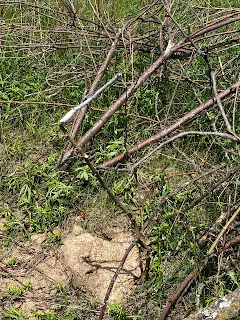
You can say it, "That is an ugly baby." You can click on the picture to embiggen it.


Not my best work, but not my worst, either

The memorial plaque. I broke down and bought a Chinesium solar nightlight.

Tuesday, May 13, 2025

State of the author and Karma

Today was a recovery day.

Among the things I observe about growing older is that my body needs more time to recover between challenges. There are probably many, good biological reasons for this. Another thing is that the "signals" for thirst and hunger are muted compared to even ten years ago. I now have to explicitly program breaks to drink and eat.

Those of you who enjoy the serialized fiction have been incredibly patient. Thank-you!

March-April-May are my GO month for planting. Seeds that are not planted will not yield. Blogging is a vice. Gardening/fruit-growing, fishing and hunting put food on the table and doing it right is time intensive. My typical day during these months is to wake at 5:00AM, "receive" Quicksilver at 6:30. Hand-off QS to Mrs ERJ at 9:30. Load the truck, sharpen the tools etc for about an hour. Then drive-work until about 4 in the afternoon and then drive home. Crash. Lather. Rinse. Repeat.

On days following "BIG" days, I need a recovery day. Sometimes I get a break when the weather is bad or Mrs ERJ has appointments and I need to watch QS. When I am on top of my game, I schedule a BIG day before the weather gets crappy. Then I recover on a day when I could not work anyway.

I have a hard-stop at the beginning-of-June when the orchard grass starts pollinating. I will be forted-up in the house for about a week while I wait for the toxic air (to me anyway) to abate.

Maybe I can write a few installments about A Little East of Paris then.

Memorial Plaque

The mystery plaque was in memory of a child who miscarried back before the current owner purchased the property.

Flowers are cheap. Blue flowers are lobelia. White and purple flowers are alyssum.

I will tidy up around the plaque and dress it up with some flowers. I will take a few pictures and send them into the ether. Hopefully, the grieving parents will see that their unborn child's memorial was honored.

I have no expectations of "Karma". But just as luck favors the prepared, good fortunes favor those who "do the right thing".