Dad is still on this side of the veil.
Hospice started today.
Belladonna moved back to our house 9:00PM Monday.
She had a job interview 9:00AM Tuesday and had a job 10:00AM.
It is not a forever job. But it will suffice as she works her way through grad school.
We moved Sprite's cows and her bull over to her place. Matt, the trucker, is scheduled to show up tomorrow at 8:00AM to take them to auction.
The calves will stay until August/September. In terms of on-the-hoof mass, the calves are 25% of what I was feeding. That means that the bale of hay that lasted 1.5 days will now last 4 days. That is a significant drop in my work load.
Kubota was a big help in moving the cows. He showed much more persistence in solving issues with the shorts in the fence. The mama cows were bawling, pushing to get back to their calves as we worked the fence, trying to find the short.
There were about a half dozen. The one shown in the image above was the last one. The wire had popped out of the insulator and was in hard contact with another T-post.
I am beat. I spent 5 hours in a pair of boots that did not fit quite right. I was walking on churned up, frozen mud.
I am planning on a couple of ibuprofen and a good night's sleep.
Encourage one another and build one another up. Pray without ceasing. Test everything. Keep what is good. Avoid all evil. -1 Thess 5:11,17,21,22
Monday, December 16, 2019
Steve Straeder (fiction)
Steve Straeder walked down the center of the road while his dog, creatively named “Dog” ran ahead and snuffled in the bushes beside the road.
Dog was of indeterminate parentage and weighed about sixty pounds. He was short-haired and his muzzle suggested a Boxer somewhere in his muddled ancestry. Like his master, Dog carried a pack. Neither partner was allowed a free ride.
Steve traded the small items that would have normally been found on the end-caps at Walmart. Needles, thread, thimbles, fish hooks, teething lotion, dried herbs, blades for utility knives...the list of items he was willing to carry was almost endless. The one characteristic they shared was high value for their weight and bulk.
Another characteristic they shared was that one-hundred of them were of little more value to the average homesteader than one of them. Unlike a hundred ounces of gold, one-hundred utility knife blades were hardly worth stealing because turning them into cash was too much work. Too much work for anybody except for Steve.
Steve's pack was a large laundry hamper lashed to a backpack frame. He briefly tried various fabric packs but nothing beat the laundry hamper for functional durability. That, and he could unload it much more quickly than he could unload a stuff-sack bag.
Among Steve’s skills was the ability to whistle both loudly and fluently. He bet early on that he could create a network of customers who would ask for “The Whistling Peddler”. He had been finessing his route. It had to be small enough that he visited frequently and that customers would wait for him. It had to be large enough that goods that were common at one end would be rare at the far end. Steve would never figure the territory out completely because it was always changing, but he derived great entertainment at playing with his “territory”.
Steve invariably looped in a generous pickle shape. The long axis of the pickle ran east-west and the return route was often a mere three miles north or south of the outbound leg. That way, he was able to use intelligence gained on the outbound leg to his advantage on the way back.
Steve was not the only young man to take to the open road. Some pushed carts. Some sharpened knives or claimed to do “gunsmithing” or dentistry. Having watched a few of the dentists, Steve quadrupled his supply of teething lotion, a concoction of Vicodin dissolved in grain spirits. He always sold out.
Dog paid his way by protecting the trading stock, finding the occasional young, unwary rabbit for the stew pot and by carrying goods. Dog was also good for business. He liked children and graciously let them crawl over him and pull his ears. Steve halfway suspected that Dog ate better at some of the farmhouses he visited than he did. Steve was not wrong.
Steve carried a .22 handgun. Word of feral dog and hog packs had him thinking about upgrading, but for now the .22 met all of his needs. He could pick a squirrel off a branch, forty feet up or pop a bullfrog in the head from ten paces. He carried it in a drop holster on his right thigh where it was within ready reach.
Steve quickly came up with a system for figuring out which homes were worth visiting. His best clue so far was a line of clothing, drying in the sun. A family that had the wherewithal and desire to care for their clothes were able to afford the tools to do so and a few luxuries besides.
After making a few sales, the matron of the house usually asked “What direction are you heading?” More often than not, he was asked if he minded returning a pan or dropping off a few iris plants or some other such errand. Life was busy and it was hard for a family to fit all the pieces in.
Steve always cheerfully agreed to attend to such errands, provided they were in his general direction of travel, the item was not obnoxiously heavy and the distance was not obscene. Few things guaranteed a warm welcome better than a stranger returning a prized tool or other cherished item.
It was rare that he traveled more than six miles in one day. Given the grind of everyday life, few people regularly made trips of more than three miles. Even those "short trips" ate up two full hours. One hour to walk out. Another hour to walk back. There was just not enough time in the day.
*
One of the biggest hazards to the itinerant peddler in the post-Ebola world was not feral dogs or hogs or highwaymen. Nope. It was romantic entanglements.
For a complex set of biological and social reasons, the mortality among men of marriageable age and women of the same age was much, much higher for the men.
When combined with the brutally physical life in the grid-down world, it left an extreme shortage of available men.
To the widows and un-manned women along Steve's route, Steve looked very "available", if only for the night. Some of the women were oblique in communicating their desire for company while others were more direct.
That Steve avoided such entanglements, unlike most of his former competitors, did not speak so much of his high moral standards but to his conceit that he was a judge of "fine women". The women along his route all fell short of his standard.
Steve fancied himself a connoisseur of high-class women. This is a conceit shared by all men but was taken to the extreme in Steve's case.
Steve KNEW that a high-class woman was petite and of taut musculature. While many men fixate on bosoms, Steve found them a distraction unworthy of attention.
Some women sashay. Steve demanded women who bounced on the balls of their feet, in perpetual "pounce" mode.
Steve's came by his preferences honestly. His first true-love had been both a dancer and a gymnast. They met at the high school play. Steve constructed scenery and had a crush on the female lead. Later, Steve confided that he felt she was way out of his league. She replied loftily, "That is not for you to decide." It had been a epic relationship.
Much to Steve's surprise, there were still many who had not gotten the memo: Things had changed.
He passed countless houses that clearly had residents. There was no garden. There was nobody outside collecting sticks for firewood or tending to livestock. There were no paths beaten by feet leading to the river or road or berry patch. Whoever lived in the house was still waiting to be rescued, living off food somebody had the foresight to store. Living off food and waiting for somebody else to save them.
Steve's vision of the ideal woman was one who grabbed the world-of-today by the short and curly ones and slammed it to the mat...not passively waiting for the return of the world that had been and clearly was not about to return anytime soon.
Steve was polite. Steve was professional. The women sighed. They sighed and purchased his goods. There was never even the tiniest whisper that Steve dallied with the many women who were more than willing and there was never any resentment from the men who felt very protective toward the women of their tribe.
Next
Sunday, December 15, 2019
...don't let your left hand know what your right hand is doing...
![]() |
| Notice that the angel is standing on Homer's right shoulder while the devil is standing on his left (aka, sinister) shoulder |
A thought that occurred to me is that this Bible quote (Matt 6:3,4 which is part of the Sermon on the Mount) had a secondary meaning to the Jewish people who heard it.
But when you give alms, do not let your left hand know what your right is doing, so that your almsgiving may be secret. And your Father who sees in secret will repay you.
The right hand was the clean hand and the left hand was used for unclean purposes, i.e. wiping one's bottom.
For example, our better self might take meals to an elderly shut-in. The secondary message is to not let our sinister side take advantage of those shut-ins by asking for valuable knick-knacks or offering them ludicrously low prices for them.
Or, we might offer aid to a widow out of the goodness of our hearts. Our sinister side might start murmuring that we are entitled to fringe benefits.
The best way to avoid that temptation is to quickly forget that you did those good deeds. And the best way to do that is to give the credit, the glory if you prefer, to the Holy Spirit. All we can take credit for is that we listened.
Saturday, December 14, 2019
Science is hard
In the 1990s, Management Intensive Grazing was a topic of high interest.
New Zealand had been doing it for decades and they were able to make milk, reduce the water content, put it into cans and deliver it to a Walmart shelf in Madison, Wisconsin at lower cost than the dairy farmers around Madison could put the milk into the bucket.
Dairy farmers from New Zealand found many things to criticize about how US Universities did science. Primarily, our tendency to reduce a problem down to what we saw as it component-parts and studying each part in isolation.
As a credit to the University of Wisconsin, they made an effort to address the shortcomings identified by the Kiwis. One criticism was that it does not matter how many tons of hay a grass variety makes if the cows don't eat it. No food through the cow's mouth means no milk in the bucket.
The Wisconsin experiment involved planting a checkerboard of different grass varieties reported as being good for pastures. The checker-board squares represented multiple selections of multiple species. The checkerboards were grazed five times through the growing season or on roughly 4 week intervals.
The standing dry-matter was measured before the cows went in with a weighted pressure plate tool (the standard for the time) and was measured afterward.
The percentage of grass that had been grazed on each checkerboard square was visually estimated when about half the standing dry-matter had been grazed off.
In the report, the raw data was tabulated as well as the percentage of the variety within the trial.
This is when the scientists and the engineers (maybe even the accountants) look at the chart and ask, "Why isn't it a straight line?"
The answer is that the trails were run across multiple sites and across multiple years. Different sites have different types of soil. Different years have different amounts of rainfall. The "Percent of trial average" is an attempt to handicap the cultivar by the year/site space.
The Kiwis
At this point, the Kiwis were smirking like crazy-mad.
Maybe they grudgingly gave a few points for effort but the researchers missed the point. The only two things that mattered were the weight of the milk in the milk bucket and the size of the "slice" needed to provide four hours of mob-grazing.
Since most of the research was done by working farmers, they did mostly A-B experiments which is very inefficient if you want to produce a typical, Land Grant University report. Point being, the farmer's ultimate product was a net profit making milk and the University's ultimate product was a report.
Stung by the criticism, the researchers asked for specifics.
Well, for one thing, the Kiwis pointed out, the correlation between pressure plate measurement and the dry matter not only varies by grass/clover species but by the growth habit of the variety. Some grass has limp, floppy blades, others are rigid and very upright. That is something that individual grazers figure out by experience on their own plots.
You don't just hand a grad student a pressure plate and tell him to write down dry matter.
"Surely, it cannot be that bad." the University scientists dismissed the Kiwis.
"Well, let's compare two trials" the Kiwis said. "Let's plot the most favorable site/rainfall trail on the same plot as the least favorable/rainfall site/year."
Can you, gentle readers, see the two separate populations? The most pernicious fact of this chart is that the worst performing species/cultivar of the most favorable site (for percent trial average) and rainfall is BETTER than the best species/cultivar from the least favorable site/rainfall for Total Intake.
A herdsman who is not minding his Ps and Qs might choose Calibra Perennial Ryegrass over Stampede Orchardgrass based on the research.
That would be an almost disastrous decision if the herdsman's soil was sandy or his region subject to six and eight week periods with no rain.
Where I screwed up
My mistake was even less sophisticated than described above.
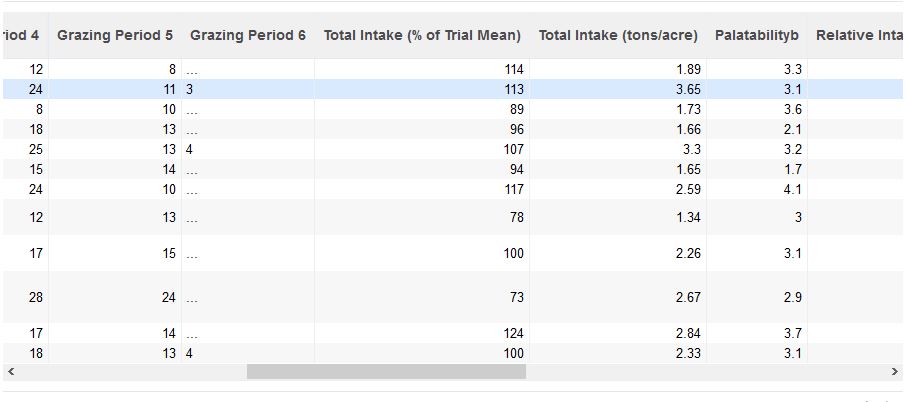
My laptop has a small screen. When I scrolled over to the names on the extreme left, I dropped down a row. Simple as that! I
Instead of locking onto the Festulolium that was reported to have produced 3.65 tons per acre I purchased the variety that was reported to produce 1.73 tons per acre.
Why Festulolium? Because it has great seedling vigor, like Perennial Ryegrass, but has better drought and cold resistance. Just the thing for patch repair of damaged pastures.
And in spite of all of that, 1.73 tons per acre is far more than bare dirt, which is what I have where the cattle churned the pasture to a sea of mud.
New Zealand had been doing it for decades and they were able to make milk, reduce the water content, put it into cans and deliver it to a Walmart shelf in Madison, Wisconsin at lower cost than the dairy farmers around Madison could put the milk into the bucket.
Dairy farmers from New Zealand found many things to criticize about how US Universities did science. Primarily, our tendency to reduce a problem down to what we saw as it component-parts and studying each part in isolation.
As a credit to the University of Wisconsin, they made an effort to address the shortcomings identified by the Kiwis. One criticism was that it does not matter how many tons of hay a grass variety makes if the cows don't eat it. No food through the cow's mouth means no milk in the bucket.
The Wisconsin experiment involved planting a checkerboard of different grass varieties reported as being good for pastures. The checker-board squares represented multiple selections of multiple species. The checkerboards were grazed five times through the growing season or on roughly 4 week intervals.
The standing dry-matter was measured before the cows went in with a weighted pressure plate tool (the standard for the time) and was measured afterward.
The percentage of grass that had been grazed on each checkerboard square was visually estimated when about half the standing dry-matter had been grazed off.
In the report, the raw data was tabulated as well as the percentage of the variety within the trial.
This is when the scientists and the engineers (maybe even the accountants) look at the chart and ask, "Why isn't it a straight line?"
The answer is that the trails were run across multiple sites and across multiple years. Different sites have different types of soil. Different years have different amounts of rainfall. The "Percent of trial average" is an attempt to handicap the cultivar by the year/site space.
The Kiwis
At this point, the Kiwis were smirking like crazy-mad.
Maybe they grudgingly gave a few points for effort but the researchers missed the point. The only two things that mattered were the weight of the milk in the milk bucket and the size of the "slice" needed to provide four hours of mob-grazing.
Since most of the research was done by working farmers, they did mostly A-B experiments which is very inefficient if you want to produce a typical, Land Grant University report. Point being, the farmer's ultimate product was a net profit making milk and the University's ultimate product was a report.
Stung by the criticism, the researchers asked for specifics.
Well, for one thing, the Kiwis pointed out, the correlation between pressure plate measurement and the dry matter not only varies by grass/clover species but by the growth habit of the variety. Some grass has limp, floppy blades, others are rigid and very upright. That is something that individual grazers figure out by experience on their own plots.
You don't just hand a grad student a pressure plate and tell him to write down dry matter.
"Surely, it cannot be that bad." the University scientists dismissed the Kiwis.
| Total intake, tons per acre...is that per annum or were the trails run for different durations? |
Can you, gentle readers, see the two separate populations? The most pernicious fact of this chart is that the worst performing species/cultivar of the most favorable site (for percent trial average) and rainfall is BETTER than the best species/cultivar from the least favorable site/rainfall for Total Intake.
A herdsman who is not minding his Ps and Qs might choose Calibra Perennial Ryegrass over Stampede Orchardgrass based on the research.
That would be an almost disastrous decision if the herdsman's soil was sandy or his region subject to six and eight week periods with no rain.
Where I screwed up
| The second row looked promising. |
My laptop has a small screen. When I scrolled over to the names on the extreme left, I dropped down a row. Simple as that! I
Instead of locking onto the Festulolium that was reported to have produced 3.65 tons per acre I purchased the variety that was reported to produce 1.73 tons per acre.
Why Festulolium? Because it has great seedling vigor, like Perennial Ryegrass, but has better drought and cold resistance. Just the thing for patch repair of damaged pastures.
And in spite of all of that, 1.73 tons per acre is far more than bare dirt, which is what I have where the cattle churned the pasture to a sea of mud.
Friday, December 13, 2019
What non-US based news sources do you monitor?
A quick survey here.
Most people are rational, at least some of the time. Their perception of the universe is largely formed by the stream of information they receive and what they see as being in their best-interest.
Most people can accept that "triangulating a solution" benefits from two or three observation points that are not identical. In fact, the greater the distance between the observation posts, the more errors-of-measurement are diluted.
We are entering the Holiday season where we will be elbow-to-elbow with people we love but sometimes disagree with. One strategy to consider is to suggest that they expand the number of news sources they monitor to get wider triangulation.
They will likely say, "Fox sucks." or "No way in Hades will I visit Horn News."
In their view, those sites are hopelessly polluted by partisan politics.
Think big
What non-US sites do you visit on a daily or weekly basis? For the sake of simplicity, consider sites based in California, New York and Atlanta to be US based.
Daily-Mail?
The Economist?
Russia Times?
Times of India?
The Straits Times (Singapore)?
The Australian?
Canadian National Post or Toronto Sun?
Others?
From the comments:
The Jerusalem Post h/t Ed Bonderenka
The Sun (UK) h/t Ed
Epoch Times (US but strong Asian coverage) h/t George True
Canadian Freepress h/t George True
Al Jazeera (Middle East NOT Israel) h/t John Galt
Back to the blog post...
The benefit of using at least one non-US news source is that the non-US source is not invested in packaging the event to fit a particular narrative. Rather than leaving information out or arranging them to fit within a particular picture frame, foreign media is more likely to just report the facts and let the reader decide.
Suggesting that your much-loved family member expand their information sources may be the best way to break off the conversation...for this year.
The question on the table is: Which sources?
Most people are rational, at least some of the time. Their perception of the universe is largely formed by the stream of information they receive and what they see as being in their best-interest.
Most people can accept that "triangulating a solution" benefits from two or three observation points that are not identical. In fact, the greater the distance between the observation posts, the more errors-of-measurement are diluted.
We are entering the Holiday season where we will be elbow-to-elbow with people we love but sometimes disagree with. One strategy to consider is to suggest that they expand the number of news sources they monitor to get wider triangulation.
They will likely say, "Fox sucks." or "No way in Hades will I visit Horn News."
In their view, those sites are hopelessly polluted by partisan politics.
Think big
What non-US sites do you visit on a daily or weekly basis? For the sake of simplicity, consider sites based in California, New York and Atlanta to be US based.
Daily-Mail?
The Economist?
Russia Times?
Times of India?
The Straits Times (Singapore)?
The Australian?
Canadian National Post or Toronto Sun?
Others?
From the comments:
The Jerusalem Post h/t Ed Bonderenka
The Sun (UK) h/t Ed
Epoch Times (US but strong Asian coverage) h/t George True
Canadian Freepress h/t George True
Al Jazeera (Middle East NOT Israel) h/t John Galt
Back to the blog post...
The benefit of using at least one non-US news source is that the non-US source is not invested in packaging the event to fit a particular narrative. Rather than leaving information out or arranging them to fit within a particular picture frame, foreign media is more likely to just report the facts and let the reader decide.
Suggesting that your much-loved family member expand their information sources may be the best way to break off the conversation...for this year.
The question on the table is: Which sources?
The Irony, It Burns
From the Washington Examiner
Now consider how Democrats actively thwart and pervert immigration laws. Immigration is not protected under the US Constitution.
The irony, it burns.
Virginia Democratic officials, however, already say local law enforcement supporting these resolutions will face consequences if they do not carry out any law the state Legislature passes.The quote is in reference to counties forming Second Amendment sanctuaries. Note that the Second Amendment refers to the US Constitution.
“I would hope they either resign in good conscience, because they cannot uphold the law which they are sworn to uphold, or they're prosecuted for failure to fulfill their oath,” Democratic Virginia Rep. Gerry Connolly told the Washington Examiner of local county police who may refuse to enforce future gun control measures. “The law is the law. If that becomes the law, you don't have a choice, not if you're a sworn officer of the law.”
Now consider how Democrats actively thwart and pervert immigration laws. Immigration is not protected under the US Constitution.
The irony, it burns.
Subscribe to:
Posts (Atom)