Thursday, February 23, 2017

Etymology "Red Neck"

Etymology:  The study of the origins of words.

On the hunt

From Wikipedia

The term redneck is a derogatory term chiefly used for a rural poor white person of the Southern United States. Its usage is similar in meaning to cracker, hillbilly (especially regarding Appalachia and the Ozarks), and white trash

"Hold my beer?"  What kind of idijiot do you think I am?  Nobody holds MY beer but me.
Well, that is their story.

But consider that English has many words of Germanic origin via its Saxon roots.

Have you every heard of "Reineke"?  Sounds a bit like Red Neck, doesn't it?


Reineke...is the main character in a literary cycle of allegorical Dutch, English, French and German fables. Those stories are largely concerned with (Reineke), an anthropomorphic red fox and trickster figure. His adventures usually involve him deceiving other anthropomorphic animals for his own advantage or trying to avoid retaliations from them. His main enemy and victim across the cycle is his uncle, the wolf Isengrim (or Ysengrim). While the character of (Reineke) appears in later works, the core stories were written during the Middle Ages by multiple authors and are often seen as parodies of medieval literature such as courtly love stories and chansons de geste, as well as a satire of political and religious institutions.
So what we have here predates the Br'er Rabbit stories.  The humor is rich....White man's Rednecky is a fox.  Black Man's Br'er is a rabbit.  The same character and many of the same stories.

The etymology of the word "Rednecky" itself, as I like to think of him, is old German for "made hard by the gods" or "denoting someone who is wise, clever, or resourceful" depending on the authority you prefer.  Both work for me.  Both describe most of the "Red Necks" I know.

Those who would reject it on the basis that "there is no evidence"  cannot present evidence that it is not true.  In fact, there IS evidence that my etymology is the true origin.  If you doubt it, reread the last paragraph and consider that some of the Br'er Rabbit stories sound much like the Red Necky stories told by slave owners.  As the fox is to the wolf, the rabbit is to the fox.

Wednesday, February 22, 2017

Why mature organizations lose their steering wheel and reverse gears

The "Myth" of the organization life cycle


Myths are not so much "Truth" with a capital "T" or Fantasies with a capital "F" but Meta-truths.  Meta-truths give us a common paradigm that we can use as a basis for communicating.

Who are those stakeholders?
  • Owners who want dividends
  • Management who want palatial  corporate offices and prestige perks
  • Labor who organizes and want more money, time off, benefits
  • Municipalities who want landscaping and tax base
  • Politicians who can milk employees for donations 
  • Politicians who would reward their faithful henchmen with "spoils"
  • Charities (like United Way) who want donations
  • SJW who see the organization as a vehicle (and bankroll) for their social causes
  • Suppliers
  • Distributors

Adding baggage decreases agility.

Every one of those stakeholders is highly resistant to any change of direction, much less reversal.  Life is too good.

Their biggest enemy is not the organization.

Their biggest enemy is two guys in a garage.

Steak and sizzle
Steak pays the bills.  Sizzle is pure profit.

Executives and owners are compensated based on profit.  Consequently "sizzle" garners much of their attention.

The offerings in the marketplace, however you choose to define that, become larger, fancier, with more bells-and-whistles, more high tech.  Because sizzle is profit and profit puts more money in folk's pockets.

Consider 

The domestic auto industry being eclipsed by the Japanese imports in the early 1970s.
1600 pounds and $11,000 in 2016 dollars
3300 pounds and $23,000 base price...if you can find a base vehicle.
And now the Japanese are looking over their shoulder at the Koreans as they infiltrate the base market abandoned by the Japanese.
And lined up behind the Koreans are the Indians.  $3600 takes this baby home!


Other industries

The inescapable conclusion is that mature organizations are poorly incentivized or mentally prepared to offer bare-bones products and services.

The political and business climate
I am not a huge conspiracy nut.  But I can see why major stakeholders in mature organizations would HATE new start-ups.

There are countless barriers to entry that can be thrown across the path.
  • Regulations
  • Fees
  • Mandatory approvals before being able to market (FDA, for instance) 
  • Litigation
Pulling the cork out of the bottle threatens a lot of people's rice bowls.  And that totally disadvantages those of living on limited resources.

Some disassembly required

Kubota was tired of his loft.  He wanted it removed.  I complied.  I used the most expeditious method possible for the disassembly.  It was glued-and-screwed together.  My chain was tighter than this guys.

Tuesday, February 21, 2017

Quince rootstock were put into the ground yesterday

I had some quince rootstock sucker and I mounded shredded brush over their bases them last summer.  I also covered the pile of mulch with dog food bags.
Etiolation is how plants respond to darkness.  One happy outcome is that the sun does not destroy the growth regulators that would otherwise cause rooting.
Well, lookie here!


This is a bunch of rootstocks that I broke apart and planted.
Some were on the skinny side for roots
Others were well endowed.


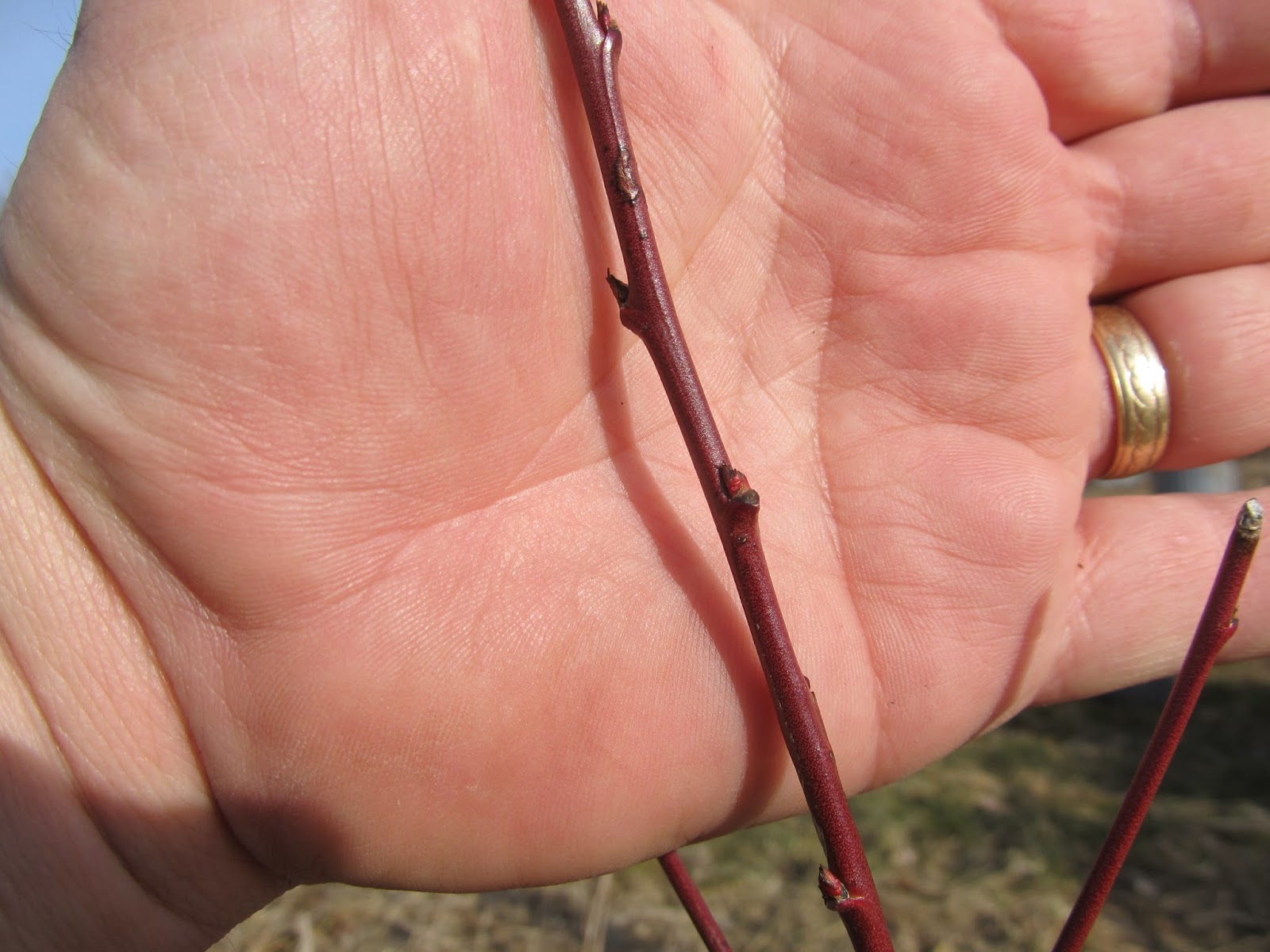
While planting the rootstocks I noticed a couple of peach seedlings.

Close up of peach twig.

Some pears cultivars are compatible with quince, which results in a dwarf pear tree.  Here is a list of compatible cultivars from a reputable source.

Quince are staging a minor come back in their own right.  Part of that is a growing interest in middle-Eastern cuisine.

Quince cultivars
This is a cultivar named Claribel.  It was grown from seed collected in the Russian Federation...close to where the Battle of Stalingrad was fought.  Do you suppose it gets cold there?

The remainder of this post are lifted from a presentation Joseph Postman gave.

Postman lists 27 quince cultivars that were capable of surviving -30 F in December.  Four were capable of surviving -40F.  They did not test all of the cultivars in the collection but chose a cross section based on SSR genetic fingerprinting and a literature search looking for cultivars that had a reputation for being winter hardy.
This is the results of the SSR study.  It gives you a feel for the Quince "family tree".  The selections circled in green are ones that I am adding to my collection.  The ones circled in red are examples of multiple cultivars being genetically identical.
This is a compilation based on several years of data.
This is a gratuitous picture of a Quince.
An image taken at the ARS Quince orchard in Oregon

New Zealand Milking Parlors

New Zealand had a problem.

New Zealand has few competitive advantages in the global economy.  They do not have massive ore deposits, or extensive fossil fuel deposits, or awesome deep-water bays for shipping.  They do not have millions of engineering graduates.  They were hampered by their position in the most active seismic region of the Pacific Rim and rolling terrain.  And they were also hampered by having  population with expectations of First World living standards.

New Zealand does have fertile soil due to all of that seismic activity.  They also have the reliable rains and temperate climate one associates with medium sized islands in the "Roaring 40s" (latitude).

So the commodity most suited to New Zealand's strengths and weaknesses was the production of dairy products.  Unfortunately, most Asians do not have a tradition of consuming dairy products.  And the one nation that did, India, was not overly endowed with hard currency.  Shipping milk to the major markets, Europe and the US, was hampered by the fact that milk is extremely perishable and heavy.

The solution was to become very good at producing "manufactured milk products" like butter, cheese and dried milk.

In the US, producers do not make money on Grade B milk, that is, the milk that is processed into dairy products.  There is always an oversupply of Grade B milk and the prices are always too darned low.  Dairies get knocked back to Grade B milk when their quality slips.  The dairy producer has to keep milking the cows.  He has no option in that regard because it is a health issue for the cows.  US producers gladly sell the Grade B milk for some money rather than dump it on the ground.

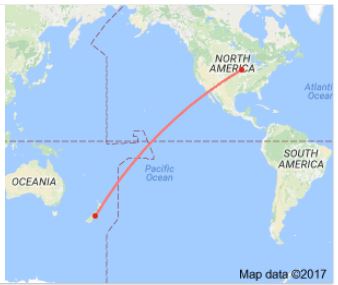
Let me recap:  New Zealand was not well suited for the production of grain but is well suited to raise dairy cattle.  The US business model involved feeding large amounts of grain to cattle, grain that New Zealand would have to buy in the US, transport the grain 8200 miles, feed the cattle, extract the milk, "manufacture" the dairy products and then ship back to the US or Europe.  And somehow make money on a product that local, US producers were losing their ass on.

The path to success was extremely Darwinian
Some of the problems solved themselves.  Feeding the cattle imported grain was an obvious non-starter.  The only path to profitability was to feed the cattle what wanted to grow in New Zealand:  Perennial Ryegrass and White Clover.

Other problems floated to the surface when the bean-counters finished their preliminary analysis.  New Zealand milk producers had to put milk in the tank at 1/3-to-1/4 the cost of US producers.  That was not going to happen relying on cute life-hacks or infinitesimally small efficiency gains.  It demanded a ruthless re-engineering of the entire business process.  No stone could be left unturned, no toad could remain unkissed.

Milking parlors
A major part of the path-to-profit was to rethink milking parlors and to make them more labor efficient.  Labor is money.  The other aspect is that "labor" was used to fix "situations" when the cows were stressed.

Stressed cows give less milk.  One of the keys was going to be figuring out ways to get cows to do what the dairyman wanted them to do without stressing them....without relying on force.

How successful were they?

In 1990 the very best US farms could milk 90 cows per hour per person.  In 1990 the very worst New Zealand farms milked 135 cows per hour per person...and the New Zealand metric included the labor spent in clean-up.  In 2010 the very best US farms were still pegged at 90 cows per hour per person.  In 2010 you were not considered much of a dairyman if you could not move 180 cows per hour per person through your milking parlor.

How did they do it?
They realized that the only things the human could uniquely do was to put the milking machine on the cow and to clean up afterward.

They looked at all of the other things milkers were doing, i.e. spending time on.  Much of it involved moving cows.

People started asking, "Why do we have to drive them into the barn?  They want to get milked.  A full udder is painful."

One of the answers was that barns are dark.  Cows are prey.  Predators den in caves.  Caves are dark.  Therefore, dark places are not safe places for cows.  The barns were opened up and the walls were removed from the  entrance and exit.  The cows could see light and landscape in the direction they were supposed to move.  It became more like walking through a valley than entering a cave.

Another answer is that cows don't deal well with corners.  Imagine a semi truck trapped in an employee parking lot.  It has a bunch of traffic stack-up behind it so it cannot back up.  It has a bunch of very sharp maneuvers to execute.  The driver stresses.  The driver locks-up.  Same thing with cows.  The solution was to never require that they turn.  Straight through, baby!

Incentives
Cows have a significant control over how quickly the let their milk down.  They can help you or they can fight you.

Realizing this, US producers reward cows after milking with grain.  Typically the operator would hook up the milking machines, leave the pit and get a five gallon bucket of corn.  He would put it in a feed trough over to the side and then go back to the pit.  When the last cow finished giving milk he would release all of the cows from the milking machines and the cows would saunter over to eat their grain.  That is a human or operator centered process.

The problem is that cows are much like the office gossip.  They are not very bright and they seem to waste what little intelligence they have on negative thoughts about their cow-workers.  "Oh hell.  I am next to Blossom, that iron-teated, splay-footed cow always take for-evah to drop her milk.  I'll show that old bitch.  I will go even slower!"  (Note:  Cows are notoriously potty-mouthed.)

Contrast that to New Zealand.
Pavlov's dog.  Ring the bell and the dog starts drooling.

The cows get plugged in.  The operator starts from whichever end has the high-producing cows.  More milk takes longer to extract and he wants them to finish in a near-deadheat.  He pulls a cord that drops five pounds of corn through a thin-walled metal "stove pipe" into a tin lined feed trough.  The corn rattles coming down the stove pipe.  It rattles when it hits the bottom of the feed trough.  Grain dust rises into the air and the ventilation pattern carries it over to the cattle.  The ventilation pattern is intentionally designed to do that.  Ryegrass and clover are salad.  Grain is the equivalent of Snickers bars.


Rudimentary pneumatic logic (in the beginning) was programmed to release each cow as she finished milking.  There was only enough corn for the first cow!  Be damned if Blossom gets it.

Pavlov's dog drooled.  Kiwi cows exploded milk.  Those cows RACE to finish first.

After leaving the center of the milking parlor they are free to go to a fresh slice of paddock.  Fresh paddock is highly valued by cows.  Unlike the paddock they just left, the fresh paddock does not have cow poop tracked all over it.  Even the girls who did not get any grain are eager to tear into the fresh paddock.

Speaking of poop...
US dairymen brag about how many cows they milk per hour.  There is a strong temptation to not keep book on the labor consumed by incidental tasks; opening and closing gates, cleaning up the poop and so on.

In New Zealand, efficiency is not about bragging, it is about economic survival.  Leaving out "real" costs leads to compromised information, poorly informed decisions and then to bankruptcy.

Consider poop.  It takes time to clean up after cows poop in the milking parlor.

In New Zealand the cows are moved from the paddock directly to the milking parlor via the opening of gates.  Most of the cows are quietly resting and chewing their cud as they wait for the gate to open.    Cows poop-and-pee when they stand up.

Then they poop-and-pee on the walk to the barn.

Some barns even had a shallow "pond" the cows walked through just before they entered the barn because stockmen noticed that cows ALWAYS poop-and-pee when they waded into streams to drink.  By the time they get to the milking machine they are pretty much all pooped and peed out.

But if they are not...the operator has a hose that attached to a ceiling mounted pivot.  The hose is not long enough to touch the floor.  That is because somebody noticed that the typical wall-mounted spigot left a loop of hose on the floor that trapped poopy-soupy water and the operator had to spray the floor down twice.

The ceiling mounted pivot might not seem like a big deal but you have to remember that the operator only has 20 seconds per cow if he is going to process 180 per hour.  He will fail if he has to leave the pit even once.  He will fail if he has to do anything twice.

So why can't the US close the gap?
The biggest reason US producers have been unable to close the gap is due to the anchoring effects of sunk costs.

Rather than build an optimum facility in the exact, best optimum location the dairyman succumbs to the temptation to refurbish an existing building.  A building that is not in the right place.  A building with the wrong exterior dimensions.  A building with uneven floors and walls that cannot be removed. A building that cannot accommodate straight through animal travel.

The New Zealand technology does not lend itself to cherry-picking.  It only takes one knot in the hose to choke the flow.


Monday, February 20, 2017

Milo...

Some guy named Milo is getting hammered.

"The Breitbart editor was disinvited from speaking at the conservative conference after an old video resurfaced"   -USA Today
I wonder if anybody is putting any effort into finding evidence that he repudiated or clarified those views between the time the video was recorded and the story broke.

Of course any back peddling that occurred after the story broke is suspect.

I have been guilty of saying some bone-headed things.  I have been guilty of saying (and writing) things that were poorly worded.  Those who might have judged looked at the preponderance of evidence and judged accordingly.

I am not apologizing for this Milo person.  I am pointing out that we have processes and, hopefully, the attention spans to exercise those processes.

Would YOU want to know the odds?

My brother was recently diagnosed with cancer.

Some folks think it is strange that he does not want to know "the odds".

I, however, think it is wise for many different reasons.

This is a "calibration" curve showing how most people process "odds" or "uncertainty".

The straight, green line that cuts across the graph diagonally is "perfect calibration."  That is not how folks intuitively process data, even ones that are highly trained in statistics.

The red, broken line more closely represents how people mentally "map" odds.  Most people are fairly well calibrated for 50:50 odds.  That is, the flip of a coin.

Most people are marginally calibrated for 25% and 75% odds.  When, in fact, the odds are 25% we treat them as if there was a 10% or 15% chance of occurring.  When there is actually a 20% chance of an event occurring we round down to 0%.  In a similar way, odds of 80% round up to 100% after being bent by our mental prism.

For all practical purposes that means that a patient who is told that their chances of survival are less than  20% will bend that information into certain doom.  They will lose the will to live.

Here is the pay-off line:
Based on the heuristics of how people process information: It would be more honest to dial in a little bit of Kentucky Windage and tell people with a 0.5%-to-20% chance of survival that they have a 25% chance of survival (which they will interpret as 10%-to-15% chance) than to than to tell them the mathematically defensible odds of survival (which they will morph to 0%).

But even that is misleading
To quote Gordon Dickson's Dorsai

Estimates had been...five percent (casualties) for the defending forces.  But such figures, without meaning to be, are misleading.  To the man in battle, twenty percent, or even five percent casualties do not mean that he will be five percent or twenty percent wounded... 

For life and death are binary.  There is no such thing as being a little bit dead.

Even if your odds of survival are one-in-a-million, iff you are the one...then you are still 100% alive.  The clarity of hindsight informs us that "your" odds for survival were 100%, just like the odds of that ovum being fertilized with that spermatozoon were 100%...in hindsight.

As a final consideration, consider the odds of a misdiagnosis.  Surely those odds are higher than 1%.

Healthcare practitioners
The game changes quite drastically for healthcare practitioners.  Doctors must use math to determine the course of treatment that offers the greatest benefit and the least harm.  Intuition is just not good enough.

Nurses must be protective of their own mental health.  Good nurses have an empathy bond with their patients.  "Knowing" that a patient might be dead in two months facilitates protective pre-grieving.  It also keeps the world orderly and sufficiently predictable to keep them from going bat-shit crazy.

The folks who are ripped to shreds are the doctors and nurses who are afflicted with cancer.  Perhaps even worse are the doctors and nurses who have close family who are diagnosed with the types of cancer that typically have 5%-to-20% survival rates.   Their professional training drags them one way.  The bonds of family anchor them.  What gives?

That is where we are today.  I have a brother with cancer.  I have a sister who worked as a nurse on the oncology floor for 25 years.  My sister lost her daughter in 2010 so she knows the agony of losing a child...and it tears her up when mom and dad ask her questions.  I have another brother who is a radiologist.  Actually, I have it pretty easy.

Bonus link on calibration and the appropriateness of extreme confidence.