Tuesday, April 21, 2015

Life is speeding up

Life is speeding up and blogging will decrease.

Track


Eaton Rapids competed at Williamston.  The women's team was getting thoroughly shellacced by Williamston.  The score was 70-17, Williamston's favor when we left.

The throwers did OK.  Belladonna threw 20 feet less than her personal record but she was very consistent at 25, 22 and 20 feet short of her PR.  That was a very respectable performance for a 40 degree day and gusts to 25 mph.

Wildchild found her groove.  She came within 7 feet of her PR.  She was dancing on happy feet.

Motor bikes


Kubota discovered that bicycle tires and glass do not play well together.  I think he may have been showing off in front of his friends.

We finally got the chain to stay on.  We suspended the bike from the garage rafters and drenched the chain with diffy lube and let it run for an hour.  The chain is now limp enough that it does not walk off the rear sprocket.

The drier


The tensioner wheel showed up in the mail yesterday.  It is now installed in the drier.  Everything is happy there.

The War on Woodchucks


Woodchucks undermine barn floors.  My dad fell through the floor of his pole barn.  After the dust settled, the ground was at belt level as he stood in the hole.  Fortunately, my dad is as tough as a cheap steak.

Woodchucks can also decimate a garden.  100' of newly sprouted green beans is just an hors-d'oeuvre to them.

The answer?

A 160 body-grip trap, sometimes called a "Coni-bear" trap, set outside a fresh hole.

By rights I should eat these ground squirrels.  Their meat tastes like excellent roast beef or turkey dark-meat.  Instead, I use them to attract pollinators for Pawpaws (Asimina triloba).  Corwin Davis of Bellvevue, Michigan determined that Pawpaws were pollinated by carrion flies.  Further, he determined that hanging carrion in the Pawpaw thicket greatly increased the number of flies in attendance and significantly improved Pawpaw yield.

It is prudent to enhance carrion fly numbers only in those Pawpaw thickets that are cross-wind or down-wind of your dwelling.  It also helps to have an understanding spouse.

Hazelnut seedlings


As reported earlier, Tom Molnar of Rutgers gifted me with a sampler-pack of seeds from some elite, blight resistant hazelnut selections.

The Eaton County Coryulus germplasm repository.
I potted out the seeds in 5 gallon nursery buckets, similar to the Black Locust root cuttings.  I had squirrels help themselves to some of the Moscow #2 and the Santium seeds.  After cussing, I moved the pots to a shallow stock tank and covered it with a salvaged, glass storm door.  I found it beside the road while walking with Mrs ERJ.  I knew it would come in handy someday.  All of that junk on the left side of the cover is wire netting.  The door is about 3 inches too short to completely cover the tank.  I may look around to see if I have a spare sheet of plywood.

Ducks


I like ducks.  They are happy birds.  Give them a wading pool, ample food and a way to get out of harms way and they are happy, happy, happy.  The Captain clued me into using pickup "toppers" for bird shelters.  You can find them beside the road for "Free".  People sell the truck and then just want to get rid of the topper.

They make dandy, varmint resistant shelters for birds.

Apricots


The apricot trees are about 30% in bloom.  We are expecting 25 degrees F tonight and 24 degrees F tomorrow night.  That does not bode well for the 2015 apricot crop.

Michigan Prop 15-1: Driving too fast for the conditions

Highway safety


Image from HERE
You know these people.  They drive too fast for the road conditions.  At night, they drive faster than warranted.  It does not matter how far ahead their headlights can illuminate, they always driver faster than their vehicle's ability to stop.. The effect of giving them better headlights, better tires, ABS braking systems is that they speed up.

These driver's have an excessive amount of confidence in Divine Providence and their own driving ability.  They are very "comfortable".  In fact, they adjust their driving habits (speed, tailgating, etc) to hit a certain comfort level.  If they overdrive their headlights by 50%, say driving 30 miles per hour instead of 20, then doubling the range of their headlights would result in them driving 60 mph instead of 40 mph.  A crash of 10 mph becomes a crash of 20 mph.

Time


Image from HERE
You know these people.  They are always five minutes late.  They cannot understand it.  They set their clocks and watches five minutes ahead.  And they are still five minutes late.  One must wonder, would they be ten minutes late if they set their timepieces ten minutes ahead?

Any sane, rational person can see what is happening.  They KNOW they have five extra minutes.  They set the watch.  They figure that five minutes belongs to them so they use it.  And then some.

Money

Image from HERE
You know these people.  They live hand-to-mouth.  They cuss at you and take sly digs at you.  They let you pay their way because "You are rich." and  "You have money."  They are paying $850/month on cellphones.

They are absolutely sure that they could get ahead if they only had 15% more income, if they could just zero-out those credit card bills.

So Aunt Rhoda dies and leaves them exactly enough money to zero out those cards.  Little Bubba gets a part time job and there is more money coming into the household economy.

Two years later they are in even worse shape than they were before.  Why?

Because they "normalized the risk" of living in debt.  They are comfortable living in debt.  And it has always worked out before.

Maturity


Maturity is knowing that there will not always be somebody there to pull you out of a ditch.

Maturity is knowing that sometimes you must forgo or cut short enjoyable experiences to meet your obligations.

Maturity is knowing that scheduling Aunt Rhoda's demise is Murder-One.  One must eventually cash out your chips and leave the casino.

State Government as yet to demonstrate this maturity.  The voters of Michigan can put the brakes on the reckless spender by voting NO on Proposal 15-1

---Sidebar---

Simulated Annealing is a numerical optimization algorithm that sidesteps the "local minima/maxima" dilemma by occasionally allowing a non-optimal solution to re-seed.  Think of it as allowing the bob-sled to pop out of the run.

Coyote.blog has a very good discussion of it HERE in the context of minimizing the travel distance for package delivery (the mail man problem).

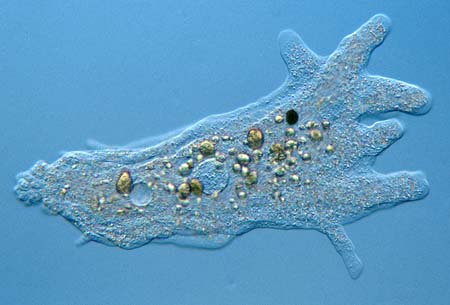
Image from HERE.  It is interesting that radiologist use "tentacles" or tooth-like outgrowths (like those seen on this amoeba) as markers to identify the most aggressive forms of carcinoma.

Societies tend to optimize in a piecewise, incremental fashion.  Almost like the way an amoeba swims. 

Image from HERE


Amoeba cannot swim up rapids, but salmon can.  Salmon practice simulated annealing.  They leap out of the water.

The progressives have been incrementally optimizing the system in conformance to their vision of utopia.  They have been doing this for a long time.  It is time for them to accept a solution that they see as non-optimal for the overall good of the State.
---End Sidebar---

Monday, April 20, 2015

Computer Coding as a Foreign Language

I want to make a modest proposal:

Count computer coding classes as fulfilling the "foreign language" requirements for High School Graduation.

There is much moaning and wailing regarding the U.S.'s lack of foreign language proficiency.  One person characterized it as:

“[Other] countries recognize that language is a tool for economic competitiveness and national security, so they have mandatory language programs,” says Shuhan Wang of the National Foreign Language Center.

Perhaps more to the point, people...parents and students recognize that learning a foreign language is to their economic advantage.  They eagerly study foreign languages because they have the reasonable expectation that it will put more money in their pockets.

That is a tough argument to make in the United States.  Show me a valid study that proves accountants or engineers or plumbers or auto mechanics make more money because they speak/read Urdu, Farsi, Mandrin or Spanish.

Computer coding, on the other hand, will improve their employability and their life-time earnings potential.

Third, fourth and fifth languages


By all accounts, learning a second language makes learning additional languages easier.  Our brain rewires.  We start paying attention to tense, plurality and so on.  There is no reason to believe that learning a computer "language" would behave any differently.

Professional programmers tend to fall into two classes.  One class is the specialist in legacy languages like COBOL.  Yes, there are still some massive applications resting on a foundation of COBOL and it has been difficult to find replacements as curators retire.

The other class of programmers learns, no masters, a new language every 18-to-24 months.  They go where the money is.  I gave up any effort to be one of those guys after Pascal "lost out" to C.  Surely that demonstrates the mental flexibility that "foreign language instruction" touts as a benefit.

Not everybody


Not everybody has a good "ear" or the ability to mimic cadence, intonation and accent.  It seems a lost cause to try to teach students another foreign language when "English" is not yet mastered.  Granted, English is bushy with many, screwy grammatical rules.  That is what happens when you pull in ideas and language from The Empire, not to mention the spicing up of Celtic, Saxon, Roman and Norman invasions.

Can anybody doubt that teaching an inner-city kid MySQL or PERL or C++ will offer him/her a surer path out of dependency than learning textbook Spanish or German?

So why not count computer coding classes toward High School graduation requirements for "foreign" language?

Schooled on Language

I was rooting around in one of the local coffee shops, scouting out a future business report when I stumbled into a conversation with a gentleman who has a service dog.

He kindly, and gently, gave me a tutorial on what is currently considered the most "proper" way to discuss people who have disabilities.  He was not harsh.  His general demeanor was "I can see that you are a gentleman.  Gentlemen make efforts to treat others with dignity and honor.  This is for your information.


Its about the person


Fashions come and go.  It used to be perfectly proper to call African-Americans "Nigger", an easier-to-enunciate derivative of "Negro".  Negro means "black" in Latin.  Then the preferred term became "Colored Person".  Then "Black" or "African-American".  So I can understand that some people will roll their eyes and decide it is simply not worth the mental effort to keep up with the current fashion.  Why learn "rules" when they seem to change on a random basis?

For those of you who are gentlemen, and ladies, there is a good tutorial at the American Psychological Association Writing Guidelines webpage.

First, and foremost, people with a disability are people.  


Quoting from the style guide:

The guiding principle for nonhandicapping language is to maintain the integrity of individuals as whole human beings by avoiding language that
  • implies that a person as a whole is disabled (e.g., disabled person)
  • equates a person with his or her condition (e.g., epileptic)
  • has superfluous, negative overtones (e.g., stroke victim)
  • is regarded as a slur (e.g., cripple).
For decades, persons with disabilities have been identified by their disability first, and as persons, second. Often, persons with disabilities are viewed as being afflicted with, or being victims of, a disability. In focusing on the disability, an individual's strengths, abilities, skills, and resources are often ignored. In many instances, persons with disabilities are viewed neither as having the capacity or right to express their goals and preferences nor as being resourceful and contributing members of society. Many words and phrases commonly used when discussing persons with disabilities reflect these biases.

Some specific "guidelines":


  • Put people first, not their disability.
    • "a person who has a disability" is preferred over "disabled person."
  • Do not label people by their disability.
    • "a child who shows difficulty concentrating" is preferred over "hyperactive kid"
  • Do not label persons with disabilities as patients or invalids.
    •  Only professional care givers can legitimately identify a person as a patient, and then only people they are personally providing care to.
  • Do not overextend the severity of a disability.
    • Specifically identifying a learning disability is preferable to a global "special kid".  The focus is on empowering people and broad-brush descriptions do not provide enough information to help others accommodate and empower that person.
  •  Use emotionally neutral expressions.
    • "A person who had a stroke" is preferred over "stroke victim".
  • Emphasize abilities, not limitations.
    •  "Uses a wheelchair" is preferred over "confined to a wheelchair"
  • Avoid offensive expression.
    • Many older terms have a negative nuance:  Crippled, crazy, retarded and so on. 
  • Seeing people with disabilities as a resource and as contributing community members, not as a burden or problem.
    •  "Family support needs" or "Accommodations" is preferred over "Family burden".

Sometimes the handicap is the environment


It is recommended that the word disability be used to refer to an attribute of a person, and handicap to refer to the source of limitations....when the limitation is environmental, as in the case of attitudinal, legal, and architectural barriers, the disability is not handicapping—the environmental factor is. This distinction is important because the environment is frequently overlooked as a major source of limitation, even when it is far more limiting than the disability. Thus, prejudice handicaps people by denying access to opportunities; inaccessible buildings surrounded by steps and curbs handicap people who require the use of a ramp.


It may seem like a lot of effort over the order of the wording.  But I figure that I will make the effort while giveing myself permission to fail.  Fortunately, it is not necessary to be perfect to be a gentleman.

Sunday, April 19, 2015

Preparing for Drought

Defining drought is an elusive task.  We know it when we see it.  Wilted plants.  Plants failing to thrive.  Dry streams and river beds.  Swamps that one can walk across.

Up-to-date Crop Moisture Index charts available HERE
One attempt to quantify drought is the Crop Moisture Index.  It portrays the moisture available in the top five feet (1.6 m) of soil.  A fine loam soil can easily hold the equivalent of up to 12" (300mm) of rain in the top five feet.  A growing crop of corn needs every bit of it.  The corn's moisture requirements typically exceeds the precipitation during the growing season by 10"-to-15".  That water must come from somewhere.

One nuance of the Crop Moisture Index is that a moisture deficiency is unlikely to be fixed by a single rain.  It takes an extra 5" and 10" of rain, over a long enough of a period for it to soak in to fix a Crop Moisture Index shortfall.

Another deficiency of the Crop Moisture Index maps is that the scale of these maps is too crude.  Drought can be a profoundly local phenomena.  I have seen corn fields where half had received an inch of rain from a July thunderstorm cell and the other half had not.  The corn in the moister half was 18" taller than the corn that stayed dry.  The transition area, the corn that received some rain but not the full inch was about six rows wide....about 20 feet. 

You might challenge me by suggesting other factors were the cause.  However, the transition was arrow straight and cut across the field diagonally, west-southwest, the direction of that the thunderstorm cell had been traveling.  And diagonally is not a pattern associated with different hybrids or a misapplication of fertilizer.

Half the field was suffering drought.  The other half was happy.  That cannot be captured in a map where the tiles are 5000 square miles.

Trail of utility trenching is easy to see.  Drought damage may be due to the synergy of nutrient poor soil and lack of moisture.  Nutrient starved plants cannot punch their roots down 5 feet and harvest all of the moisture that is available to their healthier neighbors.

Similar juxtapositioning of drought/not-drought can happen due to soil types or soil depth.  One often sees that where foundations have been built and the subsoil was dozed out over low spots.  It is also apparent where trenches have been dug and back-filled with non-native soils.

Up-to-date U.S. Drought Monitor charts available HERE
This map shows another way of quantifying drought.  It is the equivalent of the BCS system for rating college football teams.  It attempts to take data from a variety of sources and synthesize a "best definition".

It suffers the same problems of crude scale that the CMI map has.

Walk around and kick the dirt


The way to tell if you have a drought, or are on the verge of a drought, is to walk around and kick some dirt.  Check out the ephemeral swamps and ponds and road-side ditches.

A gardener can soften the edges of a drought with a little bit of lead time.  It is like driving on a slippery road;  the time to make adjustments is before you are into Deadman's Curve.

One function of rain is to carry fertilizer down to the root zone.  I am spreading Nitrogen early this year.  I would usually wait for the trees to be budding out to ensure that the trees took up the Nitrogen rather than any grasses growing beneath them.  A tree in a strong state of nutrition will have energy to grow more root hairs and to drive their roots deeper into the subsoil.  They build up carbohydrate reserves because they do not extend shoot growth.  They bank those reserves instead.

A gardener can also make some decisions to plant his/her seed further apart.  Each plant mines a block of soil commensurate with its spacing relative to other plants.  Seeding rates that result in high plant density give each plant a smaller block of soil from which to extract moisture and nutrients.

In the woods I have been doing "release" cuttings.  That is, I have been removing trees where the trees are crowded and are mutually suppressing each other's growth.  I remove less desirable species.  I remove trees with poor form.  The remaining trees end up with bigger blocks of soil from which to extract moisture.

Weed control becomes even more critical during a drought.  Weeds are more competitive growers than the gardener's vegetables or flowers.  For fruit trees, this often means more aggressive use of a herbicide like glyphosate to clear larger patches of ground cover from beneath the trees. 

Mulch is your friend.

Wind breaks are your friend.

When you water, remember that you need to lay down inches of water.  Put out some shallow, disposable, aluminum pie pans in a semi-random pattern and time how long it takes them to fill. That is how long you need to run the sprinklers each week. I use impulse sprinklers and I need to run them six hours to lay down enough water.

The pie pans are also a good method to adjust the calibration on your impulse sprinklers.  It is difficult to not over-water the center and under-water the edges when you calibrate by eye.  (Detail:  some pie pans have little holes in their bottom.  Avoid those pans when you use them for this purpose.)

The last two years have been excellent for rain but there are no guarantees in the gardening game.  I am preparing for a dry summer because it has been a very dry spring on my ten acres of paradise.

Rechargeable batteries

The last time the ERJ family made an effort to implement rechargeable batteries was about 10 years ago.

The batteries disappeared, even though the batteries were marked with yellow electrical tape.

I had kids using the devices the batteries were in: cameras, flashlights, etc.  When they were dead, they pitched them and reloaded with disposable.

I still have kids, and they are about the same ages as the last batch was ten years ago.  The difference is that they have cell phones.  These phones have a camera and lights.  They would not borrow my devices unless we were camping and they did not want to risk losing their phone.

A Plano tackle box with 10 compartments.  The cards are reversible.  The other side says "Charged".
I needed to add a few dollars to an order from an on-line retailer to get free shipping.  I decided, "What the heck.  I bought 16 rechargable AA batteries."


I determined that I needed a solid way of keeping track of my rechargeable batteries.  Even the inexpensive batteries are "spendy" at $1.75 each.  My original vision was to use a flip-top ammo carrier.  I ditched that idea because I would have to buy on-line and I really don't need capacity for 50 batteries.  I found a small Plano tackle box that will work even better.

Rechargeable batteries

Rechargeable batteries are still not as good as disposable for some applications.  There peak power output is not as great as standard, off-the-shelf alkaline batteries.  So applications that demand short pulses of high output (flash on camera, tasers) are more suited for disposable batteries. 

Disposable alkaline batteries also have higher power density per gram than NiMH batteries.  That might be a factor if you were backpacking and every gram counted.

Most of my use for AA batteries are for LED flashlights and non-flash digital camera use for this blog.  I think I will be very happy with these batteries if I can keep track of them.

Saturday, April 18, 2015

Northern Exposure (National Guard Exercise)

---No National Guard personnel were interviewed for this posting.  These are all imaginings from my fevered brain.---

The blog-o-sphere is crackling with information regarding the extraordinary (presumably) exercises being done by the National Guard.  Most of the pixels are burned on an exercise dubbed "Jade Helm".  Little discussion is about the local, Michigan exercise, "Northern  Exposure".

Northern Exposure will be held in Michigan during the month of June.  It will exercise the National Guard's ability to deal with Fukushima Daiichi type containment vessel breach event.  Ancillary challenges that are somewhat similar to nuclear power plant breaches include dirty bombs, biological warfare attacks and on a much smaller scale, chemical weapons.

Southern Michigan is a region that is vulnerable to nuclear breach risk because of the high density of nuclear power plants that are "up-wind" and its population density.  Lessons learned by the National Guard can be communicated and implemented anywhere.

The location of nuclear power plants in the mid-West.
The "transport vector".  Under typical conditions, a mechanic's fart in O'Hare International Airport takes 24-to-30 hours to reach Eaton Rapids, Michigan.


Population density chart.

Observations:


Don't expect any help from the Illinois National Guard.  They will be pinned down with body-bag detail.  Chicago is toast due to lack of lead time. 

Fleeing north is not a good option if you live in southern Michigan.  It is, however, a good option if you live in Madison, Wisconsin especially if you go northwest.

Heading south one must go as far as Cincinnati before they are not "down wind".

"Shelter in place" is probably the best option for most people while the magnitude is assessed.

Everybody west of Livingston, Oakland, Washtenaw and Wayne counties (Detroit metro area) will be on their own.  I don't expect to see National Guard knocking on doors in zipcode 48827.

I don't know what the National Guard sees as their role.  Perhaps distributing information and iodine tablets or providone-iodine saturated pads to swab inner arms.  Also, train-the-trainer exercises.

They might also have a role in maintaining civil order.  You KNOW that there will be morons who will see an "in-house-shelter-in-place" order as a license to loot.

They might have a role in keeping critical infrastructure running....water and sewage and cell phone towers, for instance.

This might get interesting.